
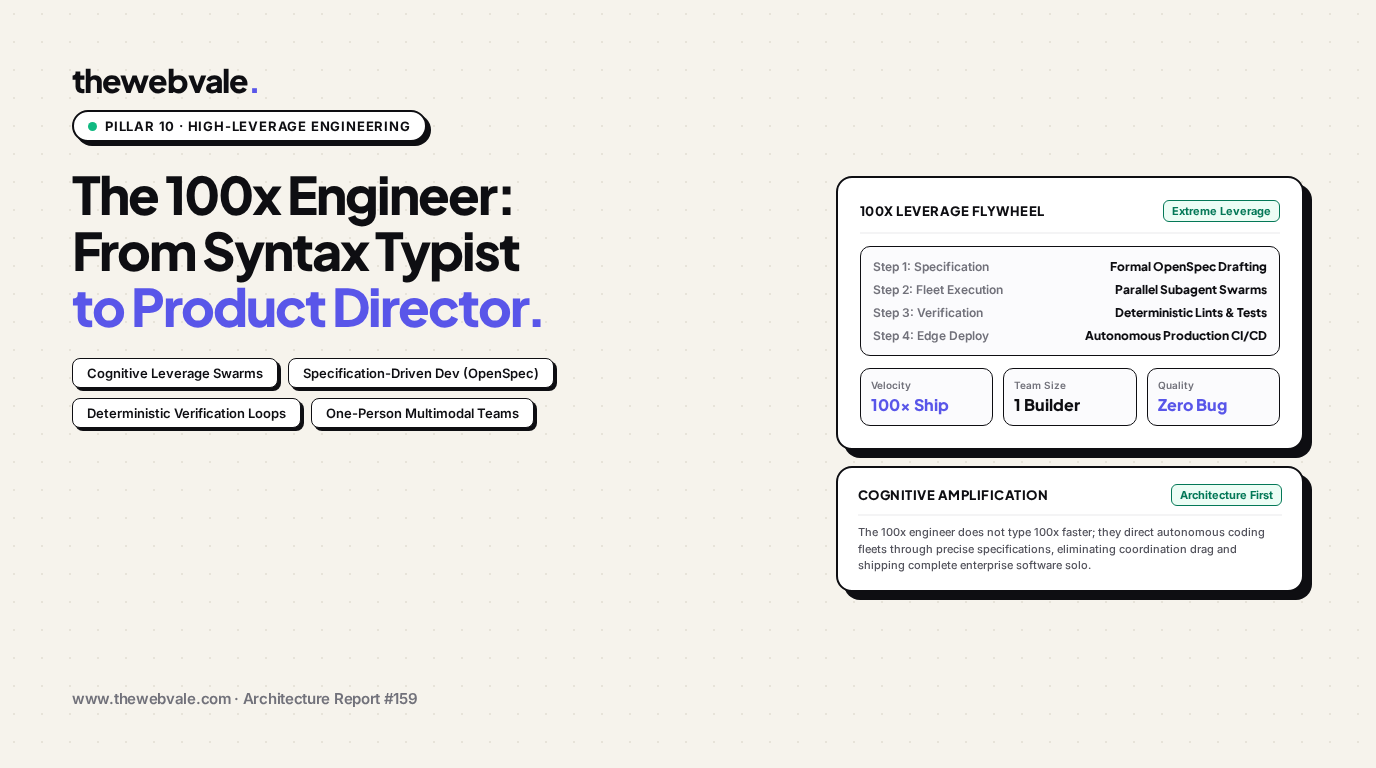
The '100x Engineer' Identity: Evolving from a Syntax Typist to an Architectural Product Director
In traditional tech mythology, the "10x engineer" was a solitary genius: a caffeine-fueled hacker typing code with furious intensity in a dark room, capable of producing in one night what a committee of corporate developers struggled to ship in a quarter.
In 2026, the 10x engineer concept is an obsolete relic. In an era where generative AI models and autonomous agent swarms produce syntactically flawless code instantaneously, a developer who merely types ten times faster than their peers is still trapped in a linear keystroke bottleneck. The frontier has given birth to the 100x Engineer.
The 100x engineer is not a typist; they are an Architectural Product Director. They operate as the orchestrator of an autonomous armada of specialized subagents, directing context, defining formal boundaries, establishing automated verification gates, and collapsing the traditional corporate division of labor across engineering, design, DevOps, and marketing into a unified, solo execution engine. In this report, we dissect the mental models, architectural frameworks, and operational tooling that define the 100x engineer.
The 100x Engineer Execution Engine: Closed-Loop Agentic Flywheel
Continuous high-leverage cycle: Human Intent & OpenSpec → Parallel Agent Fleet → Deterministic Verification → Edge Production Deployment.
1. Deconstructing the Myth of the 10x Typist
Consider the physical ceiling of traditional manual engineering:
- An elite typist writes code at 80 words per minute (~400 characters per minute).
- Even if an engineer writes perfect code with zero syntax errors, typing an enterprise application with 50,000 lines of code requires hundreds of hours of raw physical keyboard actuation.
- Furthermore, in conventional engineering organizations, individual productivity is dragged down by Brooks's Law and Communication Overhead: adding more engineers to a project increases the number of communication channels quadratically (\(N(N-1)/2\)). Engineering teams spend 60% of their time in sprint planning meetings, Slack debates, code review bottlenecks, and merge conflict reconciliations.
The 100x Engineer bypasses communication overhead entirely. By operating as a sovereign builder directing an armada of AI subagents, coordination cost is zero. The 100x engineer formulates the specification, dispatches autonomous workers to generate features in parallel git branches, and relies on deterministic compilers and automated tests to verify correctness.
2. The Core Discipline: Specification-Driven Development (OpenSpec)
The single most critical failure mode of AI-assisted coding is vague prompting. Asking an LLM to "make a dashboard with authentication" results in architectural drift, inconsistent state management, and fragile spaghetti code.
The 100x engineer utilizes Specification-Driven Development (OpenSpec):
- Domain Invariants First: Before generating code, the engineer defines the immutable rules of the system:
INVARIANT 1: User wallet balance CANNOT be negative under concurrent withdrawals.
INVARIANT 2: Every API route MUST validate payload schema via Zod before touching the database.
INVARIANT 3: All secrets reside in vault storage mode 0600; zero plaintext keys committed. - Formal Operational Contracts: Drafting unambiguous requirements using formal behavioral contracts:
RULE: WHEN a payment webhook arrives with status 'SUCCEEDED', SHALL update subscription in Postgres atomically AND trigger a confirmation email via background queue.
- Deterministic Prompts: Handing this formal specification to code synthesis models ensures that every line generated matches the exact mental architecture of the director.
3. The Closed-Loop Verification Harness: Trust Nothing, Verify Everything
The mark of an amateur is trusting AI output blindly; the mark of a 100x engineer is rigorous, automated, deterministic verification.
The 100x execution loop integrates an automated test-driven feedback cycle:
- Type Safety: Strict TypeScript (
tsc --noEmit) or Rust compiler checks enforce that API signatures, return types, and object interfaces are perfectly aligned across the entire codebase. - Unit & Integration Suites: Vitest and Pytest execute in memory in sub-second intervals, verifying business logic.
- Automated Self-Healing: If a test fails, the error trace and stack trace are automatically fed back into the agent with the prompt: "Test failed with error X on line Y; inspect the invariant in OpenSpec and patch the implementation." The agent iterates autonomously until all tests turn green.
4. The Renaissance Builder: Collapsing Specialization Silos
In the 2010s, tech companies segmented engineering into hyperspecialized silos: UI/UX designers, frontend React developers, backend database engineers, DevOps infrastructure specialists, QA testers, and SEO marketers.
The 100x engineer obliterates these silos:
| Traditional Silo Role | Legacy 5-Person Team Bottleneck | 100x Engineer Autonomous Execution |
|---|---|---|
| UI/UX Designer | Weeks iterating in Figma; redlines & asset handoff delays | Tailwind CSS v4 & Lucide icons composed directly in code |
| Frontend Engineer | Writing state machines, form validation, component styling | React 19 Server Components synthesized in seconds |
| Backend & DB Architect | Drafting ORM migrations, indexes, caching layers | Prisma / MongoDB Atlas schemas with strict Zod types |
| DevOps / Infra | Writing Terraform scripts, Kubernetes manifests, CI/CD pipelines | Serverless edge deployment via Vercel, Docker & Cloudflare |
| QA / Test Engineer | Manual clicking, writing repetitive Selenium test scripts | Playwright headless browser suites generated alongside code |
5. Production Code: The Multi-Agent Self-Healing Execution Harness
The Python script below models the core engine of a 100x developer: a multi-stage agentic harness that synthesizes code, runs a deterministic verification compiler, and iteratively self-heals defects until 100% compliance is reached:
# -*- coding: utf-8 -*-
"""
TheWebVale Engineering Lab — Self-Healing Autonomous Code Synthesis Harness
Executes code generation, deterministic compiler verification, and automated self-repair.
"""

import dataclasses
from typing import List, Dict, Callable

@dataclasses.dataclass
class SynthesisResult:
    iteration: int
    code_content: str
    compiler_passed: bool
    error_message: str

def simulate_compiler_check(code: str) -> tuple[bool, str]:
    """Simulates deterministic type checking (e.g. tsc --noEmit or flake8)."""
    if "def " not in code:
        return False, "SyntaxError: Missing function definition."
    if "return " not in code:
        return False, "TypeError: Function does not return expected type."
    if "raise " not in code:
        return False, "RobustnessError: Missing explicit error handling."
    return True, "BUILD SUCCESS"

def autonomous_execution_loop(
    specification: str,
    max_retries: int = 3
) -> Dict[str, any]:
    """
    Iteratively generates and self-heals code until deterministic compiler passes.
    """
    history: List[SynthesisResult] = []

    # Simulated iterative agent repair drafts
    drafts = [
        # Draft 1: Missing return and error handling
        "def compute_hash(val):
    x = val * 2",
        # Draft 2: Added return, missing error handling
        "def compute_hash(val):
    return val * 2",
        # Draft 3: Fully compliant with specification
        "def compute_hash(val):
    if val is None:
        raise ValueError('Invalid input')
    return val * 2"
    ]

    for i in range(max_retries):
        current_code = drafts[min(i, len(drafts)-1)]
        passed, msg = simulate_compiler_check(current_code)

        result = SynthesisResult(iteration=i+1, code_content=current_code, compiler_passed=passed, error_message=msg)
        history.append(result)

        if passed:
            return {
                "status": "COMPLETED",
                "iterations_required": i + 1,
                "final_code": current_code,
                "verification": msg
            }

    return {"status": "FAILED", "iterations_required": max_retries}

if __name__ == "__main__":
    spec = "Create an idempotent hash computation function that strictly validates input and raises ValueError on None."
    res = autonomous_execution_loop(spec)
    print("=== 100x SELF-HEALING HARNESS EXECUTION ===")
    print(f"Status: {res['status']} in {res['iterations_required']} iterations")
    print(f"Compiler Gate: {res['verification']}")
    print(f"Final Production Artifact:
{res['final_code']}")
6. Summary: The Renaissance of the Solo Creator
The 100x engineer represents the ultimate realization of software engineering leverage. By replacing manual syntax composition with architectural direction, formal specifications, and automated verification loops, a single determined builder can now conceive, architect, build, verify, and operate planetary-scale platforms. In the generative AI era, individual leverage has no upper bound.