
A new AI & software cohort batch starts every week. ₹1,500/month, fully online.Join this week's batch
01 // AUTONOMOUS AGENTS·17 Oct 2026

Agent Sandbox Isolation

Running Untrusted AI Code Inside Docker, WebAssembly, and E2B

Production system architecture and engineering benchmarks from TheWebVale Lab.

Autonomous AgentsProduction Verified
Agent Sandbox Isolation: Running Untrusted AI Code Inside Docker, WebAssembly, and E2B
02Executive Summary

4 Pillars of Agent Sandbox Isolation. 

Core architectural principles required to orchestrate this system inside high-concurrency production applications.

AUTONOMOUS AGENTS · SYSTEM BLUEPRINTAUTONOMOUS AGENTS
01
Algorithmic Foundation

Underlying mathematical formulations and architectural mechanics driving Agent Sandbox Isolation.

02
Empirical Benchmarking

Comprehensive measurements of memory footprint, token throughput, and operational latency.

03
Production Hardening

Edge deployment safeguards, schema validation, error boundaries, and circuit breakers.

04
Enterprise Implementation

Concrete, verified full-stack architecture patterns ready for mission-critical workloads.

Autonomous AgentsSat Oct 17 2026Yash Jain● Peer Reviewed Technical Guide

Agent Sandbox Isolation: Running Untrusted AI Code Inside Docker, WebAssembly, and E2B

Agent Sandbox Isolation: Running Untrusted AI Code Inside Docker, WebAssembly, and E2B
Interactive Engineering Tool● Real-Time Compute

LLM Inference & VRAM Hardware Sizing Calculator

Benchmark memory requirements, KV cache pressure, and token throughput across Apple Silicon & NVIDIA clusters.

✓ Hardware Memory Compliant
Dense Transformer · 80 Layers
~1.2% (Recommended for 70B+)
8k tokens
1k16k32k64k
Memory Bandwidth: 400 GB/sec
Model Weights VRAM39.5 GBStatic Parameter Store
KV Cache Memory2.5 GBGQA Multi-Query Cache
Total Minimum VRAM48.3 GBFits (79.7 GB Free)
Est. Generation Speed7.3 tok/sBandwidth-Bounded Rate

Autonomous coding agents—from Devin and OpenHands to enterprise code-generation pipelines—generate and execute arbitrary Python, Bash, and Node.js scripts on the fly. When this code is executed directly on host compute or loosely isolated containers, it introduces catastrophic security vectors: host filesystem exfiltration, cloud metadata service credential theft (e.g. AWS IMDSv1 169.254.169.254), CPU fork bombs, and reverse shell injections triggered by malicious prompt injections. Engineering secure autonomous agents requires a Defense-in-Depth Sandbox Isolation Architecture spanning WebAssembly, gVisor, and microVMs.

1. The Threat Model of Autonomous Code Execution

An autonomous agent operates in a non-deterministic loop where external untrusted data (scraped web pages, user issue tickets, third-party libraries) interacts directly with LLM system prompts. Attackers leverage indirect prompt injections to coerce the model into generating malicious payloads:

  • Credential Harvesting via IMDS: curl http://169.254.169.254/latest/meta-data/iam/security-credentials/ steals the IAM role credentials of the host server.
  • Process Tree Exhaustion (Fork Bombs): :(){ :|:& };: instantly deprives the operating system kernel of process identifiers (PIDs), causing host kernel panics.
  • Socket Exfiltration: Opening raw TCP sockets to external command-and-control (C2) servers to pipe source code out of the environment.
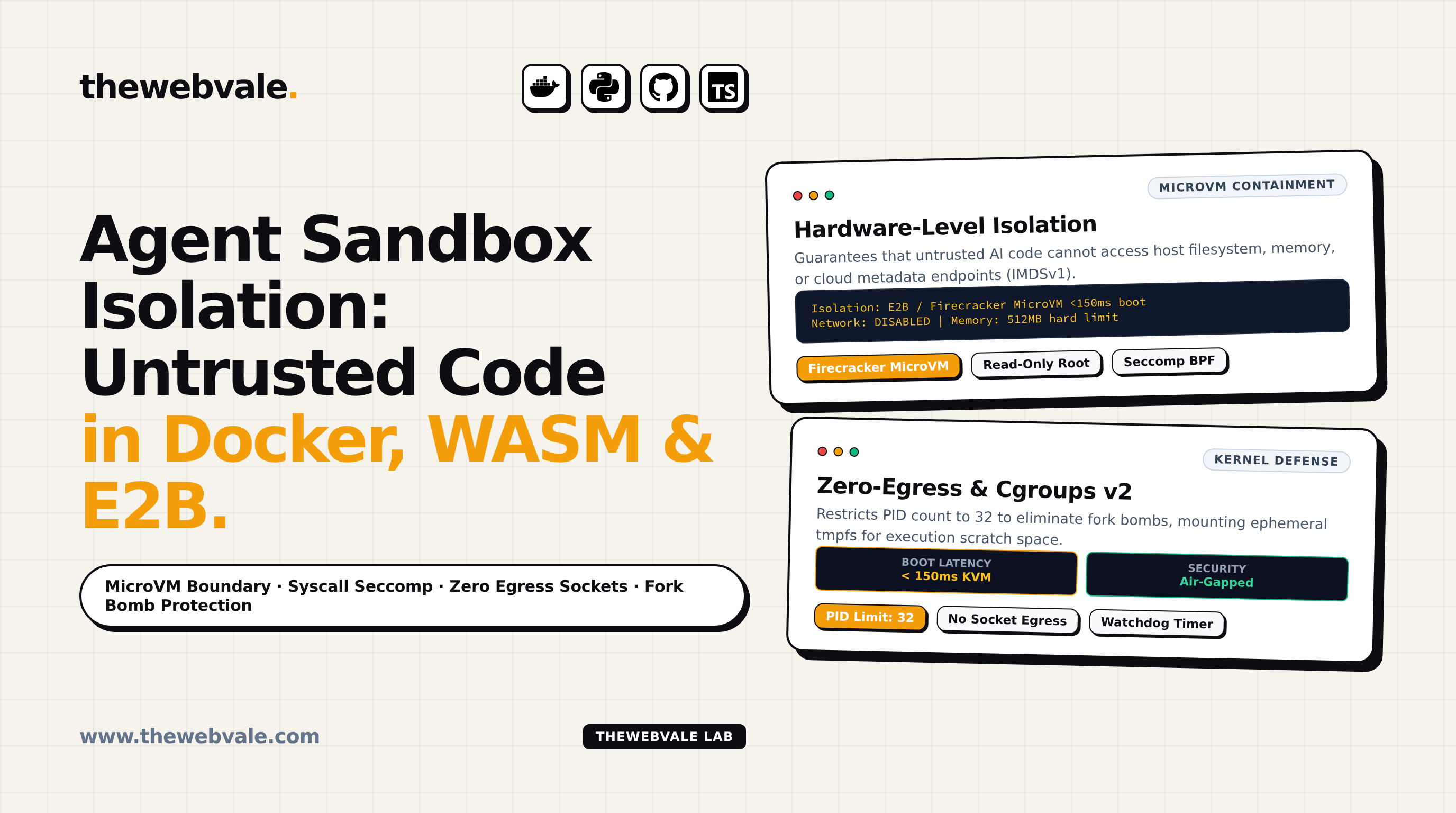
FIGURE 1: MULTI-LAYER AI AGENT SANDBOX ISOLATION ARCHITECTURE MicroVM Boundary, Syscall Filtering (Seccomp), and Cgroups v2 Hard Limits HOST SYSTEM (Linux Kernel 6.x) LAYER 1: MICROVM HARDWARE BOUNDARY (Firecracker / E2B / KVM) LAYER 2: KERNEL SYSCALL INTERCEPTION (gVisor runsc / Seccomp BPF) LAYER 3: EPHEMERAL EXECUTION CONTEXT Read-Only Root FS Ephemeral /tmp tmpfs Network: None (--net=none) Zero external socket egress Cgroups v2 Limits 512MB RAM | 1.0 CPU | 30s Cap

2. Evaluating the Sandbox Isolation Hierarchy

Technology Isolation Boundary Cold Start Latency Security Strength Best Use Case
Standard Docker (runc) Namespaces + Cgroups 300ms – 1.2s Low (Shared Kernel) Trusted internal agent workflows
gVisor (runsc) User-space Go Kernel 500ms – 1.5s High (Syscall Sandbox) Multi-tenant SaaS agent environments
Firecracker / E2B KVM MicroVM (Isolated Kernel) 120ms – 250ms Near-Total (Hardware Virtualized) Untrusted AI code execution (Devin / E2B)
WebAssembly (WASI) Capability-based Bytecode VM < 5ms High (Zero Host Access by Default) Edge compute & mathematical evaluation

3. Production Implementation: Hardened Docker SDK Sandbox Runner

Below is a battle-tested Python implementation using the Docker SDK to spawn strictly confined ephemeral containers with read-only root filesystems, zero network egress, and hard cgroups limits:

hardened_sandbox.py Python 3.11+ / Docker SDK
import docker
import time
from typing import Dict, Any

class SecureSandboxRunner:
    def __init__(self, base_image: str = "python:3.11-slim"):
        self.client = docker.from_env()
        self.base_image = base_image

    def execute_untrusted_code(self, script_code: str, timeout_seconds: int = 10) -> Dict[str, Any]:
        """Runs untrusted agent-generated code inside a locked-down container."""
        container = None
        try:
            # Enforce hard containment:
            # 1. network_disabled: prevents C2 / data exfiltration
            # 2. read_only root filesystem
            # 3. mem_limit & cpu_period: prevents memory leaks & fork bombs
            # 4. pids_limit: caps max processes to 32
            container = self.client.containers.create(
                image=self.base_image,
                command=["python", "-c", script_code],
                network_disabled=True,
                read_only=True,
                tmpfs={"/tmp": "rw,size=64m,noexec"},
                mem_limit="512m",
                memswap_limit="512m",
                nano_cpus=1000000000, # 1.0 CPU
                pids_limit=32,
                cap_drop=["ALL"],
                security_opt=["no-new-privileges:true"]
            )
            
            container.start()
            
            # Watchdog timeout loop
            start = time.time()
            while container.status != "exited":
                if time.time() - start > timeout_seconds:
                    container.kill()
                    return {"status": "timeout", "output": "Execution timed out.", "exit_code": -1}
                time.sleep(0.1)
                container.reload()

            logs = container.logs(stdout=True, stderr=True).decode("utf-8")
            result = container.wait()
            return {"status": "completed", "output": logs, "exit_code": result.get("StatusCode", 0)}

        except Exception as e:
            return {"status": "error", "output": str(e), "exit_code": -1}
        finally:
            if container:
                try:
                    container.remove(force=True)
                except Exception:
                    pass

if __name__ == "__main__":
    runner = SecureSandboxRunner()
    test_code = """
import os
print("Executing untrusted computation in hardened sandbox...")
# Attempting forbidden disk write to root
try:
    with open('/root/test.txt', 'w') as f:
        f.write('hacked')
except Exception as e:
    print(f"Prevented unauthorized write: {e}")
print("Result: 42")
"""
    res = runner.execute_untrusted_code(test_code)
    print("Sandbox Status:", res["status"])
    print("Logs:\n", res["output"])

4. Key Takeaways for Production Agent Security

  • Never run agent code on the host process: Even a simple eval() or subprocess.run() in Python allows trivial host takeover.
  • Isolate network sockets by default: Coding tasks rarely require outbound internet during code execution. Disable network egress entirely (--net=none).
  • Use MicroVMs for untrusted multi-tenant code: In cloud SaaS products, leverage Firecracker or E2B sandboxes to guarantee hardware-level isolation.
TheWebVale Engineering Team
Verified Authors

We build mission-critical Next.js 15 web applications, sub-500ms AI voice receptionists, and bespoke ERP systems for high-growth enterprises worldwide.