
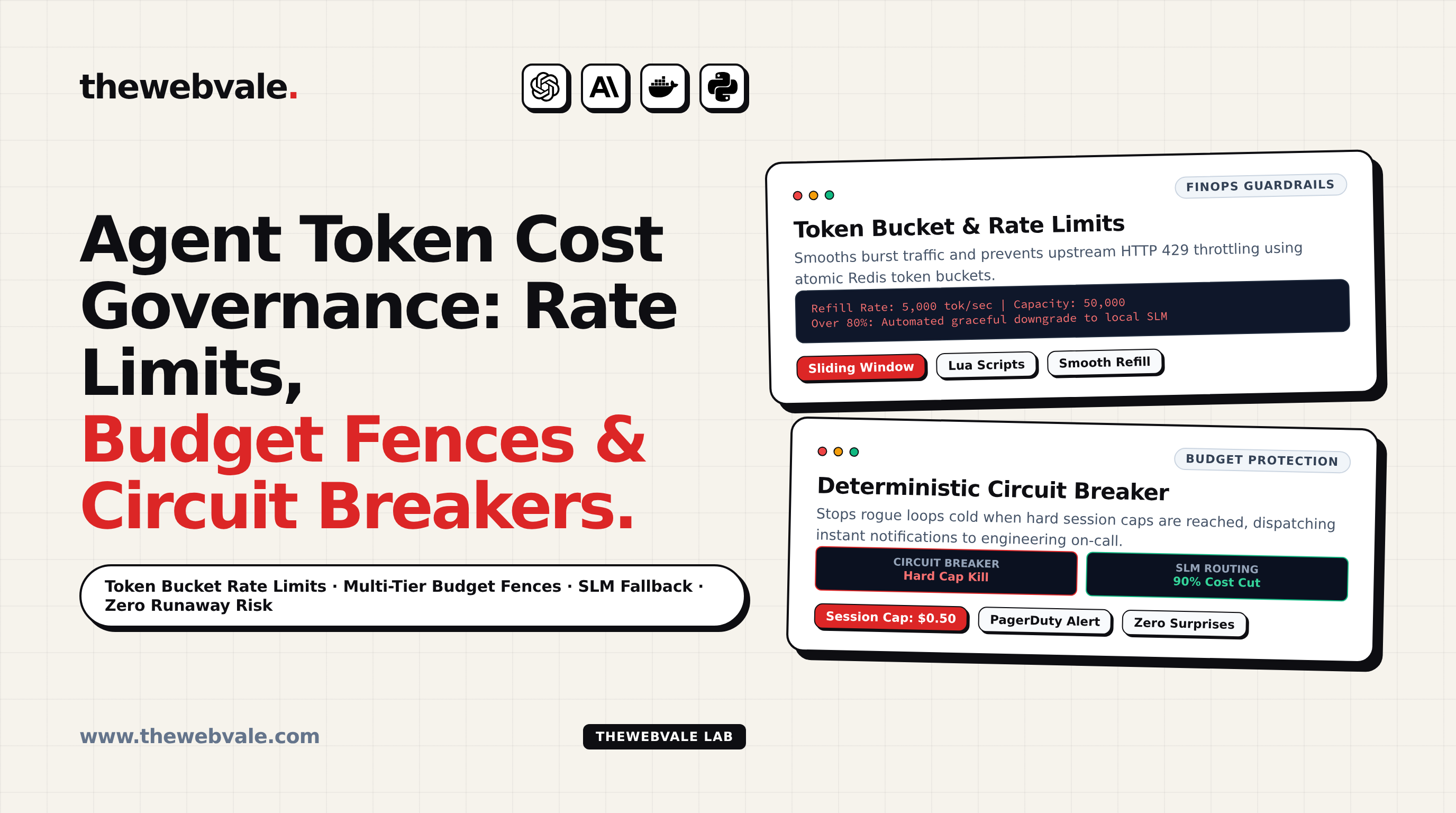
Agent Token Cost Governance: Rate Limits, Budget Fences, and Circuit Breakers
As engineering teams transition from single-turn chat interfaces to autonomous, recursive multi-agent swarms, the economic dynamics of AI infrastructure change radically. A subtle bug in an agent's reflection prompt or a poorly formatted tool error can trap models in recursive retry loops that burn through tens of millions of tokens in minutes. Without rigorous FinOps guardrails, a single rogue agent can run up a $5,000 monthly cloud invoice over a weekend. Establishing Autonomous Token Cost Governance requires layered budget fences, sliding-window rate limiters, token-bucket algorithms, and automated fallback circuit breakers.
1. Mathematical Modeling of Token Consumption in Recursive Swarms
In a standard linear application, token consumption grows proportionally to user requests: $\mathcal{O}(N)$. In recursive agent loops with branching subagents and tool execution traces, consumption grows exponentially with task complexity and tree depth $D$:
Where $b$ is the agent branching factor. If $b=3$ and the agent recurses to depth 4 due to an unresolved compilation error, a single user prompt can trigger over 81 frontier model calls.
2. The Three-Tier Budget Fence Architecture
Leading engineering organizations enforce a three-tier budgetary hierarchy to prevent unexpected financial loss:
- Tier 1: Per-Turn Fence ($0.05 cap): Protects against anomalous context blowups where an agent accidentally passes massive minified JavaScript bundles into the prompt.
- Tier 2: Per-Session Fence ($0.50 cap): Prevents infinite self-correction loops. If an agent fails to resolve a unit test within 10 turns, the session pauses and requests human intervention.
- Tier 3: Monthly Organization Fence: When an organization reaches 80% of its monthly allowance, automated prompt routing gracefully switches non-critical background jobs to quantized open-weight models (Llama 3.3 70B, Qwen 2.5).
3. Production Implementation: Redis Token Bucket Rate Limiter
Below is a production Python token governor leveraging Redis to enforce sliding window token consumption with atomic Lua scripts:
4. Summary of Cost Governance Guardrails
| Guardrail Level | Trigger Metric | Automated Action | Business Impact |
|---|---|---|---|
| Rate Limiter | Token Bucket Empty | Full Jitter Sleep Backoff | Prevents upstream HTTP 429 penalties |
| Soft Budget Fence | 80% of Session Limit | Model Downgrade to SLM | Reduces marginal token cost by 90% |
| Hard Circuit Breaker | 100% Dollar Limit Hit | Kill Task & Dispatch Alert | Zero runaway invoice risk guaranteed |