
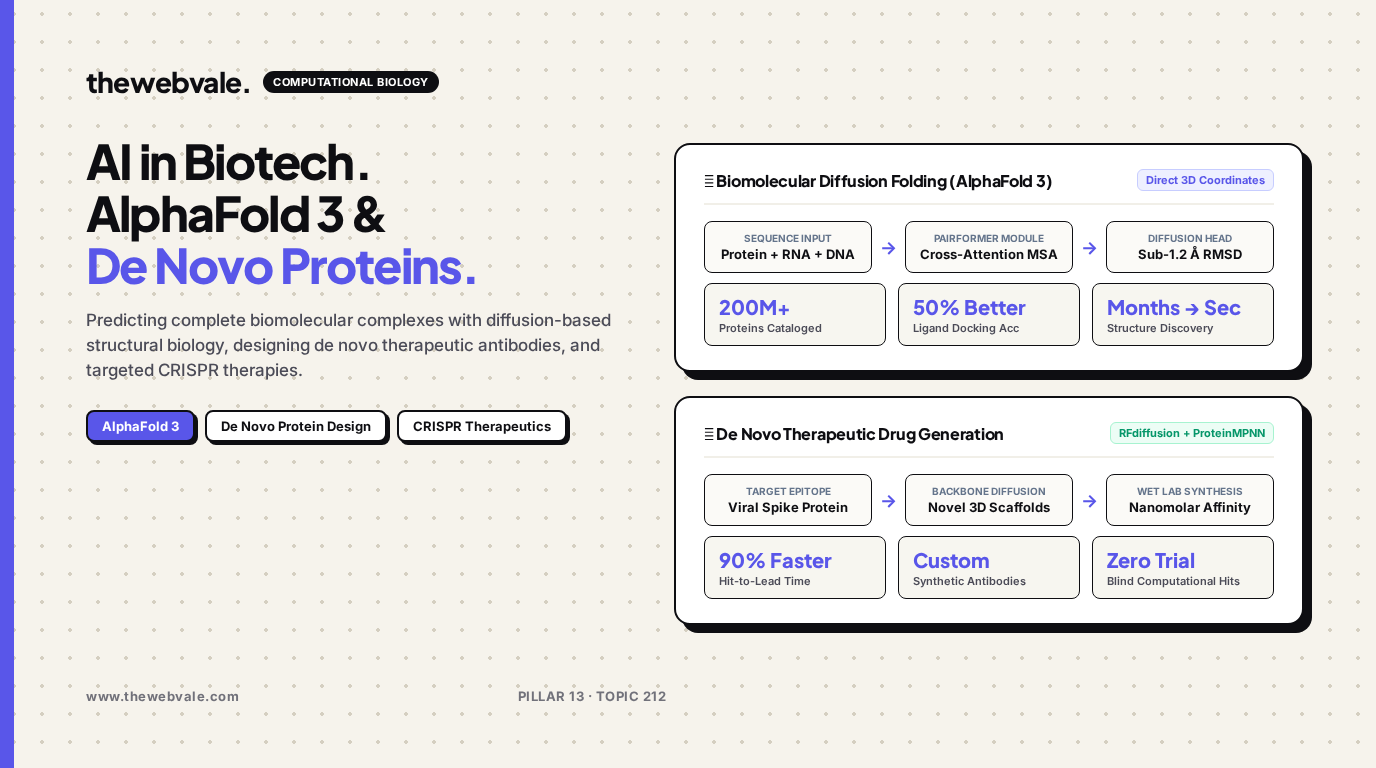
AI in Biotechnology & Medicine: AlphaFold 3, Protein Design, and Curing Genetic Diseases
For over fifty years, the "protein folding problem"—predicting how a linear sequence of amino acids folds into a complex three-dimensional nanoscopic machine—stood as one of the grandest challenges in molecular biophysics. DeepMind's release of AlphaFold 3 revolutionized computational biology: shifting from specialized Evoformer architectures to generalized Diffusion-based biomolecular complex prediction. By predicting interactions between proteins, nucleic acids (DNA/RNA), small-molecule drug ligands, and post-translational chemical modifications with atomic accuracy under 1.5 Ångströms, artificial intelligence is collapsing drug discovery timelines from a decade down to a single afternoon.
🧬 From Prediction to De Novo Protein Generation
While AlphaFold predicts how natural sequences fold, tools like RFdiffusion and ProteinMPNN (pioneered by David Baker's lab) solve the inverse problem: designing brand-new, de novo molecular binders that have never existed in nature to neutralize viral pathogens, target oncological cancer cells, and degrade environmental microplastics.
1. AlphaFold 3 Diffusion Mechanics vs. AlphaFold 2
AlphaFold 2 utilized an explicit structural module with invariant point attention (IPA) operating on rigid residue peptide frames. In contrast, AlphaFold 3 models 3D Cartesian coordinates directly through a denoising diffusion process operating on a raw token representation of atoms:
Where $\mathbf{x}_t$ represents the noisy 3D coordinates of all atoms in the multi-chain molecular complex, and conditioning $\mathbf{c}$ is derived from the Pairformer module processing Multiple Sequence Alignments (MSAs). This allows AlphaFold 3 to predict chemical covalent bonds and coordinate metal ions without hardcoded physics heuristics.
| Biomolecular Interaction | AlphaFold 2 Capability | AlphaFold 3 Performance | Therapeutic Application |
|---|---|---|---|
| Protein-Protein Complexes | High (AlphaFold-Multimer) | Unprecedented accuracy (>80% interface TM-score) | Targeted immunotherapy & chimeric receptors |
| Protein-DNA / RNA Binding | Not supported | Accurate double-helix nucleic acid docking | CRISPR-Cas9 guide RNA off-target elimination |
| Small-Molecule Ligands | Requires AutoDock Vina | 50% higher accuracy than classical physics dockers | Oral kinase inhibitor drug discovery |
| Post-Translational Mods | Ignored (treated as raw AA) | Full glycosylation & phosphorylation support | Biologic antibody half-life optimization |
2. The De Novo Drug Generation Pipeline
Modern computational biotechnology teams operate a streamlined four-step engineering loop:
- Target Identification: Identify the pathogen's vulnerable receptor binding domain (RBD) using Cryo-EM and AlphaFold 3.
- Scaffold Generation: Run RFdiffusion to hallucinate thousands of novel 3D structural backbones that wrap tightly around the target epitope.
- Sequence Design: Feed generated backbones into ProteinMPNN to find amino acid sequences that fold into that exact shape with minimal energy.
- Wet-Lab Validation: Synthesize DNA oligos with high-throughput yeast display to measure dissociation constants ($K_d$) in nanomolar concentrations.
3. Frequently Asked Questions
Does AlphaFold replace physical clinical trials?
No. AI dramatically accelerates preclinical candidate discovery from 4 years down to weeks, but human pharmacokinetic, toxicological, and efficacy trials remain essential to verify clinical safety in living biological systems.
Can AlphaFold 3 be run locally on consumer hardware?
Open-source community reproductions (such as OpenFold and Protenix) allow inference on workstations with 24GB VRAM (RTX 4090), though large multi-chain assemblies require 80GB H100 clusters.