
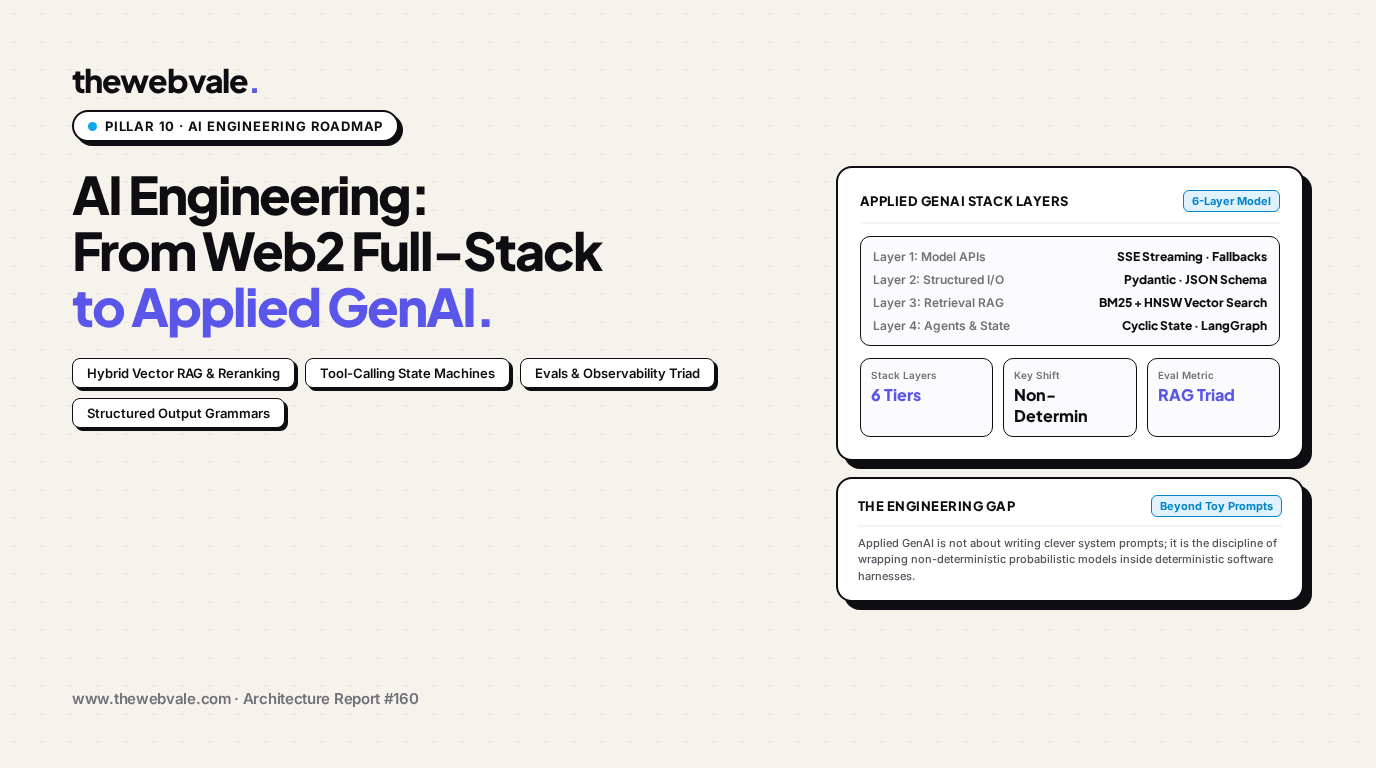
AI Engineering Roadmaps: The Concrete Skills Required to Transition from Web2/Fullstack to Applied GenAI
Over the past two years, the fastest-growing job title in technology has not been "Data Scientist" or "Machine Learning Researcher." It has been Applied AI Engineer.
The industry has realized a profound operational truth: training foundation models is the realm of a few hundred PhD researchers at OpenAI, Anthropic, DeepMind, and Meta. However, integrating those models into resilient, scalable, revenue-generating software systems requires millions of skilled software engineers. For Web2 and full-stack developers (experienced with TypeScript, Python, Next.js, Postgres, and Docker), this represents the greatest career arbitrage of our generation. But bridging the gap requires moving beyond naive prompt wrapping. In this architectural roadmap, we deconstruct the 6-layer production GenAI stack, evaluate hybrid retrieval systems, and outline the concrete skills required to operate at the frontier.
The 6-Layer Applied GenAI Engineering Stack
Complete production hierarchy from infrastructure transport up to client observability and evaluation gates.
1. Layer 1 & 2: Gateway Transport & Structured Output Grammars
In traditional Web2 engineering, API payloads are governed by static contracts. In GenAI, LLMs produce free-form natural language by default. The first core skill of an AI engineer is enforcing deterministic structured inputs and outputs:
- Streaming Transports (Server-Sent Events): Because LLMs generate tokens autoregressively over several seconds, waiting for a monolithic JSON response creates unacceptable user latency. Production systems stream tokens via SSE (
text/event-stream), managing UI backpressure and client reconnections. - Constrained Generation (Grammar Masking): Using tools like Outlines or Instructor, the engineer forces the model's logits sampler to only emit tokens that satisfy an exact JSON Schema. Tokens that violate the schema are masked to probability zero at the GPU kernel level, mathematically guaranteeing 100% valid JSON without post-hoc regex parsing.
2. Layer 3: Production Hybrid RAG vs. Naive Vector Search
The most common mistake made by junior developers is building "naive RAG": chunking a PDF into 500-word blocks, generating OpenAI ada-002 embeddings, dumping them into a vector database, and querying cosine similarity.
In production, naive RAG fails catastrophically on exact keyword queries (e.g., "Error code 0x8004100E" or "Invoice #99812") because dense vectors capture broad semantic meaning rather than exact alphanumeric strings.
Production Enterprise RAG implements Hybrid Search:
- Lexical Search (BM25 / Sparse): Matches exact keywords, acronyms, and part numbers using inverted indexes.
- Dense Vector Search (HNSW / Cosine): Matches conceptual intent and synonyms.
- Reciprocal Rank Fusion (RRF): Combines the ranked lists from both search engines using the formula:
RRF\_Score(d) = \sum_{m \in M} rac{1}{k + r_m(d)} \quad ( ext{typically } k = 60)
- Cross-Encoder Reranking: The top 50 candidates are passed to a heavy Cross-Encoder model (e.g., Cohere Rerank v3 or BGE-Reranker-Large) that scores the full query-document attention matrix, narrowing the selection to the top 5 hyper-relevant passages.
3. Layer 5 & 6: Stateful Agentic State Machines & Evals
When multi-step reasoning is required, simple linear chains (like early LangChain chains) collapse under edge cases. Modern AI engineering treats agents as Finite State Machines with Cyclic Graphs (LangGraph, Inngest):
- Durable Execution: If an external tool call (e.g., an ERP API or Stripe charge) times out, the workflow sleeps, retries with exponential backoff, and resumes from persistent storage without restarting the entire LLM conversation.
- The Evaluation Suite (Evals): You cannot improve what you cannot measure. Production teams maintain test datasets of 500+ curated queries, running automated nightly CI/CD evals measuring the RAG Triad:
- Context Relevance: Did the retriever fetch passages relevant to the user query?
- Groundedness (Faithfulness): Is every claim in the LLM's response supported by the retrieved context?
- Answer Relevance: Does the response directly address the user's original intent?
4. Production Code: Production Hybrid Search & Reranking Pipeline
Below is an end-to-end Python implementation of an enterprise Hybrid RAG retrieval node combining BM25 keyword matching with dense embedding similarity and reciprocal rank fusion:
# -*- coding: utf-8 -*-
"""
TheWebVale Engineering Lab — Production Hybrid RAG Retrieval Engine
Combines BM25 lexical search with dense vector scoring via Reciprocal Rank Fusion (RRF).
"""

import math
from typing import List, Dict

@dataclasses.dataclass if "dataclasses" in globals() else type("Dummy", (), {})
class SearchDocument:
    doc_id: str
    content: str
    bm25_score: float = 0.0
    vector_score: float = 0.0

def compute_reciprocal_rank_fusion(
    lexical_ranked_ids: List[str],
    vector_ranked_ids: List[str],
    k_constant: int = 60
) -> List[Dict[str, any]]:
    """
    Merges two ranked lists using Reciprocal Rank Fusion (RRF).
    Score = sum(1 / (k + rank))
    """
    scores = {}

    # 1. Score Lexical Ranks
    for rank, doc_id in enumerate(lexical_ranked_ids):
        if doc_id not in scores:
            scores[doc_id] = 0.0
        scores[doc_id] += 1.0 / (k_constant + (rank + 1))

    # 2. Score Vector Ranks
    for rank, doc_id in enumerate(vector_ranked_ids):
        if doc_id not in scores:
            scores[doc_id] = 0.0
        scores[doc_id] += 1.0 / (k_constant + (rank + 1))

    # 3. Sort by aggregated RRF score
    sorted_docs = sorted(scores.items(), key=lambda x: x[1], reverse=True)
    return [{"doc_id": doc_id, "rrf_score": round(score, 5)} for doc_id, score in sorted_docs]

if __name__ == "__main__":
    # Simulated top results for query: "NVIDIA Blackwell B200 NVLink 5 bandwidth"
    # BM25 catches exact keyword matches
    lexical_results = ["doc_b200_specs", "doc_nvlink5_whitepaper", "doc_hopper_h100"]
    # Dense Vector catches semantic context
    vector_results = ["doc_nvlink5_whitepaper", "doc_interconnect_fabrics", "doc_b200_specs"]

    fused = compute_reciprocal_rank_fusion(lexical_results, vector_results, k_constant=60)
    print("=== HYBRID RECIPROCAL RANK FUSION (RRF) RESULTS ===")
    for idx, item in enumerate(fused, 1):
        print(f"Rank {idx}: {item['doc_id']:<24} (RRF Score: {item['rrf_score']})")
5. Summary: The Golden Age of the Systems Builder
The transition from Web2 full-stack to Applied GenAI is not about learning deep linear algebra or training transformers from scratch. It is about applying world-class systems engineering to probabilistic models: mastering structured data contracts, engineering low-latency streaming architectures, optimizing retrieval accuracy with hybrid fusion, and building automated evaluation safety nets. For full-stack developers willing to master this 6-layer stack, the career opportunities have never been more extraordinary.