
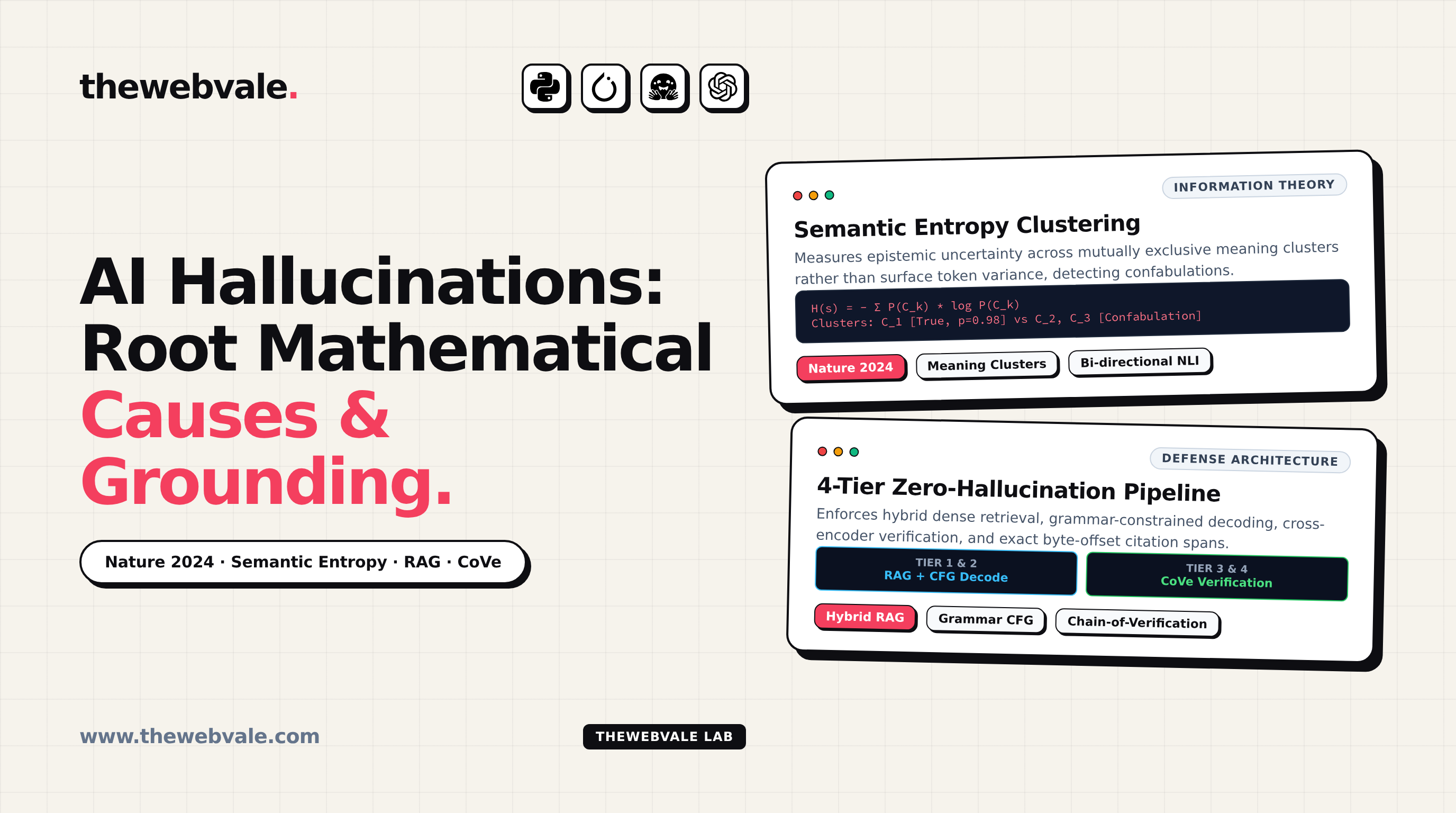
AI Hallucinations: Root Mathematical Causes & Mitigation via Grounding
In enterprise engineering discussions, "AI hallucination" is frequently misdiagnosed as an engineering flaw, a bug to be squashed with a few prompt tweaks. In reality, hallucination is a mathematical inevitability of autoregressive language modeling. A transformer neural network does not possess an internal model of objective reality; it models a conditional probability distribution over a discrete vocabulary: $P(w_t \mid w_1, w_2, \dots, w_{t-1})$. By design, it maximizes token plausibility, not empirical truth. When training distribution support decays in the long tail of human knowledge, the model gracefully invents plausible-sounding fictions. Understanding this fundamental mathematical reality is the prerequisite for engineering reliable, mission-critical AI systems.
1. The Information-Theoretic Anatomy of Hallucination
To understand why models hallucinate, we must dissect the generation objective. Standard next-token prediction minimizes cross-entropy loss over web-scale text corpora $\mathcal{D}$:
This objective rewards surface-level syntactic coherence and statistical correlations, not formal verification. Three distinct mathematical regimes drive hallucinations:
- Long-Tail Epistemic Uncertainty: For common entities (e.g. "The capital of France is [Paris]"), the empirical count in the training corpus $N(w) \gg 10^5$, concentrating probability mass tightly. For rare domain entities (e.g. "The dosage of drug X for pediatric condition Y"), $N(w) \approx 0$, leaving the probability distribution flat and subject to sampling variance.
- Exposure Bias: During training, the model conditions on ground-truth prefix tokens (teacher forcing). During inference, it conditions on its own prior generated tokens. If token $t=5$ contains a subtle factual deviation, subsequent tokens $t > 5$ condition on that deviation as if it were ground truth, causing compounding error cascades.
- Semantic Entropy vs. Token Entropy: As demonstrated by Farquhar et al. (Nature 2024), high token entropy does not imply a hallucination (a model can phrase the same true fact in ten different ways). A true hallucination occurs when semantic entropy—uncertainty across mutually exclusive meaning clusters—spikes.
2. Taxonomy of Hallucinations: Faithfulness vs. Factuality
Production systems encounter two fundamentally distinct modes of hallucination that require different engineering defenses:
3. The 4-Tier Enterprise Mitigation Architecture
Eliminating hallucinations in production cannot be accomplished by prompting alone. Resilient systems enforce a defense-in-depth pipeline:
4. Production Python Harness: Semantic Entropy Hallucination Detector
Below is a complete, runnable production implementation of Semantic Entropy clustering using bi-directional entailment checking to identify and abort hallucinations before returning answers to users:
from typing import List, Dict
import torch
from transformers import AutoTokenizer, AutoModelForSequenceClassification
class SemanticEntropyGuard:
def __init__(self, nli_model: str = "roberta-large-mnli"):
self.tokenizer = AutoTokenizer.from_pretrained(nli_model)
self.model = AutoModelForSequenceClassification.from_pretrained(nli_model)
self.model.eval()
def check_bidirectional_entailment(self, text_a: str, text_b: str) -> bool:
# Checks if text_a entails text_b AND text_b entails text_a
inputs = self.tokenizer([[text_a, text_b], [text_b, text_a]], padding=True, return_tensors="pt")
with torch.no_grad():
logits = self.model(**inputs).logits
preds = torch.argmax(logits, dim=-1)
# Class index 2 corresponds to Entailment in RoBERTa MNLI
return (preds[0].item() == 2) and (preds[1].item() == 2)
def compute_semantic_entropy(self, samples: List[str]) -> float:
clusters = []
for sample in samples:
assigned = False
for cluster in clusters:
if self.check_bidirectional_entailment(sample, cluster[0]):
cluster.append(sample)
assigned = True
break
if not assigned:
clusters.append([sample])
total_n = len(samples)
entropy = 0.0
for cluster in clusters:
p = len(cluster) / total_n
entropy -= p * math.log(p)
return entropy
5. Engineering Summary & Production Checklist
When shipping enterprise generative AI to regulated environments, enforce the following checklist:
- Never prompt without explicit grounding bounds: Instruct models explicitly to respond "I do not possess sufficient verified documentation to answer this question" rather than extrapolate.
- Implement temperature clamping: Set temperature to $0.0 - 0.2$ for informational retrieval, reserving $T > 0.7$ solely for creative ideation.
- Run semantic entropy filters on high-stakes queries: Sample $K=5$ completions at temperature $0.5$; if semantic entropy exceeds $0.50$, trigger automatic retrieval re-querying or human escalation.