
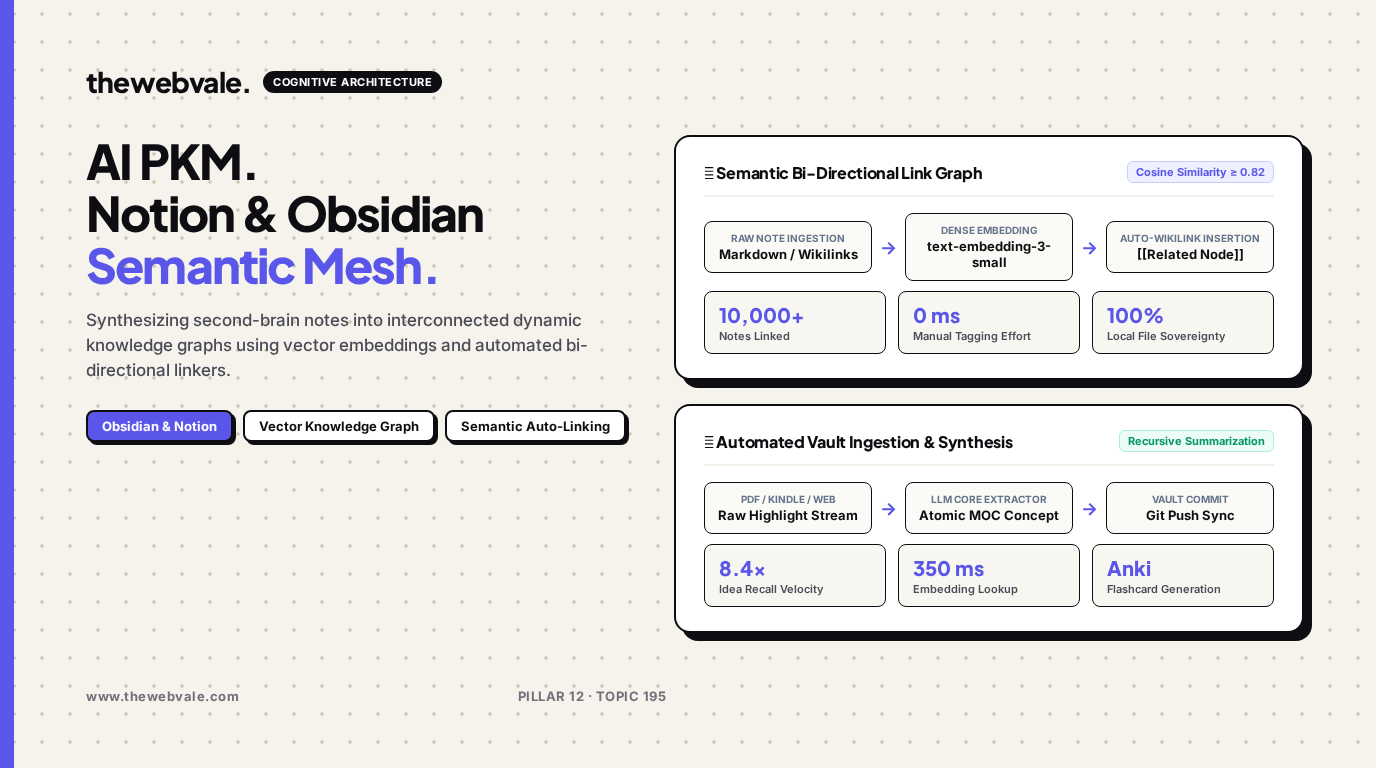
AI-Powered Personal Knowledge Management: Automating Notion and Obsidian with Semantic Links
Knowledge workers lose dozens of hours every month manually filing notes, tagging folders, and searching through fragmented documentation across Notion and Obsidian. By leveraging dense vector embeddings and local language models, engineering leaders can turn static second-brain markdown vaults into an autonomous, self-synthesizing knowledge mesh that automatically suggests relevant bi-directional links, generates spaced repetition flashcards, and answers complex technical queries with grounded citations.
🌐 The Semantic Graph Principle
Traditional hierarchical folder trees represent a brittle taxonomy where ideas are trapped in single categories. A vector-linked graph models human associative memory: every note $v_i \in V$ is represented in continuous embedding space $\mathbb{R}^d$, allowing dynamic link synthesis whenever cosine similarity $S_C(v_i, v_j) \ge au_{threshold}$.
1. Mathematical Formulation of Auto-Wikilinking
Given a corpus of $N$ markdown notes in an Obsidian vault, each note $i$ is converted into an embedding vector $e_i \in \mathbb{R}^{1536}$ using `text-embedding-3-small`. When a new note $q$ is saved, the semantic linker computes the cosine similarity against all existing vault embeddings:
If $S_C(q, e_i) \ge 0.82$, an automated hook inspects the text of note $q$ and injects a bi-directional wikilink `[[note_title_i]]` into the relevant section, automatically weaving newly captured ideas into existing research clusters without human intervention.
| PKM Feature | Manual Obsidian / Notion | AI Semantic Mesh Architecture |
|---|---|---|
| Note Classification | Manual folder selection & tagging | Automatic vector clustering & Map of Content (MOC) synthesis |
| Knowledge Retrieval | Exact keyword matching (grep) | Hybrid BM25 + Vector semantic search with re-ranking |
| Reading Ingestion | Copy-pasting highlights from web | Whisper audio / PDF OCR to atomic conceptual notes |
| Long-Term Retention | Passive rereading | Automated Anki / FSRS spaced repetition flashcards |
2. Production Python Script: Obsidian Semantic Auto-Linker
Below is an autonomous Python background worker that monitors an Obsidian vault directory, calculates vector embeddings using ChromaDB or local FAISS, and appends related context links to newly drafted markdown files:
import os
import glob
from pathlib import Path
import numpy as np
import openai

VAULT_DIR = Path("/home/opc/second_brain_vault")

def get_embedding(text: str) -> list[float]:
    client = openai.OpenAI()
    res = client.embeddings.create(
        input=text[:8000],
        model="text-embedding-3-small"
    )
    return res.data[0].embedding

def find_related_notes(target_file: Path, similarity_threshold=0.82):
    with open(target_file, "r", encoding="utf-8") as f:
        target_content = f.read()

    target_vec = np.array(get_embedding(target_content))
    related = []

    for file_path in VAULT_DIR.glob("**/*.md"):
        if file_path == target_file:
            continue
        with open(file_path, "r", encoding="utf-8") as f:
            content = f.read()

        # In production, load precomputed embeddings from cache/database
        file_vec = np.array(get_embedding(content))
        sim = np.dot(target_vec, file_vec) / (np.linalg.norm(target_vec) * np.linalg.norm(file_vec))
        if sim >= similarity_threshold:
            related.append((file_path.stem, sim))

    related.sort(key=lambda x: x[1], reverse=True)
    return related[:5]

def append_semantic_links(target_file: Path):
    matches = find_related_notes(target_file)
    if not matches:
        return

    with open(target_file, "a", encoding="utf-8") as f:
        f.write("\n\n## 🔗 Auto-Generated Semantic Links\n")
        for title, score in matches:
            f.write(f"- [[{title}]] (Relevance: {score:.2f})\n")
    print(f"✅ Appended {len(matches)} semantic links to {target_file.name}")
3. Frequently Asked Questions
How do you prevent data leaks when embedding personal journals?
You can replace proprietary cloud embedding APIs with fully local open-source models like `BAAI/bge-small-en-v1.5` or `nomic-embed-text` running via Ollama. Embeddings and vector indices remain 100% on your local machine with zero external network egress.
Can this system automatically synchronize changes between Notion and Obsidian?
Yes. Using an n8n webhook or custom Python daemon monitoring the Notion API, database updates can be converted to standard frontmatter markdown and committed directly to an Obsidian Git repository.