
The Attention Economy & Digital Dopamine: How Short-Form Algorithms Affect Cognitive Endurance
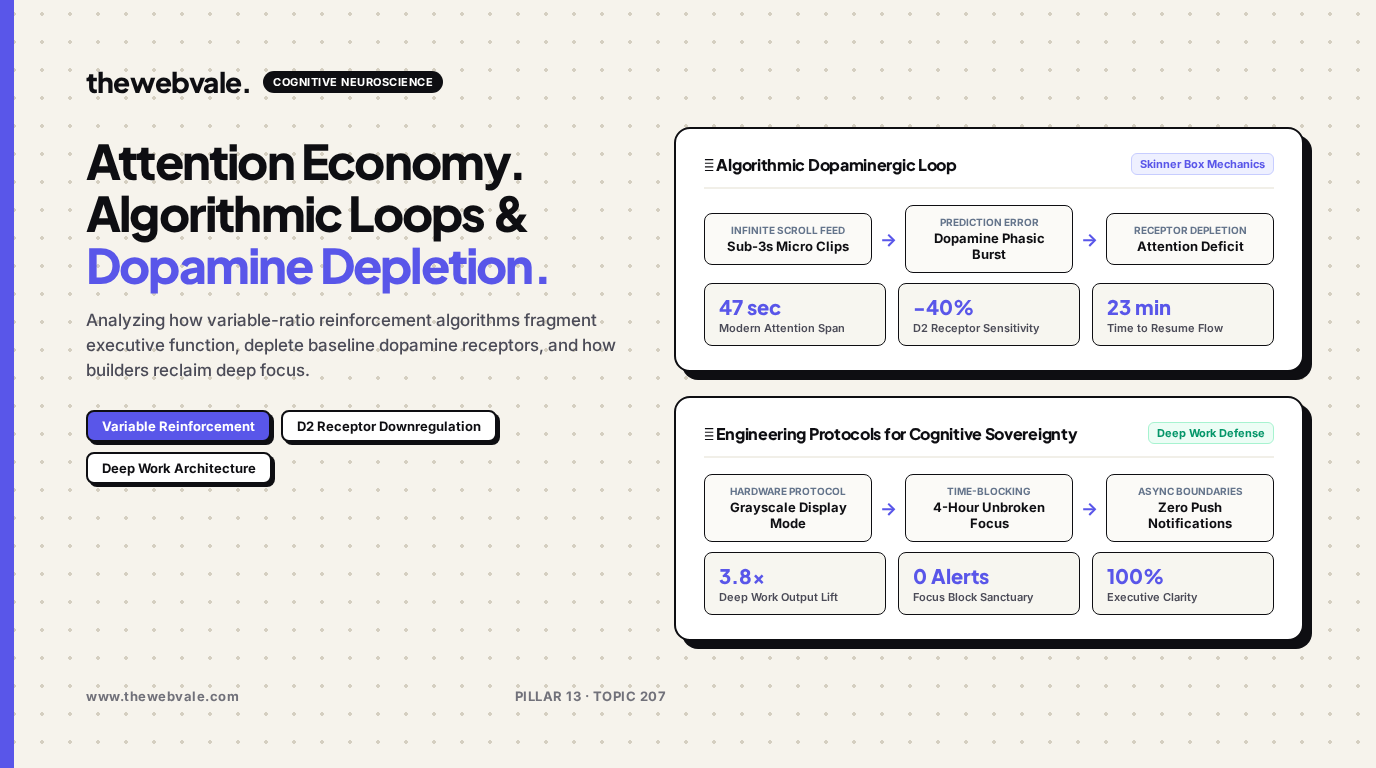
In an era where algorithmic recommendation engines optimize for user dwell time with sub-millisecond precision, human attention has become the most intensely monetized natural resource on earth. Short-form video feeds—TikTok, Instagram Reels, YouTube Shorts—exploit variable-ratio reinforcement schedules to trigger phasic dopamine bursts every 15 to 30 seconds. This continuous overstimulation leads to dopamine receptor downregulation, elevates chronic brain fog, and degrades the sustained executive focus required to architect complex software systems.
🧠 The Neurobiology of Attention Fragmentation
Dopamine is not the neurochemical of pleasure; it is the molecule of anticipation and prediction error. When an algorithm randomizes rewards (some videos boring, others thrilling), synaptic dopamine release surges by 200% above baseline. To maintain homeostasis, the brain downregulates post-synaptic $D_2$ receptors, rendering low-stimulation activities—like reading documentation or debugging complex distributed race conditions—psychologically painful.
1. The Cognitive Cost of Context Switching
Gloria Mark's research at UC Irvine demonstrates that average knowledge worker screen focus has plummeted from 2.5 minutes in 2004 to just 47 seconds today. When focus is interrupted by a notification or algorithmic check, resuming deep flow requires an average latency of:
Checking a smartphone 5 times an hour completely destroys the possibility of entering prolonged neurobiological flow state ($ heta$-wave synchronization in the prefrontal cortex).
| Neurobiological Dimension | High Algorithmic Consumption | Protected Deep Focus Regimen | Engineering Impact |
|---|---|---|---|
| Baseline Dopamine State | Depleted / Desensitized ($D_2$ down) | Calibrated & High Sensitivity | Effortless sustained concentration |
| Working Memory Span | Truncated to 1-2 chunks | Extended 5-7 concept stacks | Holding whole microservice architectures in mind |
| Boredom Tolerance | Near zero (instant reflex pull) | High (embraces cognitive friction) | Patience to trace obscure compiler memory leaks |
| Sleep Architecture | Suppressed Slow-Wave Sleep | Deep restorative REM + SWS cycles | Consolidation of complex algorithmic insights |
2. The Sovereign Deep Focus Protocol: 4 Concrete Rules
To produce 100x engineering outcomes, elite builders enforce strict environmental and device boundaries:
- Grayscale Hardware Mode: Switch mobile OS displays to monochrome (`Settings -> Accessibility -> Display & Text -> Color Filters -> Grayscale`). Removing saturated red notification badges drops screen pickups by 35%.
- The 4-Hour Morning Block: Protect 8:00 AM to 12:00 PM from all email, Slack, and social feeds. This time is reserved exclusively for primary architectural problem solving.
- Async Work Batches: Check communications only at two fixed daily checkpoints (12:00 PM and 4:30 PM). Treat instant messaging as an asynchronous message queue, not an interrupt vector.
- Physical Device Quarantine: Keep smartphones in a separate room during working sprints and charging overnight outside the bedroom.
3. Frequently Asked Questions
How long does it take for dopamine receptors to reset after a digital detox?
Neurobiological studies show that significant $D_2$ receptor upregulation occurs within 14 to 21 days of removing high-frequency algorithmic stimulation, leading to a noticeable return of mental clarity and reading stamina.
Is listening to background music or white noise beneficial for coding?
Instrumental soundscapes (ambient electronica, binaural 40Hz gamma beats, or brown noise) provide gentle auditory masking without lyrical language processing, stabilizing attention without triggering dopamine depletion.