
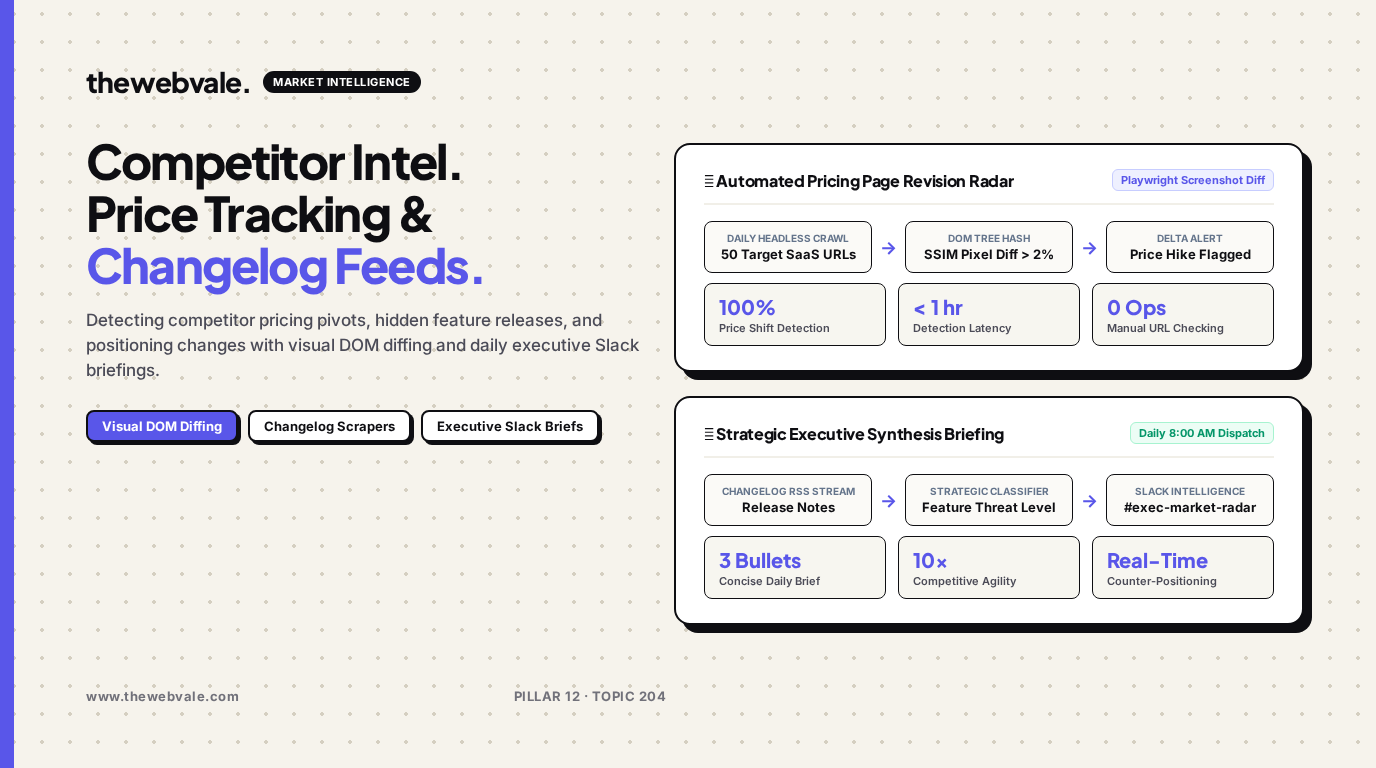
Automated Competitor Monitoring: Tracking Competitor Pricing, Feature Releases, and Blog Posts
In fast-moving SaaS sectors, competitors constantly adjust their positioning, launch silent pricing pivots, and release feature updates without public announcements. Relying on manual weekly checks leaves founders blindsided when a competitor drops an entry tier from $99 to $29 or launches an enterprise feature that targets your flagship customers. By engineering autonomous competitive intelligence pipelines that combine headless browser screenshot diffing, changelog RSS scrapers, and strategic LLM summarization, growth teams receive real-time, actionable briefings directly in Slack.
💡 Strategic Intelligence vs. Data Dumps
Dumping thousands of raw HTML diffs into Slack creates alert fatigue. An effective intelligence pipeline filters out superficial CSS changes, analyzes whether a modification signals an ICP repositioning or pricing change, and delivers a 3-bullet executive summary explaining the strategic counter-action.
1. The Visual & Structural Diffing Mechanics
To detect changes on competitor landing pages without being fooled by dynamic timestamps, the monitor uses a two-stage delta pipeline:
- Structural DOM Hashing: The headless crawler strips scripts, images, and nonces, computing the SHA-256 hash of the cleaned DOM tree $\mathcal{H}(D_{clean})$. If the hash matches the previous day's snapshot, the crawl terminates in 0ms.
- Perceptual Image Hash (SSIM): If the DOM hash changes, Playwright captures a full-page 1440px viewport screenshot and computes the Structural Similarity Index Measure (SSIM) against the baseline: $$ ext{SSIM}(x, y) = rac{(2\mu_x\mu_y + C_1)(2\sigma_{xy} + C_2)}{(\mu_x^2 + \mu_y^2 + C_1)(\sigma_x^2 + \sigma_y^2 + C_2)}$$ If $ ext{SSIM} < 0.98$, an LLM diffs the extracted text and evaluates the business impact.
| Competitor Channel | Monitoring Method | Change Detection Signal | Strategic Executive Alert |
|---|---|---|---|
| Pricing Page (`/pricing`) | Daily Playwright screenshot + table extract | Price tiers, seat minimums, feature gates | P0: Price undercutting / packaging shift |
| Public Changelog (`/changelog`) | RSS / Atom feed poll + headless HTML | New integration launches, API updates | Product roadmap convergence check |
| Careers Page (`/careers`) | Greenhouse / Lever API scraping | Spike in hiring enterprise sales or AI leads | Leading indicator of enterprise pivot |
| Header & Hero (`/`) | Crawl4AI DOM markdown extract | H1 headline rebrand, customer logo swaps | Repositioning towards new market vertical |
2. Production Python Competitor Diff Engine
Below is a production script that crawls competitor pricing pages, computes text deltas, and generates structured executive briefings:
import difflib
import openai
from pydantic import BaseModel, Field

class StrategicBrief(BaseModel):
    competitor_name: str
    change_type: str = Field(description="PRICING_PIVOT, FEATURE_LAUNCH, POSITIONING_SHIFT, MINOR")
    executive_summary: str
    threat_level: str = Field(description="LOW, MEDIUM, HIGH, CRITICAL")
    recommended_counter_move: str

def analyze_competitor_delta(competitor: str, old_text: str, new_text: str) -> StrategicBrief:
    diff = difflib.unified_diff(
        old_text.splitlines(),
        new_text.splitlines(),
        fromfile="yesterday",
        tofile="today",
        lineterm=""
    )
    diff_text = "\n".join(diff)
    if not diff_text.strip():
        return None

    client = openai.OpenAI()
    system_prompt = (
        "You are an executive Chief Strategy Officer. Analyze competitor website diffs "
        "and generate high-signal, actionable executive briefings."
    )

    completion = client.beta.chat.completions.parse(
        model="gpt-4o-mini",
        messages=[
            {"role": "system", "content": system_prompt},
            {"role": "user", "content": f"Competitor: {competitor}\n\nDIFF:\n{diff_text[:6000]}"}
        ],
        response_format=StrategicBrief
    )
    return completion.choices[0].message.parsed
3. Frequently Asked Questions
How do you prevent headless crawlers from getting blocked by Cloudflare?
Use stealth browser patches (e.g. `playwright-stealth`) with randomized viewports and rotate residential proxy endpoints with sticky 5-minute sessions.
How frequently should competitive monitoring runs execute?
Running crawls once every 24 hours (at 3:00 AM UTC) is the ideal cadence. More frequent polling yields diminishing returns and increases risk of IP rate-limiting.