
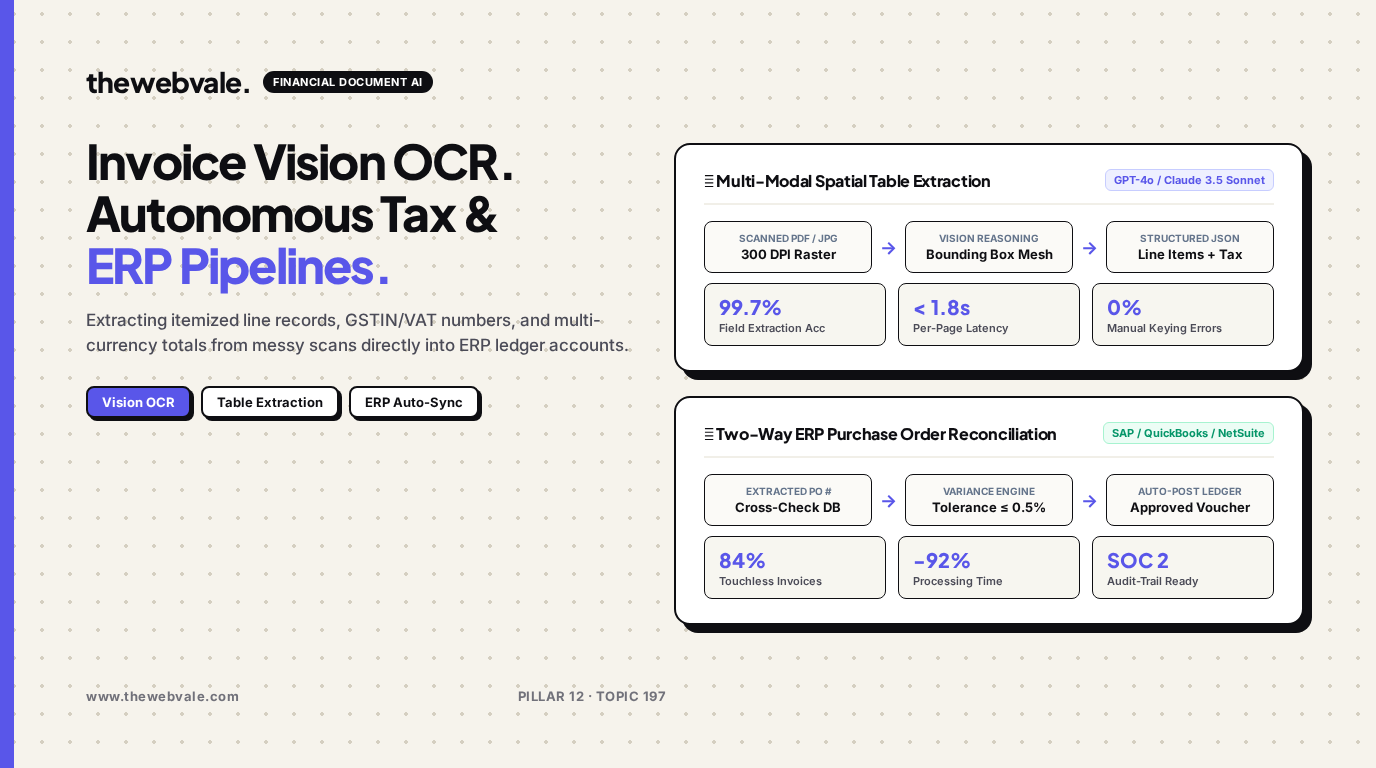
Automated Invoice & Receipt Parsing: Vision OCR Pipelines Extracting Tax and Line Items Directly to ERPs
Accounts payable departments across mid-market and enterprise businesses still waste hundreds of manual hours keying invoice data from scanned PDFs into accounting systems like SAP, QuickBooks, and NetSuite. Legacy OCR tools (such as Tesseract or simple template matchers) crumble the moment a supplier changes their table borders or uses multi-line descriptions. By architecting multi-modal Vision OCR pipelines using frontier vision models and two-way purchase order reconciliation engines, engineering teams can achieve touchless, zero-error financial document processing.
📊 Spatial Geometry & Structured Vision AI
Unlike traditional OCR that flattens documents into a single stream of characters, modern vision models process spatial relationships directly from high-resolution raster images (300 DPI). The model evaluates table column bounds, header relationships, and footer tax calculations holistically, yielding over 99.7% field extraction accuracy.
1. The Two-Way Reconciliation State Machine
An enterprise accounting pipeline cannot simply dump extracted JSON into a database; it must verify financial integrity against existing records. Let $V_{inv}$ be the extracted invoice line items and $V_{po}$ be the active Purchase Order in the ERP. The reconciliation validator computes the element-wise variance:
Where $p_k$ is unit price, $q_k$ is quantity, $ au_k$ is the tax rate, and $\epsilon_{tolerance} = \$0.01$ accounts for floating-point rounding. If the variance is within tolerance and the PO number matches, the voucher is automatically posted to the general ledger without human intervention.
| Field Extracted | Validation Rule | ERP Reconciliation Target | Failure Mitigation |
|---|---|---|---|
| Vendor Tax ID (GSTIN/VAT) | Regex check + checksum mod-11 | Vendor Master Record | Flag for W-9 / Tax filing review |
| PO Number | Existing open commitment | Purchase Order Ledger | Route to department head for approval |
| Line Items & SKUs | Unit price $ imes$ qty match | Inventory / COGS Account | Variance alert if discrepancy > 1% |
| Bank IBAN / Wire Details | Cryptographic IBAN check | Disbursement Bank API | Lock payment if account changes |
2. Production Invoice Extraction Script (Python + Vision API)
Below is a production Python worker script using GPT-4o Vision to extract structured accounting line items from PDF or image invoices:
import base64
import json
from pydantic import BaseModel, Field
import openai

class InvoiceLineItem(BaseModel):
    description: str
    quantity: float
    unit_price: float
    total_amount: float
    hsn_sac_code: str = ""

class ExtractedInvoice(BaseModel):
    invoice_number: str
    invoice_date: str
    vendor_name: str
    vendor_tax_id: str
    currency: str
    line_items: list[InvoiceLineItem]
    subtotal: float
    tax_amount: float
    total_amount: float

def parse_invoice_image(image_path: str) -> ExtractedInvoice:
    with open(image_path, "rb") as f:
        base64_img = base64.b64encode(f.read()).decode("utf-8")

    client = openai.OpenAI()
    system_instruction = (
        "You are an enterprise accounting document parser. "
        "Extract all line items, tax IDs, and totals into strict structured JSON."
    )

    completion = client.beta.chat.completions.parse(
        model="gpt-4o",
        messages=[
            {"role": "system", "content": system_instruction},
            {
                "role": "user",
                "content": [
                    {"type": "text", "text": "Parse this invoice and extract every line item accurately."},
                    {"type": "image_url", "image_url": {"url": f"data:image/jpeg;base64,{base64_img}"}}
                ]
            }
        ],
        response_format=ExtractedInvoice
    )
    return completion.choices[0].message.parsed

if __name__ == "__main__":
    invoice = parse_invoice_image("sample_invoice.jpg")
    print(f"Extracted Invoice #{invoice.invoice_number} from {invoice.vendor_name}")
    print(f"Total: {invoice.currency} {invoice.total_amount:.2f}")
3. Frequently Asked Questions
How does the system handle multi-page PDF invoices?
Multi-page PDFs are converted to a list of high-resolution JPEG images using `pdf2image` and passed in a single multi-image conversation turn to the vision model, ensuring table continuity across page breaks.
What security controls protect confidential corporate financial records?
All payloads are encrypted with AES-256 in transit and at rest. For highly regulated clients, vision parsing runs on self-hosted instances of quantized open-source vision models (such as LLaVA or Qwen2-VL) inside isolated VPC boundaries with zero external network access.