
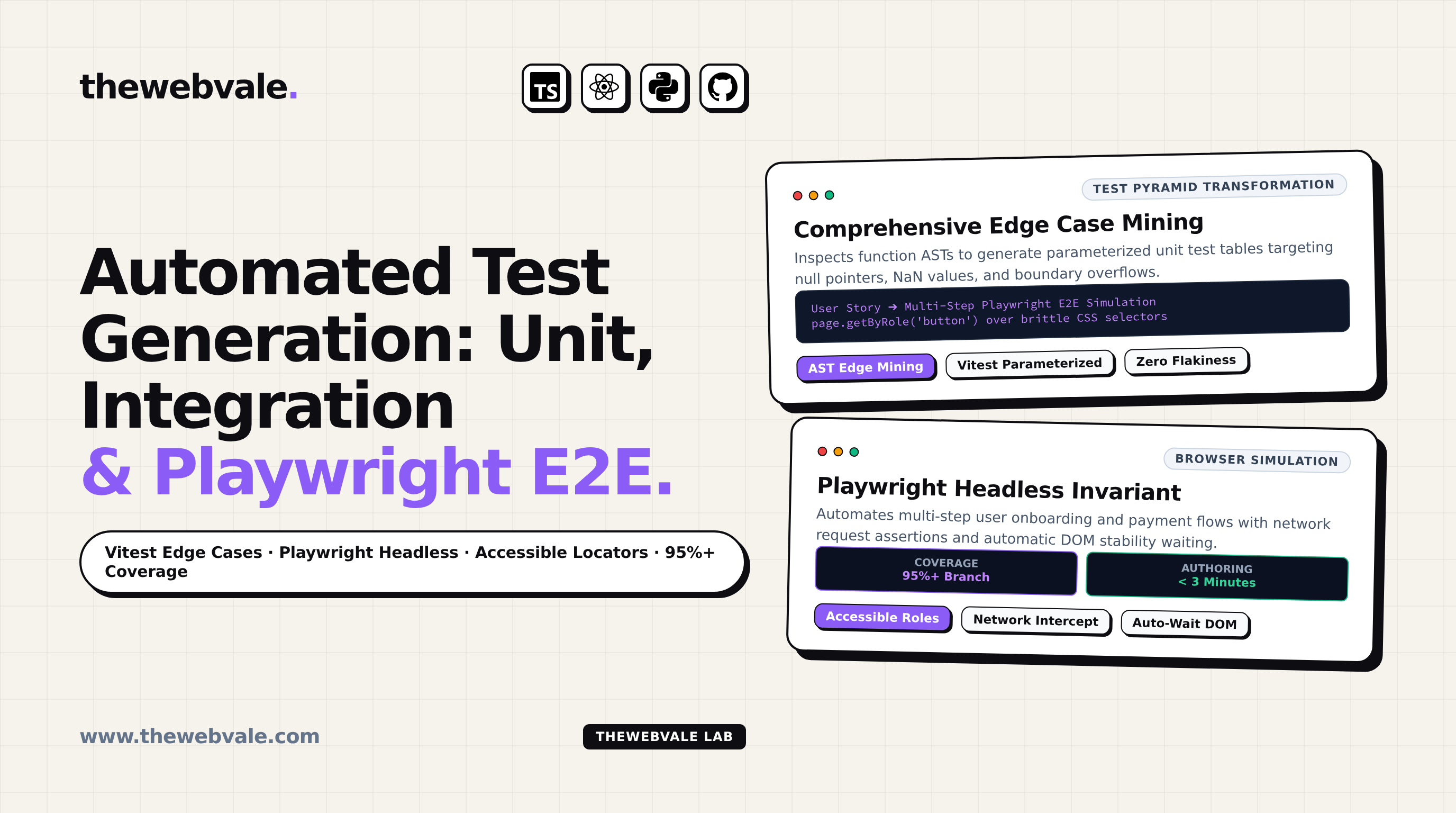
Automated Test Generation: Using AI to Write Unit, Integration, and E2E Playwright Tests
In the software development lifecycle, automated testing represents an enduring paradox: every engineering leader acknowledges that comprehensive test coverage is the single best predictor of system reliability, yet writing and maintaining tests remains the most procrastinated task across engineering teams. With the arrival of multimodal reasoning models, Autonomous Test Generation has evolved from basic regex-based unit scaffolding to sophisticated, behavioral test suites spanning unit tests, integration contracts, and multi-step Playwright End-to-End (E2E) browser simulations.
1. Transforming the Test Pyramid with Generative AI
Autonomous test generation structures tests across three deterministic tiers:
- Unit Tier (Vitest / Pytest): The model inspects pure function ASTs, generating parameterized test tables that specifically target edge cases: null pointers, off-by-one indices, zero division, NaN values, and boundary overflows.
- Integration Tier (Supertest / API Contracts): Validates HTTP status codes, CORS headers, database mock transactions, and Zod input rejection for malicious inputs.
- E2E Tier (Playwright / Chromium): Ingests high-level user stories (e.g., "User signs up, enters billing details, upgrades to Enterprise, and verifies invoice PDF download") and generates resilient headless browser scripts.
2. Production Implementation: Playwright E2E User Journey Test
Below is a battle-tested Playwright TypeScript test script generated from a user story specification, demonstrating resilient accessibility-driven locators and network response assertions:
3. The Secret to Eliminating Flaky AI-Generated Tests
The fatal error of naive AI test generators is relying on brittle structural CSS selectors such as div > div:nth-child(2) > span. To prevent false-positive test failures:
- Force Accessible Role Locators: Instruct the generator to strictly use
page.getByRole(),page.getByLabel(), andpage.getByTestId(). - Leverage Playwright Auto-Waiting: Avoid hardcoded
sleep(3000)timers. Playwright automatically waits for elements to be actionable and visible. - Isolate Test Databases: Run tests against ephemeral SQLite or MongoDB in-memory instances to eliminate cross-test data pollution.
4. Test Automation Metrics
| Test Suite Type | Manual Authoring Time | AI Generation Time | Coverage Improvement |
|---|---|---|---|
| Unit & Edge Case Suites | 4 – 6 Hours | < 3 Minutes | +45% Branch Coverage |
| API Integration Contracts | 3 – 5 Hours | < 2 Minutes | 100% Schema Validation |
| Playwright E2E User Journeys | 8 – 14 Hours | < 8 Minutes | Critical Flow Protection |