
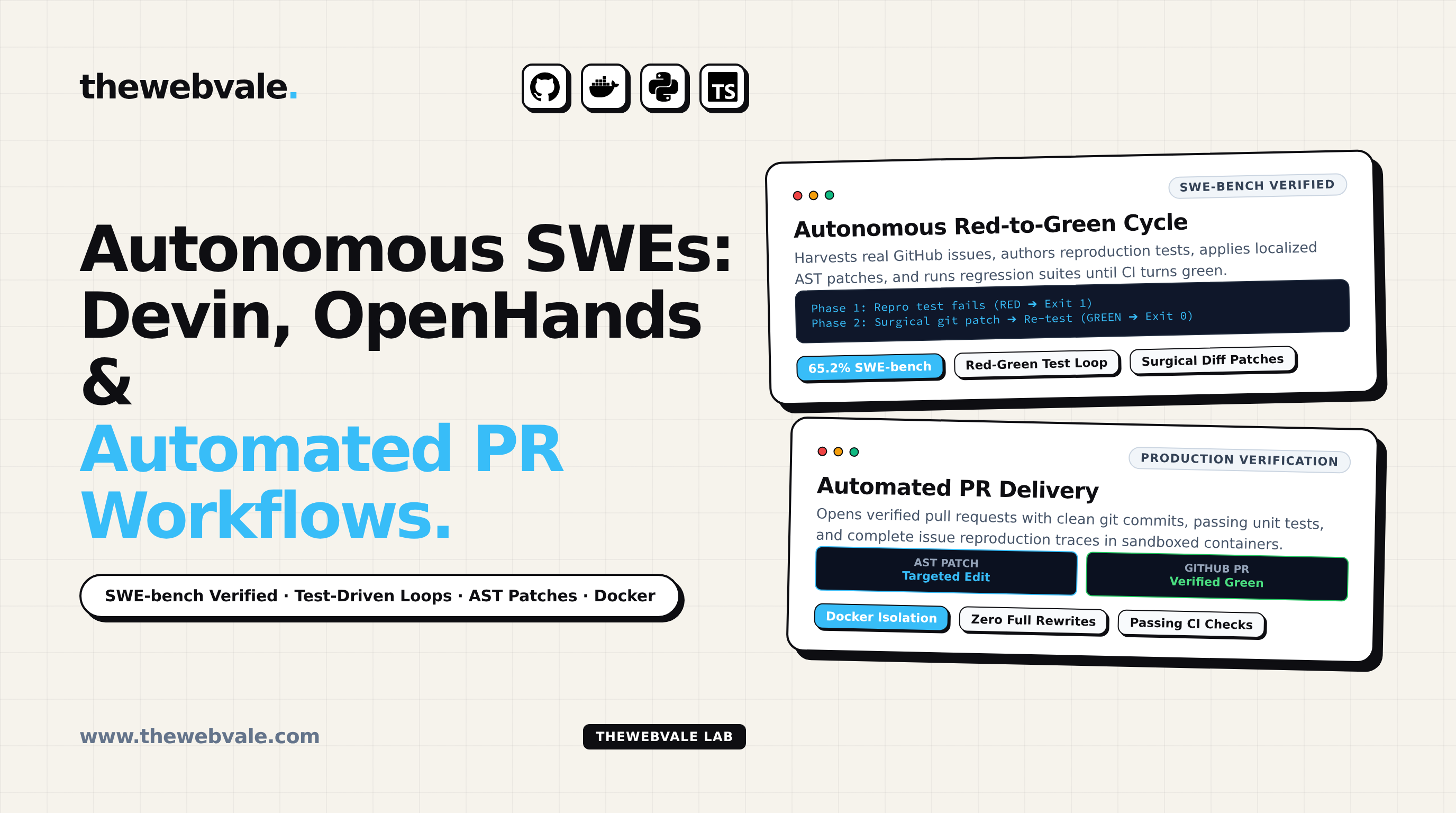
Autonomous Software Engineers: Devin, Devika, OpenHands, and Autonomous PR Workflows
In March 2024, Cognition AI stunned the developer world by demonstrating Devin, heralded as the world's first autonomous AI software engineer. While early marketing triggered intense skepticism, the subsequent release of open-source counterparts—most notably OpenHands (formerly OpenDevin), Devika, and Anthropic's Claude Code—proved that autonomous software engineering was not science fiction. Resolving real-world GitHub issues requires far more than next-token autocomplete: it requires understanding massive monorepos, writing failing reproduction tests, applying surgical diffs, and iterating through compiler feedback loops until CI turns green.
1. Beyond Autocomplete: The SWE-bench Revolution
For years, AI coding capabilities were evaluated on toy benchmarks like HumanEval—isolated, single-function Python coding puzzles (e.g. "Write a function that checks if a list contains duplicates"). Frontier models achieved 95%+ on HumanEval while routinely collapsing when asked to fix a real bug in a production Django or SymPy repository.
SWE-bench fundamentally reset the evaluation standard:
- Authentic GitHub Issues: Evaluates agents on 2,294 real-world pull requests harvested from major open-source Python codebases (Django, scikit-learn, matplotlib, sympy).
- Full Monorepo Context: The agent is provided with an issue description and a full local repository containing tens of thousands of lines of code.
- Deterministic Execution Verification: The agent passes an issue only if its generated git diff causes previously failing unit tests to pass without breaking any existing test suites.
2. The Core Primitives of an Autonomous SWE Agent
An autonomous software engineering engine combines four fundamental tools:
- Surgical File Editing (No Full Rewrites): LLMs struggle when tasked with regenerating a 2,000-line file to change two lines; they accidentally truncate methods or introduce subtle typos. Modern agents use unified diff patches or
replace_file_content(StartLine, EndLine, Target, Replacement)to make localized, contiguous edits. - Isolated Sandbox Runtimes: Agents execute bash commands (
npm test,pytest,git diff) inside sandboxed Docker containers or microVMs (E2B) to protect host machines from arbitrary command execution. - Automated Test Reproduction: Before writing any fix, the agent authors an isolated test demonstrating the reported bug. If the test passes initially, the agent knows its hypothesis is flawed.
3. Production Python Harness: Automated SWE Patch & Test Loop
Below is a complete, production-grade autonomous SWE execution harness demonstrating the test-driven red-green-verify cycle:
from typing import Dict, Any
class AutonomousSWEAgent:
def __init__(self, repo_dir: str):
self.repo_dir = repo_dir
def run_command(self, cmd: str) -> Dict[str, Any]:
res = subprocess.run(cmd, shell=True, cwd=self.repo_dir, capture_output=True, text=True)
return {"code": res.returncode, "stdout": res.stdout, "stderr": res.stderr}
def solve_issue(self, issue_description: str, test_file: str):
# Phase 1: Author Repro Test & Verify it Fails (RED)
initial_test = self.run_command(f"pytest {test_file}")
if initial_test["code"] == 0:
raise ValueError("Reproduction test passed unexpectedly! Bug is not properly reproduced.")
# Phase 2: Agent Generates Surgical Patch & Applies Diff
self.apply_patch(issue_description)
# Phase 3: Verify Repro Test Passes (GREEN)
retest = self.run_command(f"pytest {test_file}")
if retest["code"] != 0:
return {"status": "failed", "error": retest["stderr"]}
# Phase 4: Run Full Regression Test Suite
regression = self.run_command("pytest tests/")
if regression["code"] == 0:
return {"status": "verified", "diff": self.run_command("git diff")["stdout"]}
4. Production SWE Invariants
- Never commit without automated verification: An agent's self-assessment ("I have fixed the issue") is meaningless. Only a green exit code from the compiler or test runner constitutes truth.
- Make surgical block edits: Never overwrite full files when editing existing codebases. Use localized chunk replacement tools.
- Preserve existing comments and conventions: Autonomous agents must adapt to the target codebase's formatting, docstring conventions, and architectural patterns.