
The Battery Bottleneck in Humanoid Robotics: Energy Density & Thermal Limits
In commercial promotional videos, humanoid robots perform backflips, carry 20-kilogram crates, and sort automotive stampings with effortless grace. What promotional demonstrations rarely disclose is the cable trailing behind the robot, or the fact that after 45 minutes of untethered operation, the machine must be placed on a gantry crane while technicians swap out a hot, depleted battery pack.
While silicon compute and neural networks obey Moore's and Wright's laws—doubling performance every two years—electrochemistry obeys the stubborn laws of thermodynamics and atomic valence. Modern lithium-ion cells advance at an agonizing 3% to 5% annually. For a 60-kilogram bipedal machine that must support its own inverted-pendulum weight while driving 30 to 50 electric actuators, the battery bottleneck is the single greatest physical barrier to 8-hour industrial factory autonomy. In this technical deep dive, we deconstruct the mass-energy penalty, dynamic C-rate discharge kinetics, torso thermal dissipation, and cell chemistry tradeoffs across the humanoid frontier.
System Architecture: Humanoid Torso Energy Management & Thermal Dissipation
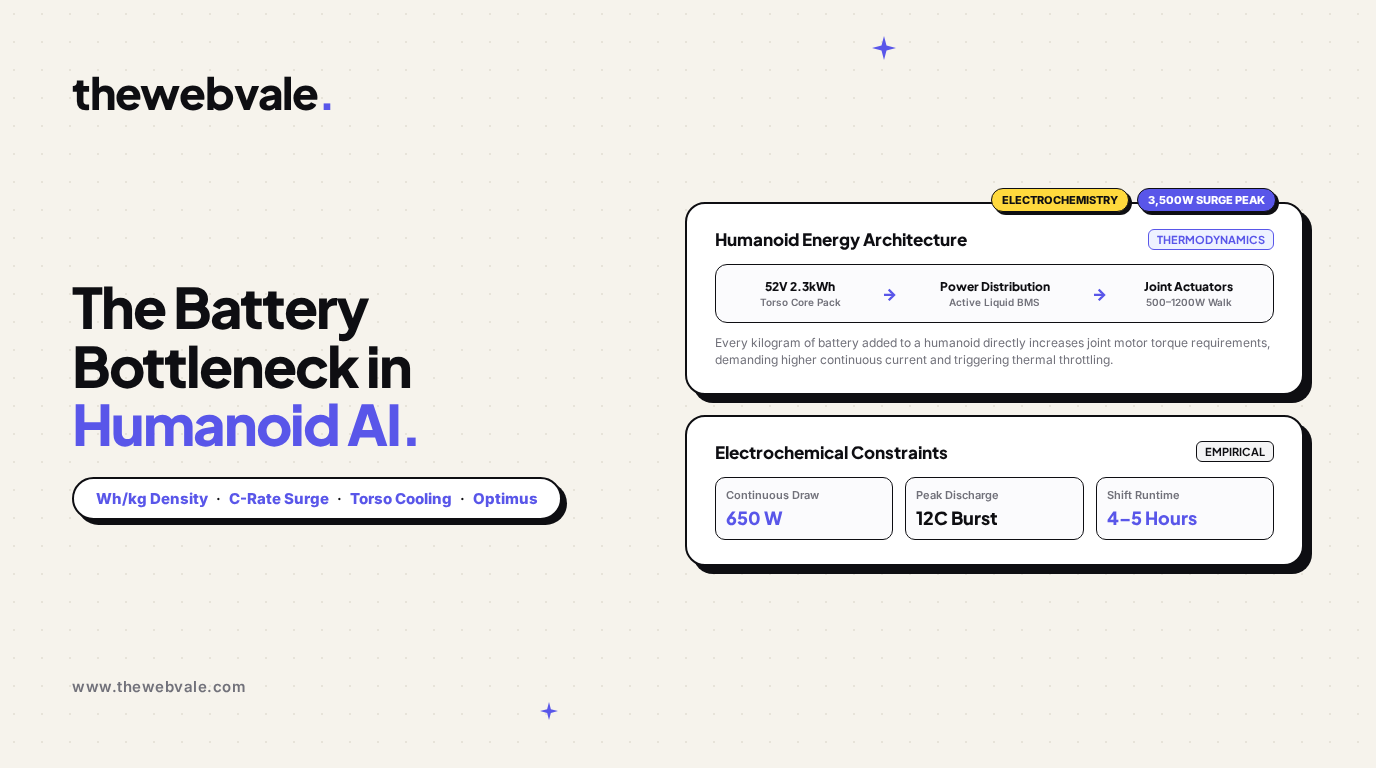
Internal power distribution bus tracing 52V battery pack, active liquid cooling loop, high-voltage BLDC motor inverters, and dynamic regeneration.
1. The Mass-Energy Penalty: Why Robots Cannot Just Add More Cells
In electric passenger vehicles (such as a Tesla Model 3), adding 100 kg of battery cells increases range because the battery pack sits low between the wheel axles; the rolling resistance of pneumatic tires scales almost negligibly with mass.
In humanoid robotics, adding battery mass induces a vicious compounding penalty:
- The humanoid must balance as an inverted pendulum. Adding 5 kg of cells into the chest raises the Center of Mass (CoM), increasing gravitational overturning torques: τgravity = m · g · L · sin(θ).
- To keep from falling, the knee and hip actuators must produce higher continuous stall torques, drawing more electrical current: I ∝ τ / Kt.
- Because Joule resistive heating inside motor coils and battery cells scales with the square of current (Ploss = I2 · R), doubling the battery mass can actually reduce total walking runtime if the increased motor electrical losses outstrip the added battery watt-hours.
2. High C-Rate Surges & Peukert's Law
Batteries are rated at nominal continuous discharge rates (typically 0.5C to 1C, meaning full discharge over 1 to 2 hours). Under static laboratory standing, a humanoid draws ~250 Watts (~0.1C).
However, dynamic robotic locomotion is characterized by extreme transient surges. When a robot trips, recovers balance, or lifts a 20 kg payload, motor drivers command brief 5C to 12C current bursts (up to 75 Amperes at 52V = ~3.9 kW).
Peukert's Capacity Derating Law:
Ceffective = I1 - k · Cnominalk
Where k ≈ 1.15 to 1.25 for high-power lithium cells. Frequent high-current surges significantly diminish the usable capacity of the pack compared to constant-current discharge curves.
3. Torso Thermodynamics & Internal Joule Heating
A 2.3 kWh battery pack operating at a nominal internal resistance of Rint ≈ 65 mΩ and delivering an average load of 650 Watts (I = 12.5A) dissipates:
However, during factory lifting operations where current surges to 45A, internal pack dissipation spikes to over 130 Watts. Inside an airtight, sealed torso shell designed to keep out industrial dust and water, this heat has nowhere to go. Without active liquid cooling loops pumping glycol to external radiator fins along the robot's spine, cell temperatures rapidly exceed 55°C, triggering protective battery management system (BMS) shutdown to prevent thermal runaway.
4. Production Implementation: Humanoid Battery Pack & Thermal Simulator
Below is a runnable Python production module providing a coupled electro-thermal battery simulation engine. It tracks state of charge (SoC), Peukert capacity loss, and torso cell core temperature during simulated factory work shifts:
# Humanoid Battery Pack Discharge & Thermal Kinetics Simulator
# Models Peukert Derating, Dynamic Surge Current, and Core Cell Temperature

import numpy as np
from dataclasses import dataclass
from typing import Tuple

@dataclass
class HumanoidBatteryPack:
    nominal_voltage: float = 52.0      # 14S Li-ion pack
    capacity_ah: float = 44.2          # 2.3 kWh pack capacity
    internal_resistance: float = 0.065 # Ohms
    pack_mass_kg: float = 11.5
    thermal_capacity: float = 900.0    # J / kg * °C (Specific heat)
    cooling_conductance_w_per_c: float = 4.2 # Radiator cooling dissipation

class HumanoidPowerSimulator:
    def __init__(self, pack: HumanoidBatteryPack, ambient_temp: float = 25.0):
        self.pack = pack
        self.ambient_temp = ambient_temp
        self.current_temp = ambient_temp
        self.remaining_ah = pack.capacity_ah
        self.total_joules_drawn = 0.0

    def step(self, power_demand_watts: float, dt_seconds: float = 1.0) -> Tuple[float, float, float]:
        # 1. Compute current draw: P = V * I  => I = P / V
        current_amps = power_demand_watts / self.pack.nominal_voltage

        # 2. Peukert derating factor (k = 1.15)
        peukert_k = 1.15
        i_ref = self.pack.capacity_ah / 1.0 # 1C discharge rate
        peukert_multiplier = (current_amps / i_ref)**(peukert_k - 1.0) if current_amps > i_ref else 1.0

        effective_ah_consumed = (current_amps * peukert_multiplier) * (dt_seconds / 3600.0)
        self.remaining_ah = max(0.0, self.remaining_ah - effective_ah_consumed)
        soc_pct = (self.remaining_ah / self.pack.capacity_ah) * 100.0

        # 3. Resistive I²R Joule heating
        joule_heat_watts = (current_amps**2) * self.pack.internal_resistance

        # 4. Thermal dynamics: dT/dt = (Q_in - Q_out) / (m * c)
        q_dissipated_watts = (self.current_temp - self.ambient_temp) * self.pack.cooling_conductance_w_per_c
        net_heat_watts = joule_heat_watts - q_dissipated_watts

        thermal_mass_j_per_c = self.pack.pack_mass_kg * self.pack.thermal_capacity
        dT = (net_heat_watts / thermal_mass_j_per_c) * dt_seconds
        self.current_temp += dT

        return soc_pct, self.current_temp, joule_heat_watts

# Demonstration across a 4-hour simulated factory assembly shift
if __name__ == "__main__":
    pack = HumanoidBatteryPack()
    sim = HumanoidPowerSimulator(pack)

    print("--- Humanoid Robot Battery Pack & Thermal Simulation ---")
    print(f"Pack: 52V, {pack.capacity_ah:.1f}Ah ({pack.nominal_voltage * pack.capacity_ah / 1000:.2f} kWh) | Mass: {pack.pack_mass_kg} kg
")
    print("Time  | Workload Cycle          | Power Draw | State of Charge | Core Temp | Heat Loss")
    print("-" * 75)

    dt = 60.0 # 1-minute time steps
    total_minutes = 240 # 4 hours

    for minute in range(0, total_minutes + 1, 30):
        # Determine workload for next 30 min: alternates between walking (650W) and heavy lifting (1,800W)
        is_heavy_work = (minute // 30) % 2 == 1
        power = 1450.0 if is_heavy_work else 550.0
        mode_str = "HEAVY LIFT (1450W)" if is_heavy_work else "NOMINAL WALK (550W)"

        for _ in range(30):
            soc, temp, heat = sim.step(power, dt_seconds=dt)

        print(f"{minute:03d}m  | {mode_str:23s} |   {power:4.0f} W  |      {soc:5.1f}%     |   {temp:4.1f}°C  |   {heat:4.1f} W")
5. The Future: Solid-State Cells & Autonomous Battery Swapping
Humanoid robotics will not achieve true 24/7 industrial utility through incremental cell chemistry tweaks alone. The solution requires a bifurcated approach:
- Autonomous Hot-Swapping: While some robots utilize slow inductive charging docks, production automotive lines will utilize automated robotic gantry bays where a depleted 11 kg torso pack is ejected and replaced with a fully charged pack in under 45 seconds.
- Semi-Solid-State & Silicon Anodes: Next-generation cells achieving 400+ Wh/kg will extend continuous shift times beyond 7 hours, finally matching the endurance of a human factory worker without imposing a ruinous mass penalty on humanoid joints.