
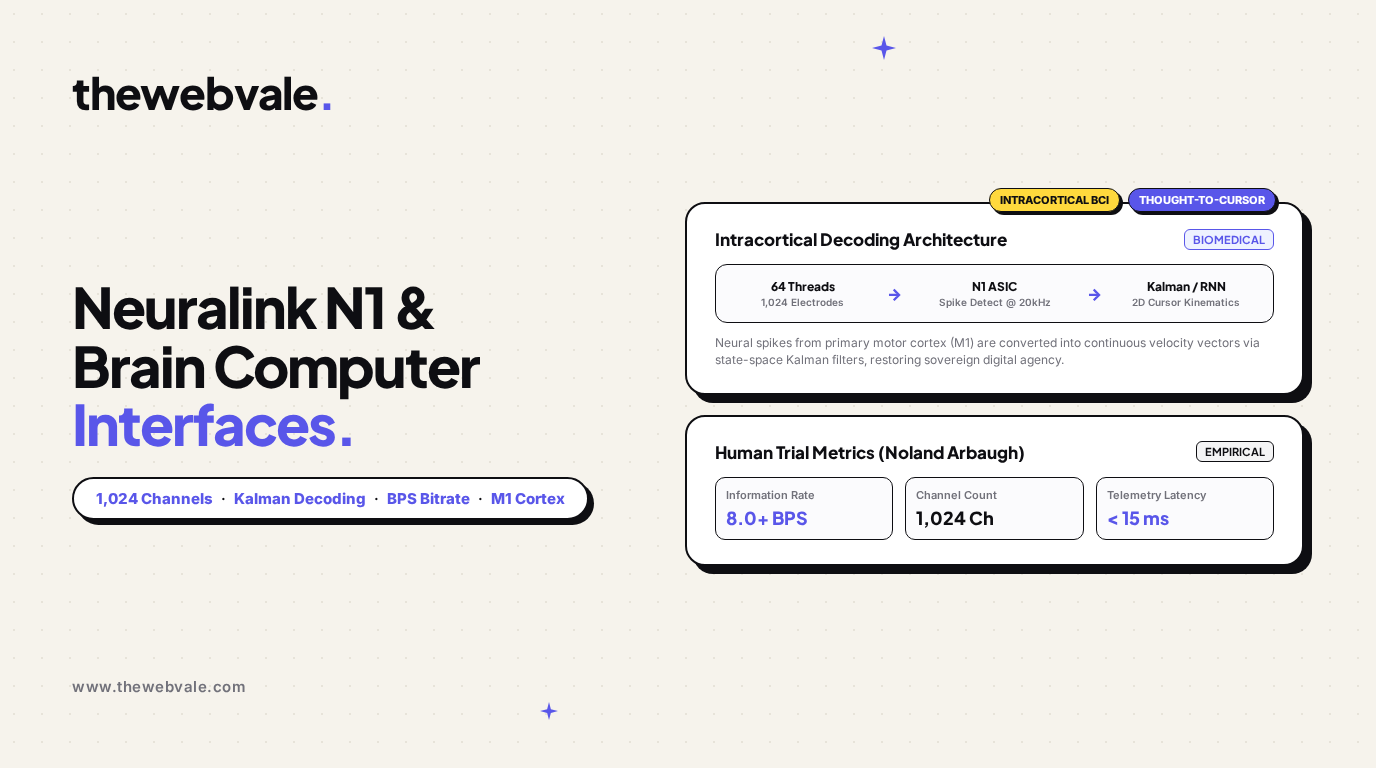
Brain-Computer Interfaces (BCI): Neuralink N1 Human Trials & Thought-to-Cursor Decoding
In January 2024, a quadriplegic patient named Noland Arbaugh made medical history: paralyzed from the shoulders down following a diving accident, he played online chess and Civilization VI entirely with his mind. This milestone was achieved through the Neuralink N1 Telepathy implant—marking the transition of intracortical Brain-Computer Interfaces (BCIs) from heavily wired, sterile academic laboratories into sovereign, untethered human reality.
Bridging biological wetware with digital silicon is among the most formidable interdisciplinary engineering challenges in modern science. The human brain contains approximately 86 billion neurons communicating through microvolt-scale ionic action potentials across fluid, pulsatile cortical tissue. In this technical deep dive, we deconstruct the micro-electrode thread architecture of the N1 implant, analyze spike-sorting signal processing mathematics, and examine the recursive Kalman decoders that transform neural intent into sub-millimeter cursor trajectories.
System Architecture: Intracortical Neural Signal Processing & Decoding Flow
Complete data acquisition chain from motor cortex micro-threads to analog ASIC filtering, spike detection, wireless BLE transmission, and kinematic decoding.
1. The Mechanical & Surgical Paradigm: Flexible Polyimide vs. Silicon Shank Arrays
Prior to Neuralink, the predominant clinical standard for human intracortical recording was the Utah Array (manufactured by Blackrock Neurotech). The Utah Array consists of a rigid 4x4 mm silicon block with 96 sharp silicon needles. While historically groundbreaking, rigid arrays suffer from a devastating biomedical flaw:
The human brain is a viscoelastic jelly suspended in cerebrospinal fluid, pulsating continuously by 1–3 mm with each heartbeat and respiration cycle. Rigid silicon needles act as micro-swords against moving cortical tissue, inducing chronic shear strain. Over 6–12 months, this mechanical irritation activates microglia and astrocytes, encapsulating the electrodes in a dense, non-conductive glial scar that increases electrical impedance and permanently attenuates action potential recordings.
Neuralink resolved this by engineering micron-scale flexible polymer threads:
- Each thread is 4 to 6 microns thick (thinner than a human red blood cell) fabricated from biocompatible polyimide with thin-film platinum-iridium electrodes.
- Because flexible threads have zero column stiffness, they cannot be pushed into the brain manually. Neuralink built the R1 Surgical Robot, which uses a 40-micron tungsten-rhenium needle to individually grasp and insert each thread into cortical layers II/III and V at 30 insertions per minute, using optical coherence tomography (OCT) to dynamically steer clear of micro-blood vessels to prevent hemorrhage.
2. Electrophysiological Signal Processing: Spike Detection Mathematics
Each of the 1,024 channels records raw extracellular electrical potential sampled at 20 kHz with 10-bit ADC resolution. Transmitting 1,024 channels × 20,000 samples/sec × 10 bits = 204.8 Mbps over wireless Bluetooth would exhaust the miniature battery in under 15 minutes.
Therefore, the N1 ASIC executes on-chip hardware feature extraction. The signal is passed through a 250 Hz – 5 kHz analog bandpass filter. Rather than sorting individual single-unit action potential waveforms, the chip detects Threshold Crossings (TC):
Spike Threshold Calculation:
Vthreshold = -κ · σRMS = -κ · [ median(|V(t)|) / 0.6745 ]
Where κ is typically configured between 4.0 and 4.5. The median-based standard deviation estimator σRMS provides robust noise estimation immune to high-frequency action potential outliers. Whenever the negative voltage peak crosses Vthreshold, an event packet (channel ID and timestamp) is logged, compressing wireless telemetry bandwidth by over 99% to under 200 kbps.
3. Decoding Intent: The State-Space Kalman Velocity Decoder
To translate population spike counts into smooth 2D computer cursor movement on a screen, the host device executes a Recursive State-Space Kalman Filter running at 50 Hz to 100 Hz.
The system models cursor kinematics and neural firing rates through coupled linear stochastic differential equations:
Kinematic State Evolution (Prior):
xt = A · xt-1 + wt, wt ∼ N(0, W)
Neural Observation Model (Likelihood):
zt = C · xt + vt, vt ∼ N(0, V)
Where xt = [px, py, vx, vy, 1]T represents the 2D position and velocity state vector, and zt ∈ R1024 is the vector of spike counts observed across all channels in the preceding 20 ms bin.
The Kalman filter executes recursive two-stage updates:
- Time Update (Predict): x̂t|t-1 = A · x̂t-1|t-1; Pt|t-1 = A · Pt-1|t-1 · AT + W.
- Measurement Update (Correct): Kt = Pt|t-1 · CT · [ C · Pt|t-1 · CT + V ]-1; x̂t|t = x̂t|t-1 + Kt · [ zt - C · x̂t|t-1 ].
4. Production Implementation: Real-Time Kalman Neural Velocity Decoder
Below is a runnable Python production module providing an online state-space Kalman filter decoder that ingests simulated cortical spike trains and outputs continuous 2D cursor control:
# Real-Time State-Space Kalman Filter for Intracortical BCI Cursor Control
# Simulates Population Spike Train Ingestion and Kinematic Trajectory Decoding

import numpy as np
from typing import Tuple

class KalmanBCIDecoder:
    def __init__(self, num_channels: int = 64, dt: float = 0.02):
        self.num_channels = num_channels
        self.dt = dt

        # State vector: [pos_x, pos_y, vel_x, vel_y, 1.0 (bias)]
        self.state_dim = 5
        self.x_hat = np.array([0.0, 0.0, 0.0, 0.0, 1.0])
        self.P = np.eye(self.state_dim) * 0.1

        # Kinematic state transition matrix A (assuming damped velocity continuity)
        damping = 0.92
        self.A = np.array([
            [1.0, 0.0, dt,  0.0, 0.0],
            [0.0, 1.0, 0.0, dt,  0.0],
            [0.0, 0.0, damping, 0.0, 0.0],
            [0.0, 0.0, 0.0, damping, 0.0],
            [0.0, 0.0, 0.0, 0.0, 1.0]
        ])
        # State process covariance W
        self.W = np.diag([1e-4, 1e-4, 1e-2, 1e-2, 0.0])

        # Randomly initialize neural tuning model C (channels x state_dim)
        # In production, C is fit via Ridge regression on training trajectories
        np.random.seed(42)
        self.C = np.random.randn(num_channels, self.state_dim) * 0.5
        self.C[:, 4] = np.random.uniform(5.0, 20.0, size=num_channels) # Baseline firing rates

        # Observation noise covariance V
        self.V = np.eye(num_channels) * 4.0

    def decode_step(self, spike_counts: np.ndarray) -> Tuple[np.ndarray, np.ndarray]:
        # 1. Prediction step
        x_pred = self.A @ self.x_hat
        P_pred = self.A @ self.P @ self.A.T + self.W

        # 2. Measurement update
        y_residual = spike_counts - (self.C @ x_pred)
        S = self.C @ P_pred @ self.C.T + self.V
        K_gain = P_pred @ self.C.T @ np.linalg.inv(S)

        self.x_hat = x_pred + K_gain @ y_residual
        self.P = (np.eye(self.state_dim) - K_gain @ self.C) @ P_pred

        pos = self.x_hat[:2]
        vel = self.x_hat[2:4]
        return pos, vel

# Demonstration of BCI cursor control simulation
if __name__ == "__main__":
    decoder = KalmanBCIDecoder(num_channels=64, dt=0.02)

    print("--- Neuralink N1 Telepathy Kalman Decoder Emulation ---")
    print(f"Tracking 64 Neural Channels @ 50 Hz Update Cycle (dt=20ms)
")

    # Simulate user intending to move cursor diagonally toward (+1.0m, +1.0m)
    intended_velocity = np.array([0.5, 0.5]) # m/s

    for step in range(25):
        # Generate synthetic Poisson spike counts conditioned on intended velocity
        true_kinematics = np.array([0.0, 0.0, intended_velocity[0], intended_velocity[1], 1.0])
        expected_spikes = np.maximum(0.1, decoder.C @ true_kinematics * decoder.dt)
        observed_spikes = np.random.poisson(expected_spikes)

        pos, vel = decoder.decode_step(observed_spikes)

        if step % 5 == 0 or step == 24:
            print(f"Step {step:02d} (t={step*0.02:0.2f}s) | Decoded Pos: [{pos[0]:+0.3f}, {pos[1]:+0.3f}] m | Vel: [{vel[0]:+0.3f}, {vel[1]:+0.3f}] m/s")
5. Summary & The Neurotechnological Horizon
The clinical validation of the Neuralink N1 Telepathy trial proves that direct digital brain interfacing is no longer theoretical science fiction. By pairing sub-micron robotic insertion of flexible polymer threads with hermetic analog ASICs and recursive Kalman state decoders, paralyzed individuals have reclaimed autonomous digital communication. As channel densities expand from thousands to tens of thousands of electrodes, BCIs will progress from basic 2D cursor control toward fluid multi-articulated prosthetic manipulation, sensory write-back restoration, and direct cortical synthesis.