
Startup Playbooks & Micro-SaaSSun Oct 18 2026Yash Jain● Peer Reviewed Technical Guide
Building Micro-SaaS with AI: Finding Micro-Niches and Validating Demand Before Writing Code
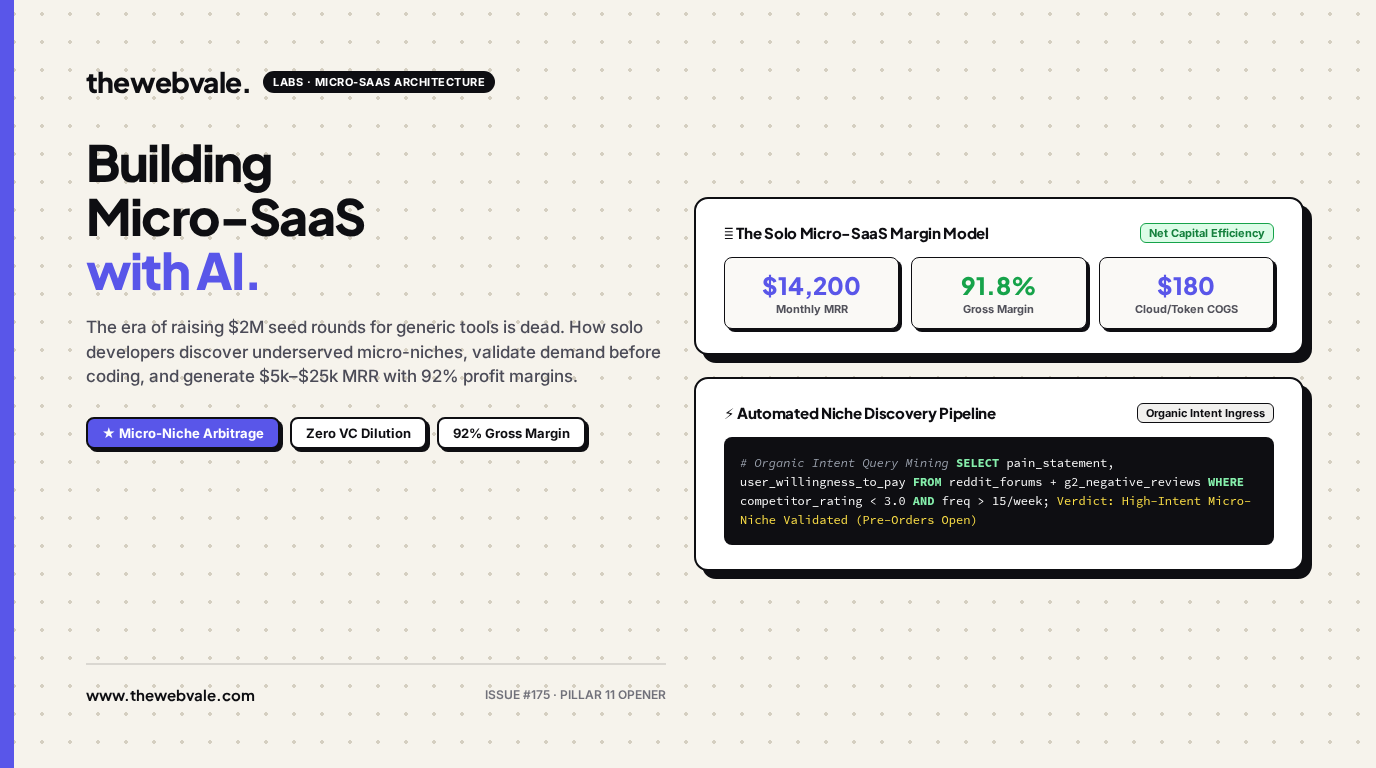
## Executive Summary: The Post-Venture Micro-SaaS Renaissance
For the past fifteen years, the prevailing startup playbook dictated that building software required venture capital. Founders were urged to incorporate Delaware C-Corps, pitch angel investors for pre-seed capital, hire 5-to-10 engineers, and burn $40,000 to $80,000 monthly in pursuit of massive, horizontal total addressable markets (TAMs) such as "AI Project Management" or "AI Customer CRM."
In 2026, this venture-backed model has become economically treacherous for all but frontier foundation model labs. Massive horizontal markets are savagely contested by Big Tech incumbents (Microsoft Copilot, Google Workspace, Salesforce Agentforce).
Simultaneously, the collapse of software synthesis costs enables a far more lucrative and sovereign archetype: **The AI Micro-SaaS Business**:
1. **Targeting Micro-Niches**: Focusing on narrow, unsexy enterprise workflows (e.g., automated state real-estate disclosure compliance, niche Shopify B2B PDF invoice formatters, local trucking dispatch parsers) that are too small for venture capital to care about ($2M–$10M TAM).
2. **Zero Venture Dilution**: Built and operated by a single sovereign engineer utilizing AI code synthesis harnesses.
3. **Hyper-High Net Profit Margins**: Generating $8,000 to $30,000 in monthly recurring revenue (MRR) with 88% to 94% net profit margins and virtually zero cloud infrastructure overhead.
This architectural and commercial guide breaks down the mathematical unit economics, niche validation discovery pipelines, and a production Python script to mine organic customer complaints across developer and business forums.
---
## 1. Mathematical Physics of Micro-SaaS Unit Economics
In traditional enterprise SaaS, customer acquisition cost (CAC) and customer lifetime value (LTV) were burdened by sales representative commissions, customer success teams, and expensive office leases:
$$\text{Net Profit}_{\text{VC}} = (N \times \text{ARPU}) - \left( \text{CAC}_{\text{outbound}} + \text{Payroll}_{\text{team}} + \text{Infra}_{\text{fixed}} + \text{Token}_{\text{COGS}} \right) < 0$$
In an AI-augmented solo Micro-SaaS architecture, payroll is zero, infrastructure is serverless edge-computed, and acquisition is organic intent-driven:
$$\text{Net Profit}_{\text{Micro-SaaS}} = N \times \text{ARPU} - \left( \text{Token}_{\text{COGS}} + \text{Serverless}_{\text{infra}} \right)$$
### Empirical Unit Economics:
Consider a solo Micro-SaaS serving 320 niche logistics brokers at $49/month:
- **Gross Monthly Revenue**: $320 \times \$49 = \mathbf{\$15,680\text{ MRR}}$ ($188,160 ARR).
- **Anthropic Claude 3.5 Sonnet / OpenAI Batch Inference (Cached)**: $140/month.
- **MongoDB Atlas Serverless + Vercel Pro Hosting + Domain**: $42/month.
- **Stripe Processing Fees (2.9% + $0.30)**: $550/month.
- **Total Operating Expenses**: **$732/month**.
- **Net Pre-Tax Profit**: **$14,948/month (95.3% Net Margin)**.
A solo developer capturing 300 paying niche subscribers generates more net personal cash flow than a venture-backed founder with $5M in funding and a $50k monthly burn rate.
---
## 2. The 3-Stage Micro-Niche Discovery Protocol
Do not brainstorm software ideas in isolation. High-margin Micro-SaaS opportunities are discovered by listening for customer frustration in existing business software ecosystems:
```
+-------------------------------------------------------------------------------+
| THE NICHE DISCOVERY PIPELINE |
+-------------------------------------------------------------------------------+
| |
| [ 1. G2 / CAPTERRA 1-STAR REVIEWS ] |
| * Filter reviews of massive legacy software (e.g., Salesforce, QuickBooks) |
| * Search for: "I hate that this doesn't export to...", "Manual double-entry" |
| |
| │ Organic Intent Mining |
| ▼ |
| |
| [ 2. REDDIT / INDUSTRY FORUM SCRAPING ] |
| * Subreddits: r/freightbrokers, r/realtors, r/shopify, r/accounting |
| * Search queries: "Is there a tool that...", "How do you guys automate..." |
| |
| │ Problem Extraction |
| ▼ |
| |
| [ 3. PRE-CODE SMOKE TEST VALIDATION ] |
| * Launch 1-page landing page with Loom demo. |
| * Require $29 refundable pre-order or verified work email waitlist. |
| * If 15 people pay before the code exists -> PROCEED TO BUILD. |
| |
+-------------------------------------------------------------------------------+
```
---
## 3. Comparative Matrix: Venture-Backed SaaS vs. Sovereign Micro-SaaS
The following table contrasts the operational reality between the two founding pathways:
| Operating Dimension | Venture-Backed SaaS (Series A) | Sovereign AI Micro-SaaS |
|---|---|---|
| **Capital Required** | $1,500,000 – $4,000,000 | $200 (Domain + Compute) |
| **Team Size** | 8 – 15 Employees | 1 Sovereign Developer |
| **Time to Breakeven** | 3 – 5 Years (If ever) | 14 Days |
| **Pricing Model** | $10k – $50k Enterprise (High friction) | $29 – $149/mo Self-Serve Credit Card |
| **Founder Dilution** | 60% – 85% by Series B | **0% (100% Founder Owned)** |
| **Freedom & Autonomy** | Board meetings, pitch decks, investor calls | Total location & architectural sovereignty |
---
## 4. Production Implementation: Automated Niche Pain-Point Scraper
The following Python production script demonstrates an automated sentiment and complaint miner that searches community text feeds, filters out generic noise, and identifies recurring enterprise software pain points:
```python
# -*- coding: utf-8 -*-
"""
TheWebVale Sovereign Niche Scout — Automated Software Pain Point Discovery
Scans unstructured text for high-intent commercial frustration and willingness-to-pay
"""
import re
from typing import List, Dict, Any
from dataclasses import dataclass
@dataclass
class CommunityPost:
platform: str
subreddit_or_source: str
author: str
body_text: str
class NichePainMiner:
# High intent buying triggers
INTENT_TRIGGERS = [
re.compile(r'(?i)is there (any|a) tool that'),
re.compile(r'(?i)i would pay (good money|\$\d+) for'),
re.compile(r'(?i)tired of manually (exporting|copying|entering)'),
re.compile(r'(?i)does anyone know an alternative to'),
re.compile(r'(?i)wasting (\d+|hours) every (day|week) on')
]
@classmethod
def evaluate_post(cls, post: CommunityPost) -> Dict[str, Any]:
"""Determines if a community discussion represents a viable Micro-SaaS opportunity."""
matched_intents = []
for trigger in cls.INTENT_TRIGGERS:
if trigger.search(post.body_text):
matched_intents.append(trigger.pattern)
has_commercial_intent = len(matched_intents) > 0
score = len(matched_intents) * 35
return {
"source": f"{post.platform} [{post.subreddit_or_source}]",
"is_commercial_lead": has_commercial_intent,
"opportunity_score": min(score, 100),
"matched_patterns": matched_intents,
"summary_snippet": post.body_text[:120] + "..."
}
if __name__ == "__main__":
sample_posts = [
CommunityPost(
platform="Reddit",
subreddit_or_source="r/freightbrokers",
author="LogisticsOps88",
body_text="I am tired of manually copying rate confirmations from PDF emails into our legacy TMS. Wasting 3 hours every day on data entry! I would pay $200/mo for a tool that just parsed this to CSV automatically."
),
CommunityPost(
platform="Reddit",
subreddit_or_source="r/webdev",
author="DevGuy42",
body_text="Hey guys, look at this cool CSS animation I made for buttons."
)
]
print("==================================================")
print(" TheWebVale Micro-SaaS Organic Intent Scout ")
print("==================================================")
for p in sample_posts:
res = NichePainMiner.evaluate_post(p)
print(f"Source: {res['source']}")
print(f"Lead: {res['is_commercial_lead']} (Score: {res['opportunity_score']}/100)")
print(f"Snippet: {res['summary_snippet']}
")
print("==================================================")
```
---
## 5. Strategic Execution Invariants for Solo Builders
1. **Charge from Day One**: Never offer a free tier. If your software does not save a business owner at least 5x what you charge per month, you built the wrong tool. A free tier attracts high-support, zero-revenue churn.
2. **Build for Businesses, Not Consumers**: B2B buyers expense $49/month without a second thought if it saves their secretary 2 hours. Consumers cancel $4.99/month subscriptions if they miss a single workout.
3. **Keep the Codebase Under 5,000 Lines**: The beauty of Micro-SaaS is simplicity. Avoid over-engineering microservices or complex event buses. A single clean Next.js 15 App Router codebase with MongoDB Atlas and Tailwind v4 is all you need to reach $20,000 MRR.