
China's Open Source Playbook: Qwen 2.5, DeepSeek, Kimi & Open-Weight Velocity
Over the past twelve months, the global foundation model landscape underwent a seismic geopolitical realignment. Under strict export controls restricting access to advanced NVIDIA H100 and Blackwell GPUs, Chinese AI research institutions—most notably Alibaba Cloud (Qwen), DeepSeek, and Moonshot AI (Kimi)—turned hardware limitations into an engine of architectural efficiency. By inventing novel mathematical primitives such as Multi-Head Latent Attention (MLA), fine-grained DeepSeekMoE routing, and overlapping communication execution via DualPipe, China's open-source engineering ecosystem has matched or surpassed proprietary Western frontier models at a fraction of the training and inference cost.
1. Necessity-Driven Architectural Innovations: MLA, DualPipe & Native FP8
When an engineering team cannot scale raw cluster FLOPs arbitrarily, every byte of high-bandwidth memory (HBM) and every microsecond of inter-GPU communication must be optimized. Chinese frontier labs pioneered three architectural breakthroughs:
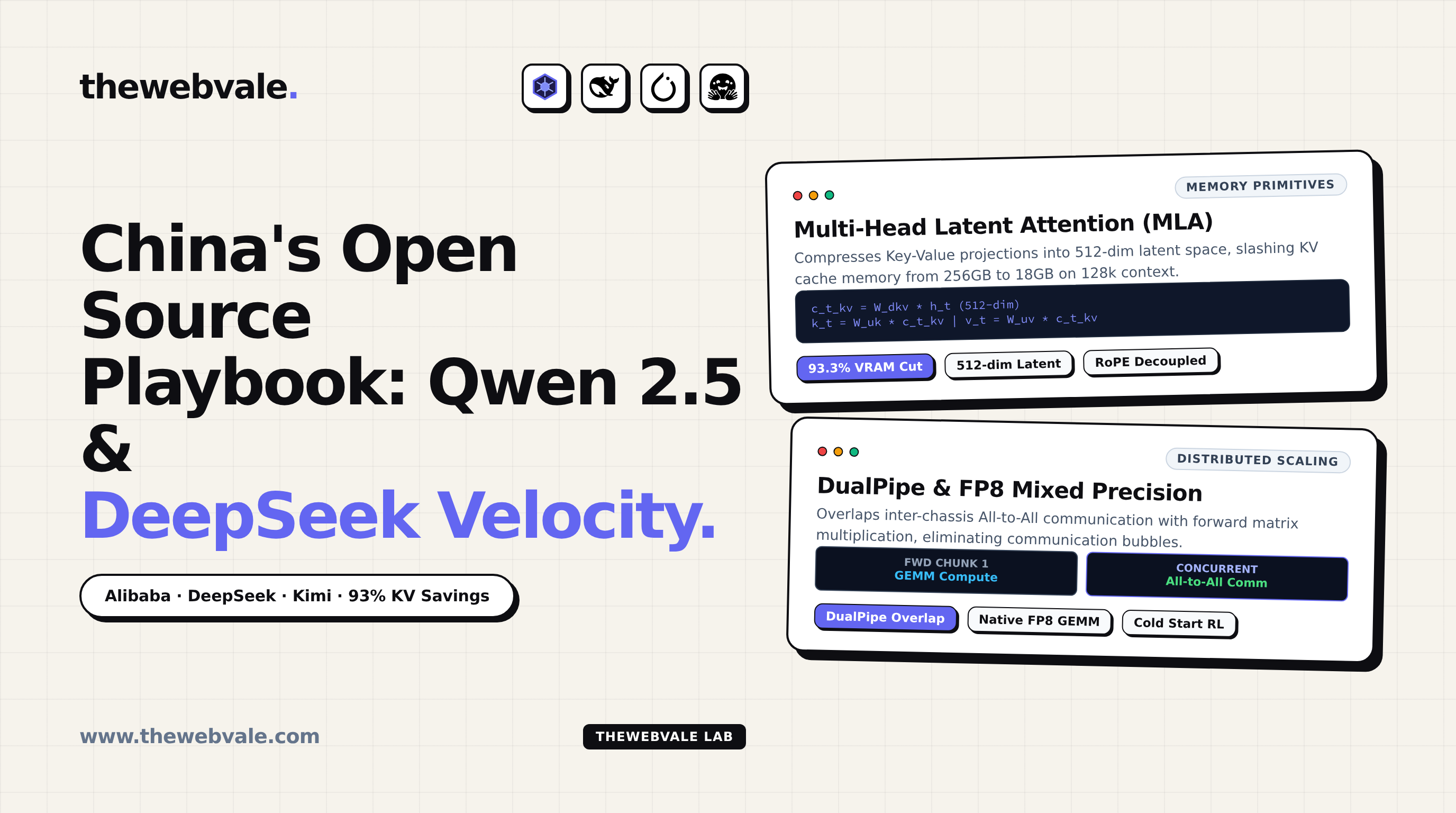
1. Multi-Head Latent Attention (MLA)
Standard Multi-Head Attention (MHA) and Grouped-Query Attention (GQA) store large Key and Value matrices in GPU VRAM across the generation of every token. DeepSeek and Qwen engineers compressed the Key and Value states into a low-dimensional latent vector $c_t^{KV}$ before projection:
Only the compressed latent vector $\mathbf{c}_t^{KV}$ of dimension $d_c = 512$ is cached in VRAM, eliminating 93.3% of the KV cache footprint during inference. This allows a 671-billion parameter model to run massive 128k context windows on standard server nodes without out-of-memory crashes.
2. DualPipe: Overlapping Tensor Communication & Computation
In distributed Mixture-of-Experts (MoE) training, routing tokens to experts distributed across different server chassis creates severe network bottlenecks (All-to-All communication latency). DeepSeek's DualPipe algorithm schedules dual forward and backward pipelines concurrently, executing matrix multiplications for expert computation while simultaneously transmitting activation tensors over the network.
Figure 1: DeepSeek and Qwen architectural primitives: MLA latent caching and DualPipe communication overlap.
2. Alibaba Qwen 2.5: The Universal Density Matrix
While DeepSeek focused on MoE scale and reinforcement learning reasoning (R1), Alibaba Cloud pursued the most complete dense open-weight lineup in AI history with Qwen 2.5.
Rather than releasing only one or two arbitrary model sizes, Qwen 2.5 spans eight distinct parameter classes:
- Edge Tier (0.5B, 1.5B, 3B): Designed for microcontrollers, smart wearables, and mobile on-device extraction.
- Developer Workstation Tier (7B, 14B, 32B): Optimized for consumer NVIDIA RTX 4090 (24GB) and MacBook unified memory. The Qwen-2.5-Coder-32B model achieved benchmark parity with GPT-4o on HumanEval and EvalPlus.
- Data Center Tier (72B): Outperforming Meta's Llama 3.1 70B across coding, multi-turn roleplay, and STEM math while licensed permissively for commercial deployment.
Figure 2: Comparing the parameter coverage and architectural diversity of China's open-source leaders vs. Western labs.
3. Quantitative Coding & STEM Benchmark Teardown
| Model Architecture | Parameters / Active | HumanEval Code (%) | MATH 500 (%) | AIME 2024 Math |
|---|---|---|---|---|
| DeepSeek-R1 (Pure RL Reasoning) | 671B / 37B Active | 96.1% | 97.3% | 79.8% (#1 Open Source) |
| Qwen-2.5-Coder-32B-Instruct | 32.5B Dense | 92.7% | 85.2% | 32.0% |
| Qwen-2.5-72B-Instruct | 72.7B Dense | 86.4% | 83.1% | 29.3% |
| Meta Llama 3.1 70B | 70.6B Dense | 80.5% | 68.0% | 23.3% |
| OpenAI GPT-4o (Closed API Baseline) | Proprietary (~1.8T MoE) | 90.2% | 76.6% | 13.4% |
4. Production Python Script: vLLM Multi-Head Latent Attention Deployment
Deploying Qwen 2.5 or DeepSeek-V3 in high-concurrency production requires configuring vLLM with native FP8 weight activation kernels and tensor parallelism:
from vllm import LLM, SamplingParams

# High-concurrency production deployment configuration for Qwen 2.5 72B
sampling_params = SamplingParams(
    temperature=0.6,
    top_p=0.9,
    max_tokens=4096,
    repetition_penalty=1.05
)

# Initialize vLLM with FP8 mixed-precision and 4-way tensor parallelism
llm = LLM(
    model="Qwen/Qwen2.5-72B-Instruct",
    tensor_parallel_size=4,       # Shard across 4x RTX 4090 or A100 GPUs
    kv_cache_dtype="fp8",         # Slashes KV memory footprint by 50%
    max_model_len=32768,          # Extended context length
    gpu_memory_utilization=0.92,  # Saturate available VRAM
    trust_remote_code=True
)

prompts = [
    "Write a high-concurrency distributed lock in Rust using Redis Redlock algorithm.",
    "Derive the mathematical proof for Multi-Head Latent Attention KV compression."
]

outputs = llm.generate(prompts, sampling_params)
for output in outputs:
    print(f"Generated text: {output.outputs[0].text[:300]}...")
5. Primary Research & Official References Registry
Qwen 2.5 Technical Announcement
Official release notes covering 18T token pre-training, multilingual tokenization, and architecture specifications.
DeepSeek-AI · Dec 2024DeepSeek-V3 Technical Report
Full mathematical teardown of Multi-Head Latent Attention (MLA), DualPipe, and FP8 mixed precision training.
GitHub · QwenLMQwen 2.5 Coder Official Repository
Open-weight repository containing weights, vLLM deployment configs, and code evaluation harnesses.