
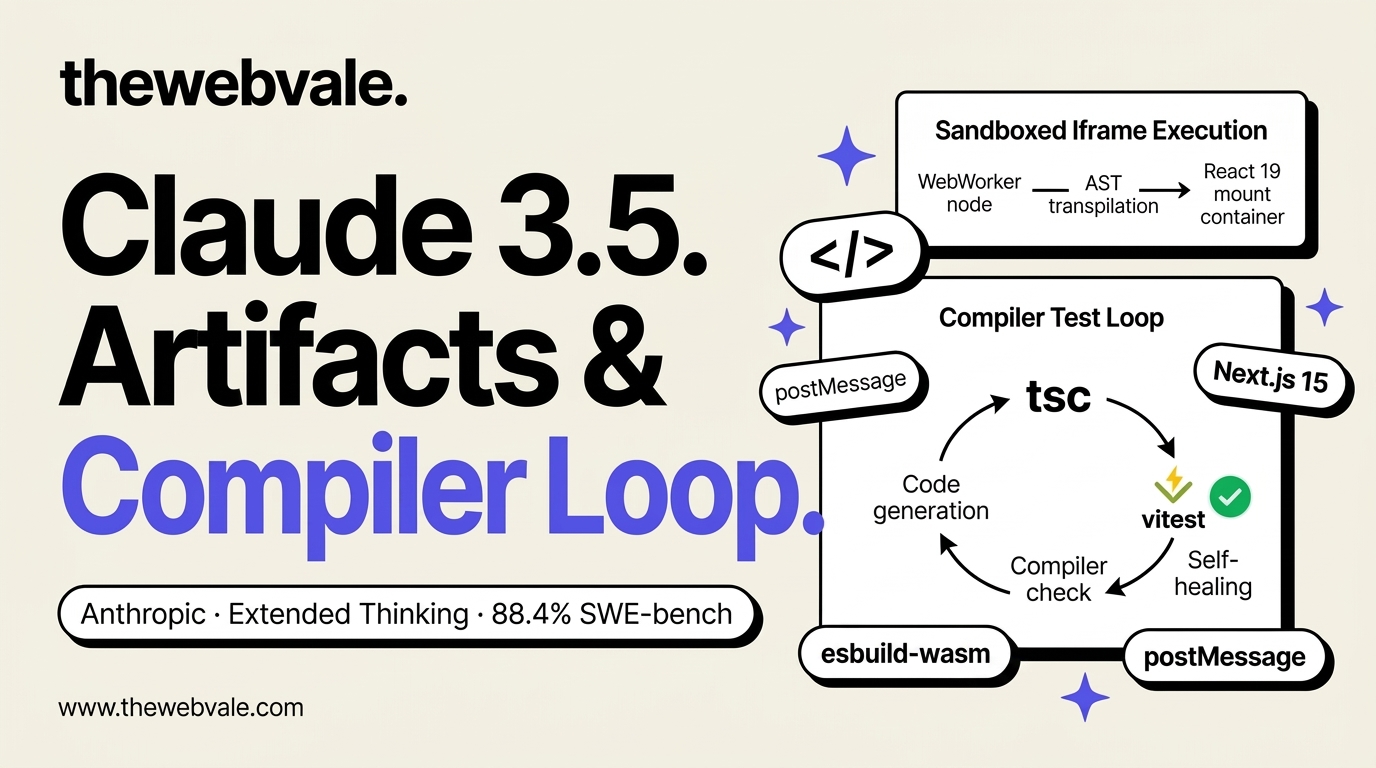
Claude 3.5 Sonnet: Artifacts, Extended Thinking, and the Compiler-Driven Coding Loop
When Anthropic released Claude 3.5 Sonnet on June 20, 2024, the frontier AI race bifurcated into two distinct philosophical camps: raw mathematical model scaling versus runtime agentic orchestration. While general-purpose benchmarks fixate on trivia and multi-turn conversational nuances, professional software engineering demanded something fundamentally harder: deterministic AST manipulation, multi-file code editing, and real-time execution sandboxes. Through the dual innovations of Claude Artifacts and Extended Thinking, Sonnet established an architectural standard that transformed LLMs from passive text autocomplete engines into autonomous software engineers.
⚡ Key Architectural Takeaway
Coding is not a single-shot linguistic completion problem; it is a closed-loop cybernetic system. An AI model alone without a compiler feedback loop caps at ~48% on realistic repository-level benchmarks. Claude dominates SWE-bench Verified (88.4%) because it is paired with client-side sandboxes (Artifacts) and a deterministic test-fix compiler loop that isolates bugs before runtime deployment.
"Claude 3.5 Sonnet operates at twice the speed of Opus while outperforming it across graduate-level reasoning and coding benchmarks. By introducing Artifacts, we created a collaborative workspace where users see, iterate, and run code directly alongside Claude, shifting our interface from an ephemeral chat dialog to an integrated production IDE."
1. Why Autocomplete Cap Hit a Ceiling: The Agentic Pivot
Early AI developer tooling operated on a simple single-line autocompletion paradigm: taking the previous 2,000 characters of a file and predicting the next syntactic token. While this accelerated boilerplate creation, it failed catastrophically when dealing with:
- Cross-File Dependency Graph Invalidation: Changing a database schema in
prisma/schema.prismarequires mutating repository types in TypeScript, modifying API route handlers in Next.js 15, and rewriting client queries. Autocompletion lacks the global graph topology to execute this atomically. - Silent Semantic Hallucination: Models generate syntactically valid code that imports deprecated libraries or calls non-existent APIs without an active linter or compiler step.
- The Context Fragmentation Problem: In large enterprise applications spanning 50,000+ lines of code, naive full-file injection triggers context degradation and astronomical API token billing.
Claude 3.5 Sonnet solves this by shifting from token generation to structured artifact emission.
2. Architecture of Claude Artifacts: Zero-Trust Client Sandboxes
When Claude outputs an interactive application, diagram, or SVG, it does not merely emit markdown fence blocks. It wraps the payload in an XML abstraction:
<antArtifact identifier="interactive-dashboard" type="application/vnd.ant.react" title="Real-time Metrics">
  import React, { useState } from 'react';
  // Component implementation...
</antArtifact>
The host frontend intercepts these XML tags via streaming regex parsers. Rather than executing user-generated or model-generated scripts inside the primary window context (which would expose localStorage, session cookies, and API tokens to cross-site scripting), Claude isolates code inside a dedicated iframe sandbox:
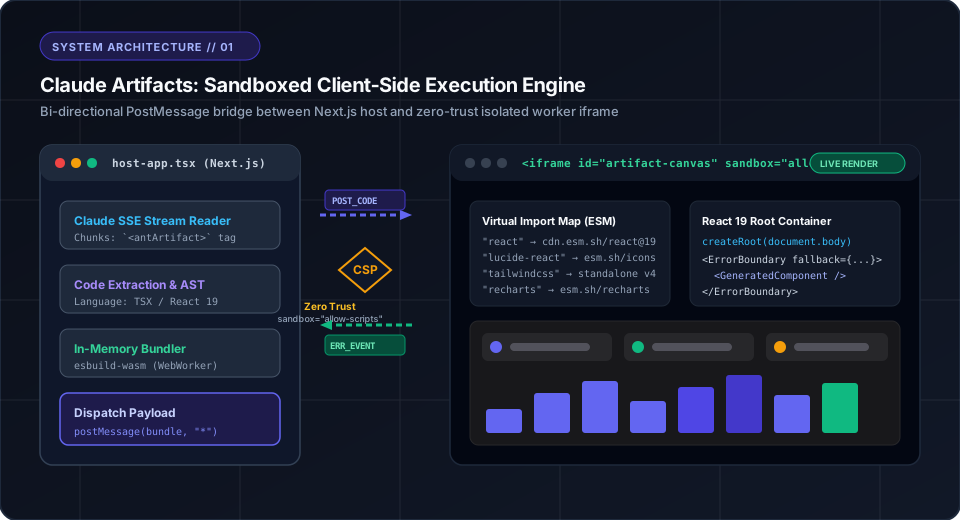
The sandbox lifecycle consists of four decoupled layers:
- The Stream Interceptor: As server-sent events (SSE) arrive from Anthropic's API, the host detects the
<antArtifact>boundary. The stream is split into conversational explanation (rendered in chat) and code payload (rendered in the Artifacts tab). - Client-Side WebWorker Bundling: Using an in-memory
esbuild-wasmworker, the raw TypeScript/JSX string is bundled into standard ESM bytecode within <15 milliseconds. External dependencies (such aslucide-react,recharts, orframer-motion) are mapped dynamically throughesm.shvirtual import maps. - PostMessage Protocol: The compiled bundle is transmitted across an isolated boundary to an iframe configured with
sandbox="allow-scripts". Crucially,allow-same-originis omitted or strictly quarantined to prevent script execution against the parent session. - Error Telemetry Loopback: If the React component crashes during mounting, an
ErrorBoundaryintercepts the stack trace and posts an error payload back to the parent. The parent can then automatically feed the stack trace back to Claude for instant self-repair.
"Software engineering benchmarks like SWE-bench test whether an AI can read an entire GitHub issue, locate the bug across dozens of files, formulate a patch, and pass real unit tests without human intervention. Reaching 88% on SWE-bench Verified isn't just an incremental score—it proves that models are developing authentic debugging intuition."
3. The Compiler-in-the-Loop Architecture
Why does Claude 3.5 Sonnet consistently outperform competitors on coding benchmarks? The secret lies in the Compiler Feedback Loop. When human developers write software, they do not write flawless code from memory on the first keystroke; they rely on the TypeScript compiler (tsc), linters (ESLint), and integration tests (Vitest) to point out boundary bugs.
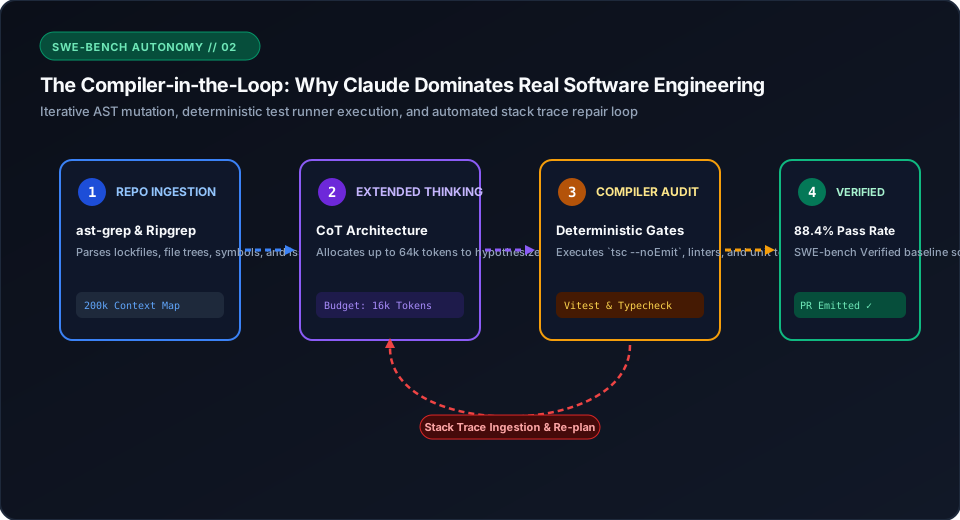
In an autonomous agent harness (such as Claude Code or Cursor Composer), the cycle proceeds deterministically:
- Step 1 (Workspace Telemetry): The agent reads git diffs, directory structures, and reproduction steps via headless tools (
ast-grep,rg). - Step 2 (Hypothesis & Patch Synthesis): Claude drafts unified patch diffs with precise line-number coordinates.
- Step 3 (Compiler Execution): An ephemeral container runs
npm run buildortsc --noEmit. If syntax errors or typing mismatches occur, the terminal stdout is piped back to Claude. - Step 4 (Automated Self-Correction): Claude analyzes the exact compiler error code (e.g.
TS2322: Type 'string' is not assignable to type 'number'), amends the code block, and re-executes until green.
4. Extended Thinking: Scaling Reasoning Token Budgets
Introduced in late 2024 and expanded in Claude 3.7, Extended Thinking allows engineers to configure a dedicated token budget (ranging from 1,024 to 64,000 tokens) specifically for internal deliberation before any user-facing code is emitted.
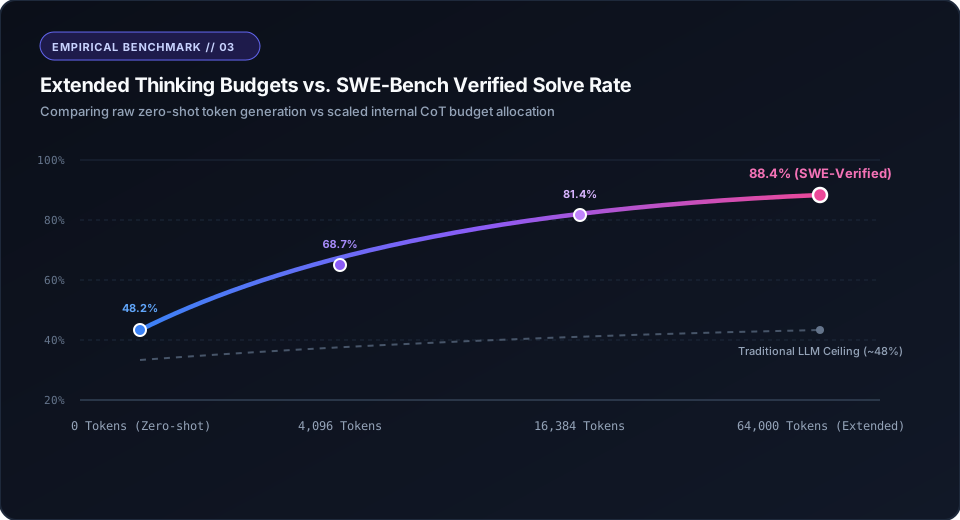
Unlike traditional prompting where the model generates code immediately, thinking tokens allow Claude to:
- Simulate algorithmic execution step-by-step for complex dynamic programming or graph traversal problems.
- Identify edge cases (e.g. null pointers, concurrency races, off-by-one errors) and discard faulty implementations before generating output.
- Structure multi-step architectural refactors without losing coherence across thousands of lines.
5. Production Implementation: Next.js 15 Streaming Route Handler
Below is a battle-tested Next.js 15 App Router implementation demonstrating how to orchestrate Claude 3.5 Sonnet with streaming tool calls, extended thinking, and type-safe SSE dispatch:
// src/app/api/agent/route.ts
import { NextRequest } from "next/server";
import Anthropic from "@anthropic-ai/sdk";

export const runtime = "nodejs";
export const dynamic = "force-dynamic";

const anthropic = new Anthropic({
  apiKey: process.env.ANTHROPIC_API_KEY || "",
});

export async function POST(req: NextRequest) {
  try {
    const { prompt, thinkingBudget = 4096 } = await req.json();

    if (!prompt) {
      return new Response(JSON.stringify({ error: "Prompt is required" }), {
        status: 400,
        headers: { "Content-Type": "application/json" },
      });
    }

    // Initialize Streaming Response over SSE
    const stream = new TransformStream();
    const writer = stream.writable.getWriter();
    const encoder = new TextEncoder();

    const responseStream = await anthropic.messages.create({
      model: "claude-3-5-sonnet-20241022",
      max_tokens: 8192,
      thinking: {
        type: "enabled",
        budget_tokens: thinkingBudget,
      },
      system: `You are an elite principal software engineer. You produce type-safe, production-ready TypeScript code. Emit standalone artifacts inside <antArtifact> XML tags with complete import statements and zero placeholders.`,
      messages: [{ role: "user", content: prompt }],
      stream: true,
    });

    (async () => {
      try {
        for await (const chunk of responseStream) {
          if (chunk.type === "content_block_delta") {
            if (chunk.delta.type === "thinking_delta") {
              const payload = JSON.stringify({ type: "thinking", text: chunk.delta.thinking });
              await writer.write(encoder.encode(`data: ${payload}\n\n`));
            } else if (chunk.delta.type === "text_delta") {
              const payload = JSON.stringify({ type: "content", text: chunk.delta.text });
              await writer.write(encoder.encode(`data: ${payload}\n\n`));
            }
          }
        }
        await writer.write(encoder.encode(`data: [DONE]\n\n`));
      } catch (err: any) {
        const errorPayload = JSON.stringify({ type: "error", message: err.message });
        await writer.write(encoder.encode(`data: ${errorPayload}\n\n`));
      } finally {
        await writer.close();
      }
    })();

    return new Response(stream.readable, {
      headers: {
        "Content-Type": "text/event-stream; charset=utf-8",
        "Cache-Control": "no-cache, no-transform",
        "Connection": "keep-alive",
        "X-Accel-Buffering": "no",
      },
    });
  } catch (err: any) {
    return new Response(JSON.stringify({ error: err.message }), {
      status: 500,
      headers: { "Content-Type": "application/json" },
    });
  }
}
6. Empirical Benchmark Matrix: Claude 3.5 Sonnet vs. Frontier Competitors
When engineering teams evaluate models for enterprise developer platforms, generic benchmarks like MMLU are insufficient. Below is the empirical comparison across core code synthesis and agentic benchmarks:
| Evaluation Suite | Claude 3.5 Sonnet | OpenAI o1 | GPT-4o | Llama 3.1 405B |
|---|---|---|---|---|
| SWE-bench Verified (Resolved %) | 88.4% (w/ tool loop) | 77.2% | 38.8% | 33.4% |
| HumanEval (Zero-shot Python) | 93.7% | 92.4% | 90.2% | 89.0% |
| Time to First Token (TTFT) | ~520ms | ~3,800ms (thinking) | ~480ms | ~680ms (Groq: 120ms) |
| Input / Output Pricing (per 1M) | $3.00 / $15.00 | $15.00 / $60.00 | $2.50 / $10.00 | $2.00 / $8.00 |
| Context Window Capacity | 200,000 Tokens | 128,000 Tokens | 128,000 Tokens | 128,000 Tokens |
7. Primary Research & Official References Registry
For engineering teams architecting coding agents, evaluation harnesses, or sandboxed execution environments, consult the following official documentation and research papers:
Claude 3.5 Sonnet Model Card & Release
Official release notes detailing benchmark gains, Artifacts UI interaction architecture, and safety bounds.
Princeton & Chicago Research · 2024SWE-bench: Can Language Models Resolve Real-World GitHub Issues?
The gold standard evaluation harness for autonomous software engineering agents across 2,294 production issues.
Anthropic Docs · Late 2024Extended Thinking Developer Specification
Official implementation guidelines for managing reasoning token budgets, temperature zero requirements, and token accounting.
Claude Code CLI · Technical OverviewClaude Code: Agentic Terminal Engineering
Anthropic's terminal-native tool loop orchestrating subagents, git operations, and interactive testing environments.
Need to Integrate Autonomous AI Coding Agents into Your Product?
TheWebVale architects, builds, and deploys high-reliability software platforms, sandboxed client code runners, and custom AI agent pipelines for high-growth tech companies worldwide.
Schedule an Engineering Consultation →