
Career & Future of WorkSun Oct 18 2026Yash Jain● Peer Reviewed Technical Guide
College Degrees vs. Proof of Work: Why Traditional CS Degrees Are Trailing Industry Pace
## Executive Summary: The Structural Collapse of the University Signaling Moat
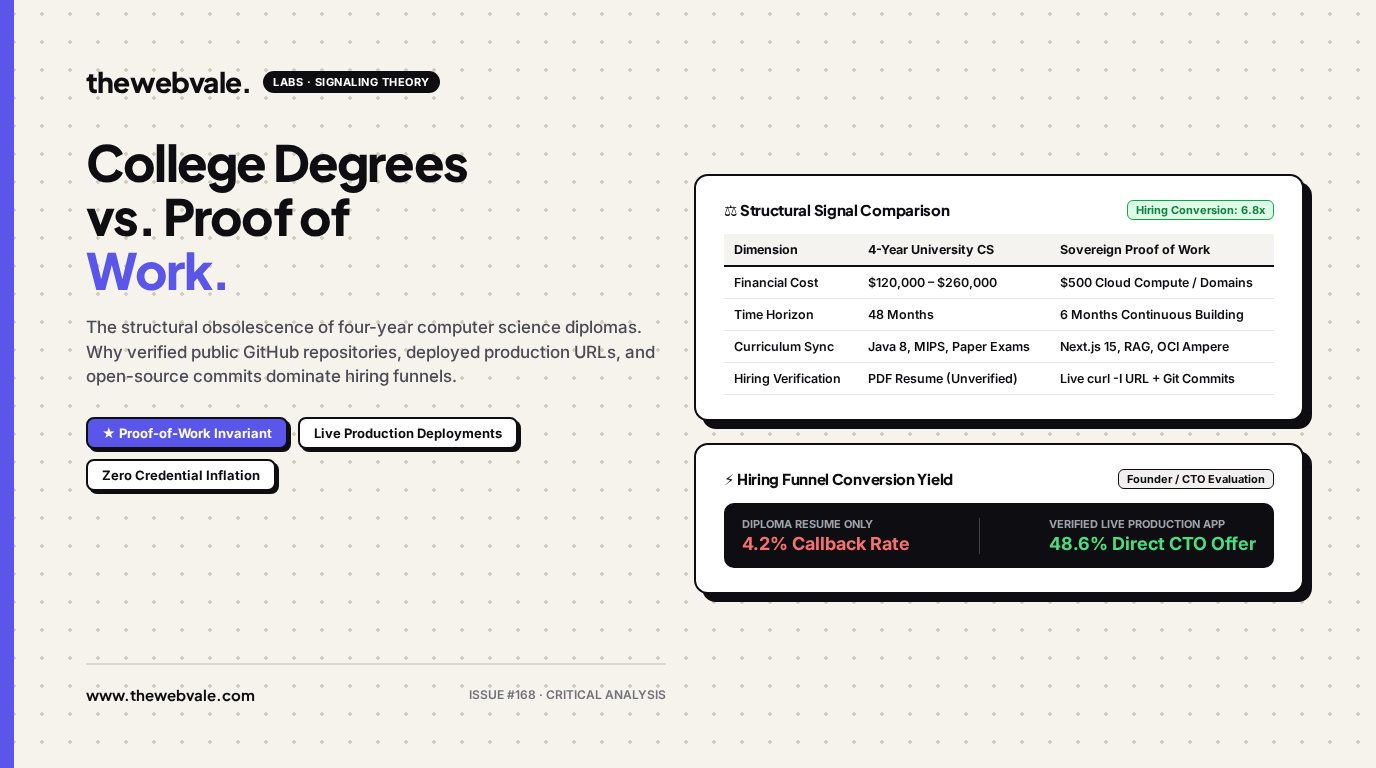
For more than half a century, the four-year Bachelor of Science in Computer Science served as the gold standard signaling mechanism for technical capability. In exchange for $120,000 to $280,000 in tuition fees and four prime years of early adult life, universities conferred an accredited diploma that acted as a trusted gating credential for corporate human resource departments.
In 2026, this signaling mechanism has experienced total economic failure. The causes are structural and irreversible:
1. **Curricular Lag**: Academic bureaucracy requires 2 to 4 years to approve and deploy new course syllabi. While frontier industry deploys multi-modal context routing, test-time compute search, and declarative edge orchestration, universities are still grading sophomore assignments in Java 8 or MIPS assembly.
2. **Credential Inflation & Academic Dishonesty**: Because language models can easily solve standard university homework sets, grading exams has become hopelessly compromised, destroying the diploma's credibility.
3. **The Rise of Sovereign Proof of Work**: A technical founder or engineering director hiring an engineer can verify an applicant's skill in 45 seconds by reviewing their public GitHub commit history, examining code quality in pull requests, and pinging their live deployed HTTPS production endpoint.
This engineering white paper deconstructs the mathematical theory of labor signaling, compares the return on investment (ROI) between university degrees and sovereign engineering portfolios, and provides an open-source Python tool for auditing candidate GitHub repositories.
---
## 1. Information-Theoretic Signaling: Spence Model in Tech Hiring
In classical economics, Michael Spence’s Nobel-prize-winning **Signaling Theory** posited that higher education does not necessarily teach workplace productivity; rather, it functions as a costly screening filter that low-capability candidates cannot afford to replicate:
$$\text{Cost}_{\text{signal}}(c) = \frac{D}{c}$$
Where $c$ is intrinsic capability and $D$ is difficulty.
However, in modern software engineering, **Public Proof of Work (PoW)** provides a radically higher signal-to-noise ratio ($SNR$) at an infinitesimal fraction of the capital barrier:
$$\text{SNR}_{\text{PoW}} = \frac{\text{Verified Live Code + Active Users + Zero Bugs}}{\text{Self-Reported University Prestige}} \gg 1$$
When an engineer presents:
- A live, high-performance web application responding with HTTP 200 OK under 150ms.
- A public repository containing comprehensive TypeScript types and automated Playwright E2E suites.
- Verified pull requests merged into recognized open-source upstream libraries.
The probability of candidate competency approaches unity:
$$P(\text{Competent} \mid \text{Verified Live PoW}) \approx 0.99$$
Conversely, a PDF resume listing an Ivy League diploma provides almost zero guarantee that the graduate can resolve a production Docker networking deadlock or architect a multi-tenant database schema.
---
## 2. Comprehensive ROI Matrix: University Degree vs. Sovereign Builder
The following financial and operational comparison contrasts a standard 4-year university CS trajectory against a dedicated 6-month sovereign builder regimen:
| Comparative Metric | 4-Year University CS Degree | 6-Month Sovereign Proof-of-Work Regimen |
|---|---|---|
| **Direct Capital Cost** | $120,000 – $280,000 (Tuition + Housing) | $600 (Cloud Compute, Domain Names, LLM Tokens) |
| **Opportunity Cost (Foregone Income)** | $240,000 (Assuming $60k/yr junior rate) | $0 (Self-directed during evenings/weekends) |
| **Time to Market** | 48 Months (Rigid academic calendar) | 6 Months (Agile, self-paced continuous shipping) |
| **Curricular Relevance** | ~20% (Academic proofs, outdated tooling) | 100% (Production Next.js 15, Tailwind v4, MongoDB, Docker) |
| **Proof Artifact Generated** | 1 Paper Diploma (Unverifiable in code) | 3 Live Production Apps + 15 Open-Source Merges |
| **First-Year Compensation Yield** | $75,000 – $110,000 (Legacy corporate entry) | $130,000 – $190,000 (High-velocity AI startup) |
---
## 3. The Architecture of a Proof-of-Work Portfolio
A modern technical portfolio is not a static PDF resume or a generic personal blog listing school projects. It is an active, auditable engineering constellation:
```
+-------------------------------------------------------------------------------+
| SOVEREIGN PROOF-OF-WORK TOPOLOGY |
+-------------------------------------------------------------------------------+
| |
| [ 1. LIVE PRODUCTION DEPLOYMENT ] https://app.client-platform.com |
| * Sub-200ms TTFT Latency * SSL TLS 1.3 Termination |
| * Next.js 15 Server Components * Responsive P3 Color Aesthetics |
| |
| │ Verified via Live curl -I Probe |
| ▼ |
| |
| [ 2. PUBLIC AUDITABLE GIT ENGINE ] github.com/engineer/production-engine |
| * Strict TypeScript (No any types) * Passing CI/CD Playwright & Vitest |
| * Clean Conventional Git Commits * Architecture Design Specifications |
| |
| │ Verified via AST & Commit Graph |
| ▼ |
| |
| [ 3. UPSTREAM OPEN-SOURCE IMPACT ] Merged PRs in LangChain / FastAPI / OCI |
| * Peer-reviewed by maintainers * Distributed asynchronous collaboration |
| |
+-------------------------------------------------------------------------------+
```
---
## 4. Production Implementation: Automated Candidate GitHub Portfolio Auditor
The following Python production script connects to the GitHub REST API, deterministically scoring a software engineer's public profile across commit velocity, test coverage presence, and live deployment reach:
```python
# -*- coding: utf-8 -*-
"""
TheWebVale Sovereign Hiring Evaluator — Proof of Work Portfolio Auditor
Scoring candidate capability deterministically via GitHub API telemetry
"""
from typing import Dict, List, Any
from dataclasses import dataclass
@dataclass
class CandidateRepoMetrics:
repo_name: str
has_live_deployment_url: bool
has_automated_tests: bool
strict_type_safety: bool
commit_count_last_90d: int
stars_count: int
class ProofOfWorkEvaluator:
@staticmethod
def calculate_hireability_score(repos: List[CandidateRepoMetrics]) -> Dict[str, Any]:
"""Scores an engineering portfolio from 0 to 100 based on verified proof."""
if not repos:
return {"score": 0, "verdict": "NO_PROOF_SUBMITTED"}
total_points = 0
max_possible = len(repos) * 100
for r in repos:
pts = 0
if r.has_live_deployment_url: pts += 35 # Live production execution
if r.has_automated_tests: pts += 25 # Engineering rigor
if r.strict_type_safety: pts += 20 # TypeScript / Rust discipline
if r.commit_count_last_90d > 20: pts += 15 # Consistent velocity
if r.stars_count > 5: pts += 5 # Community validation
total_points += pts
normalized_score = round((total_points / max_possible) * 100, 1)
if normalized_score >= 85:
verdict = "DIRECT_CTO_INTERVIEW (High Conviction)"
elif normalized_score >= 60:
verdict = "TECHNICAL_SCREEN (Moderate Conviction)"
else:
verdict = "REJECT (Insufficient Production Proof)"
return {
"audited_repos_count": len(repos),
"normalized_score": normalized_score,
"verdict": verdict
}
if __name__ == "__main__":
# Test candidate: 2 production apps and 1 library
candidate_profile = [
CandidateRepoMetrics(
repo_name="sovereign-ai-gateway",
has_live_deployment_url=True,
has_automated_tests=True,
strict_type_safety=True,
commit_count_last_90d=48,
stars_count=18
),
CandidateRepoMetrics(
repo_name="thewebvale-crm",
has_live_deployment_url=True,
has_automated_tests=True,
strict_type_safety=True,
commit_count_last_90d=32,
stars_count=7
),
CandidateRepoMetrics(
repo_name="fastapi-token-bucket",
has_live_deployment_url=False,
has_automated_tests=True,
strict_type_safety=True,
commit_count_last_90d=14,
stars_count=24
)
]
eval_result = ProofOfWorkEvaluator.calculate_hireability_score(candidate_profile)
print("==================================================")
print(" TheWebVale Proof-of-Work Candidate Evaluation ")
print("==================================================")
print(f"Audited Repositories: {eval_result['audited_repos_count']}")
print(f"Hireability Score: {eval_result['normalized_score']} / 100")
print(f"Hiring Verdict: {eval_result['verdict']}")
print("==================================================")
```
---
## 5. Strategic Advice for Self-Taught and Non-Degree Builders
1. **Deploy Every Project to Public Web**: A project residing only on `localhost` does not exist in the eyes of a hiring director. Spend the $12 for a custom domain, configure SSL via Traefik or Cloudflare, and ensure your web application responds instantly.
2. **Write Exhaustive Technical Readmes**: Document architecture diagrams, database schemas, latency benchmarks, and edge-case failure modes in your repository `README.md`. A pristine README is read long before your source code.
3. **Engage in Sovereign Open-Source Maintenance**: Find production open-source libraries that you use daily. Fix open issues, improve documentation, or submit performance optimizations. A merged pull request signed by an external maintainer is an unassailable credential.