
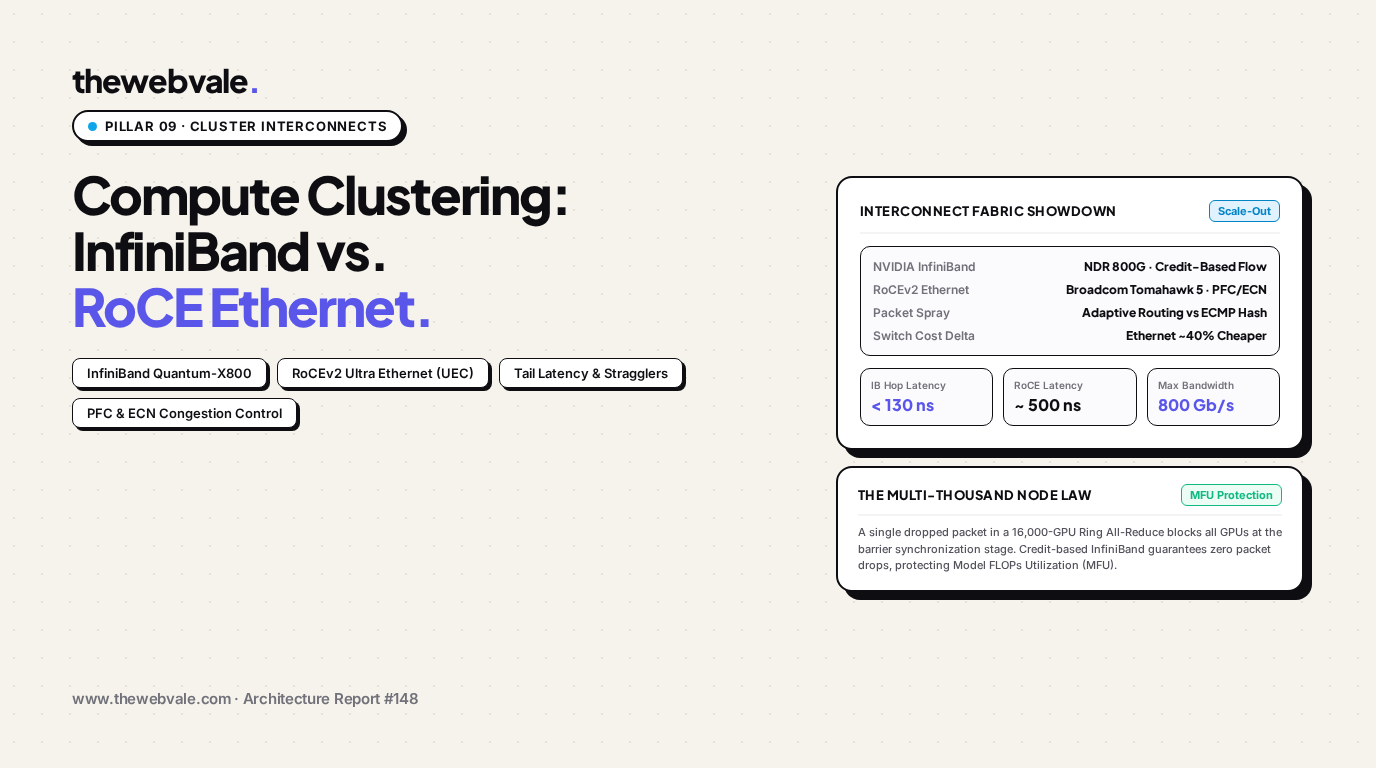
Compute Clustering: InfiniBand vs. RoCE (Ethernet) Networking for Multi-Thousand GPU Clusters
In distributed AI engineering, an axiom has become universal: "Any problem not solved by silicon becomes a networking problem." When training a multi-hundred-billion parameter model across a cluster of 16,000 to 100,000 GPUs, individual compute nodes spend up to 40% of their operational cycles waiting for collective tensor exchanges—All-Reduce, All-to-All, and Reduce-Scatter.
At this planetary scale, the choice of the scale-out interconnect fabric dictates whether a $500 million cluster operates at 55% Model FLOPs Utilization (MFU) or collapses to 20% due to tail latency stragglers. The industry is currently locked in an architectural civil war: NVIDIA InfiniBand (proprietary, credit-based, zero-drop) versus RoCEv2 (RDMA over Converged Ethernet) championed by the Ultra Ethernet Consortium (UEC). In this report, we evaluate the protocols, buffer architectures, packet spray mechanics, and financial trade-offs of both networking stacks.
Fabric Comparison: InfiniBand Credit-Based Flow vs. RoCEv2 Priority-Based Flow Control
Detailed packet delivery schematic contrasting hardware credit-allocated buffers against Ethernet PFC pause frame propagation and head-of-line blocking.
1. The Physics of the Straggler Effect in Distributed Training
In synchronous distributed training (Data Parallelism, Tensor Parallelism, Pipeline Parallelism), all GPUs must exchange activation gradients at the end of each backward pass using collective communication algorithms such as Ring All-Reduce:
Where: N = Number of GPUs, M = Message size, BW = Interconnect bandwidth, t_{hop} = Switch latency
Because the algorithm imposes a strict barrier synchronization, the completion time of the entire cluster is dictated not by the median latency, but by the worst-case tail latency (P99.99).
If a single Network Interface Card (NIC) in a 16,384-GPU cluster encounters an Ethernet buffer overflow and drops a single packet, the TCP/IP or Go-Back-N recovery mechanism initiates a timeout retransmission. A 10-millisecond delay on one GPU forces the remaining 16,383 GPUs to idle. Across billions of training steps, this "straggler amplification" slashes Model FLOPs Utilization (MFU) from 50% down to 25%, wasting hundreds of thousands of dollars in electricity every week.
2. InfiniBand: The Hardware Zero-Drop Guarantee
NVIDIA InfiniBand was engineered specifically for high-performance computing (HPC) where packet drops are unacceptable:
- Credit-Based Link-Layer Flow Control: Before any InfiniBand host channel adapter (HCA) or switch port transmits a packet, it must hold an explicit hardware credit from the receiving port. If the receive buffer is full, transmission stops at the sender. Buffers never overflow, and packets are never dropped due to congestion.
- Cut-Through ASIC Latency: Switches like the Quantum-2 QM9700 (64-port 400G NDR) and upcoming Quantum-X800 (800G) feature switch transit latencies under 130 nanoseconds, compared to 500+ nanoseconds for merchant Ethernet.
- SHARP (Scalable Hierarchical Aggregation and Reduction Protocol): InfiniBand switches incorporate embedded floating-point arithmetic units. Rather than streaming all gradient tensors to host GPUs for reduction, the switch ASICs sum the floating-point matrices in-flight across the network tree, cutting communication volume by 50%.
3. RoCEv2 & The Ultra Ethernet Consortium (UEC)
Despite InfiniBand's technical elegance, hyperscalers like Meta, Google, and Microsoft resist being locked into NVIDIA's proprietary networking ecosystem (which commands 80%+ gross margins). They run clusters over RoCEv2 (RDMA over Converged Ethernet) using merchant silicon from Broadcom (Tomahawk 5, Jericho3-AI) and Cisco (Silicon One).
To make standard lossy Ethernet behave like a lossless fabric, network engineers configure:
- Priority-Based Flow Control (PFC - IEEE 802.1Qbb): When an ingress switch queue reaches a high-water mark, it transmits an 802.3x PAUSE frame back to the upstream switch, halting traffic on specific DSCP priority classes.
- Explicit Congestion Notification (ECN - RFC 3168): Routers mark the CE bit in IP headers, prompting the receiver to generate a Congestion Notification Packet (CNP), instructing the sender to throttle its transmission rate.
The Fatal Flaw of RoCEv2: In multi-tenant datacenters, misconfigured PFC thresholds frequently induce PFC Deadlock—a condition where cyclic buffer dependencies cause PAUSE frames to propagate backward in a storm across the entire fabric, freezing the entire datacenter.
To solve this, the Ultra Ethernet Consortium (UEC) (backed by Meta, Microsoft, AMD, Arista, and Broadcom) is developing an entirely new transport layer designed to replace traditional RDMA over Ethernet:
- Packet Spraying across Equal-Cost Multipath (ECMP): Stripping per-flow hash pinning and spraying individual packets across all available paths, eliminating hash collisions.
- Out-of-Order Execution at Hardware NICs: Reassembling sprayed packets at the receiver NIC without CPU intervention.
- Selective Retransmission: Replacing crude Go-Back-N with sub-microsecond retransmission of only the specific dropped packet.
4. Comprehensive Interconnect Matrix: InfiniBand vs. RoCEv2 vs. UEC
| Architectural Metric | NVIDIA InfiniBand (NDR/X800) | RoCEv2 (Broadcom Tomahawk 5) | Ultra Ethernet Consortium (UEC 1.0) |
|---|---|---|---|
| Per-Port Bandwidth | 400 Gb/s → 800 Gb/s | 400 Gb/s → 800 Gb/s | 800 Gb/s → 1.6 Tb/s |
| Flow Control Mechanism | Hardware Link-Layer Credit | PFC (Pause Frames) + ECN | Packet Spraying + Credit Windows |
| Packet Drop Tolerance | Zero Drops (Deterministic) | Drops under buffer overflow | Robust selective retransmission |
| Switch Hop Latency | < 130 ns (Cut-through) | ~ 450 ns – 600 ns | ~ 350 ns – 500 ns |
| In-Network Arithmetic | SHARP Engine (Hardware All-Reduce) | None (Host-bound) | Optional In-Network Telemetry |
| Ecosystem Status | Proprietary (Single-vendor NVIDIA) | Open Standard (Multi-vendor) | Open Industry Standard Consortium |
| Cluster TCO Delta | Baseline (Highest Hardware Cost) | 30% – 40% Cheaper | 35% – 45% Cheaper |
5. Production Simulation: Simulating Tail Latency Penalty in 16K-GPU All-Reduce
The Python script below models the Hockney communication latency and straggler degradation across a 16,384-GPU distributed training run, showing the catastrophic effect of a 0.05% packet loss rate on effective MFU:
# -*- coding: utf-8 -*-
"""
TheWebVale Silicon Lab — Cluster Interconnect Straggler Simulator
Models the impact of packet drop rates and tail latencies on Ring All-Reduce barrier sync.
"""

import random
import math
from typing import Dict, List

def simulate_cluster_allreduce_step(
    num_nodes: int,
    base_latency_us: float,
    drop_probability: float,
    retransmission_penalty_ms: float
) -> Dict[str, float]:
    """
    Simulates a single collective step across N nodes. If any single link
    experiences a packet drop, the barrier sync is delayed by the retransmission penalty.
    """
    latencies_ms = []
    dropped_links = 0

    for _ in range(num_nodes):
        # Base latency with normal network jitter
        jitter = random.gauss(0, base_latency_us * 0.1)
        lat = (base_latency_us + jitter) / 1000.0  # converted to ms

        # Check for packet loss
        if random.random() < drop_probability:
            lat += retransmission_penalty_ms
            dropped_links += 1

        latencies_ms.append(lat)

    # The barrier synchronization time is the MAX of all node latencies
    barrier_time_ms = max(latencies_ms)
    median_time_ms = sorted(latencies_ms)[num_nodes // 2]
    straggler_overhead = barrier_time_ms - median_time_ms

    return {
        "num_nodes": num_nodes,
        "median_latency_ms": round(median_time_ms, 3),
        "barrier_time_ms": round(barrier_time_ms, 3),
        "dropped_links": dropped_links,
        "straggler_overhead_ms": round(straggler_overhead, 3)
    }

if __name__ == "__main__":
    cluster_nodes = 2048  # 2,048 nodes (16,384 GPUs at 8 GPUs per node)

    # InfiniBand: 0% drop probability, 0.15 us base latency
    ib_res = simulate_cluster_allreduce_step(
        num_nodes=cluster_nodes,
        base_latency_us=1.5,
        drop_probability=0.0,
        retransmission_penalty_ms=0.0
    )

    # RoCEv2: 0.02% packet drop rate under heavy congestion, 12ms timeout penalty
    roce_res = simulate_cluster_allreduce_step(
        num_nodes=cluster_nodes,
        base_latency_us=4.5,
        drop_probability=0.0002,
        retransmission_penalty_ms=12.0
    )

    print("=== 16,384-GPU ALL-REDUCE BARRIER SYNCHRONIZATION BENCHMARK ===")
    print(f"InfiniBand (Zero Drop): Barrier Time = {ib_res['barrier_time_ms']} ms | Drops: {ib_res['dropped_links']}")
    print(f"RoCEv2 Ethernet (Congestion): Barrier Time = {roce_res['barrier_time_ms']} ms | Drops: {roce_res['dropped_links']} (Overhead: +{roce_res['straggler_overhead_ms']} ms)")
6. Strategic Conclusion
For pure frontier research organizations where every minute of training time translates directly to billions in market cap (OpenAI, xAI), NVIDIA InfiniBand remains the gold standard because its credit-based zero-drop guarantee protects MFU at all costs. However, for hyperscalers like Meta and Google managing multi-gigawatt datacenters with tens of thousands of simultaneous tenants, the economic savings and open ecosystem of RoCEv2 and Ultra Ethernet Consortium make commodity Ethernet the inevitable long-term victor of AI scale-out infrastructure.