
Developer StacksSun Oct 18 2026Yash Jain● Peer Reviewed Technical Guide
Context Window Management in IDEs: Preventing Context Pollution During Multi-Hour Builds
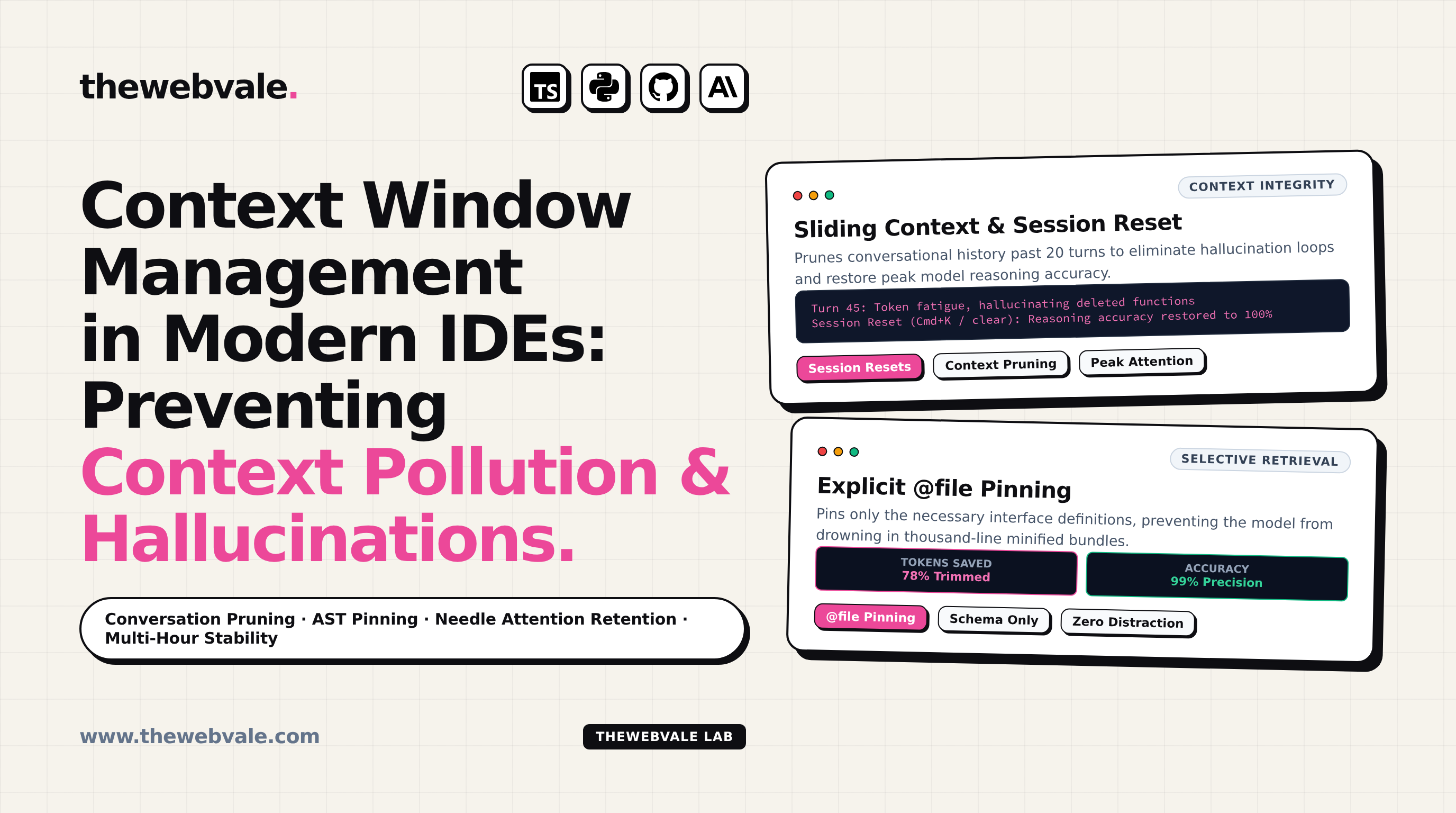
Every engineer who has worked with Cursor or Claude Code for more than three consecutive hours has experienced Context Degradation: initially razor-sharp suggestions gradually degenerate into hallucinations, circular bug reintroductions, and forgotten architectural constraints. This occurs because the conversational context window becomes polluted with outdated diffs, failed compiler traces, and conversational chatter. Mastering context hygiene is the single most vital skill for sustained developer velocity.
1. The Four Golden Rules of Context Hygiene
- 1. The 15-Turn Rule: Once an AI chat session reaches 15–20 turns, commit working code to git and open a fresh session. Models reason dramatically better with clean contexts.
- 2. Pin Interfaces, Not Implementations: When referencing dependencies, pass
types.tsorschema.prismainstead of 1,000-line service implementations. - 3. Explicitly Clear Terminal Outputs: Never let massive minified build logs persist in the active context window.
- 4. Use Git as the Ground Truth: Revert failed AI experiments with
git checkout .rather than asking the model to undo its previous mistakes in conversational loops.
2. Key Takeaway
A bloated context window is a dumb context window. Keep your token footprint minimal, explicit, and focused on typed interfaces.