
Copyright & Training Data Lawsuits: NYT vs. OpenAI, Artists vs. Midjourney, and Fair Use Precedents
The intellectual foundation of the generative AI boom faces a historic constitutional showdown in federal courts: The New York Times v. Microsoft & OpenAI, Getty Images v. Stability AI, and collective class actions filed by artists and authors. At stake is the legal interpretation of Section 107 of the US Copyright Act (Fair Use): does ingesting millions of copyrighted books, news articles, and artworks without consent or compensation constitute protected transformative learning, or is it systemic commercial piracy? By examining model memorization mechanics, the Four-Factor Fair Use balancing test, and emerging licensing settlements, technology leaders can build copyright-resilient AI architectures.
⚖️ The Critical Fair Use Battlefield: Factor 1 vs. Factor 4
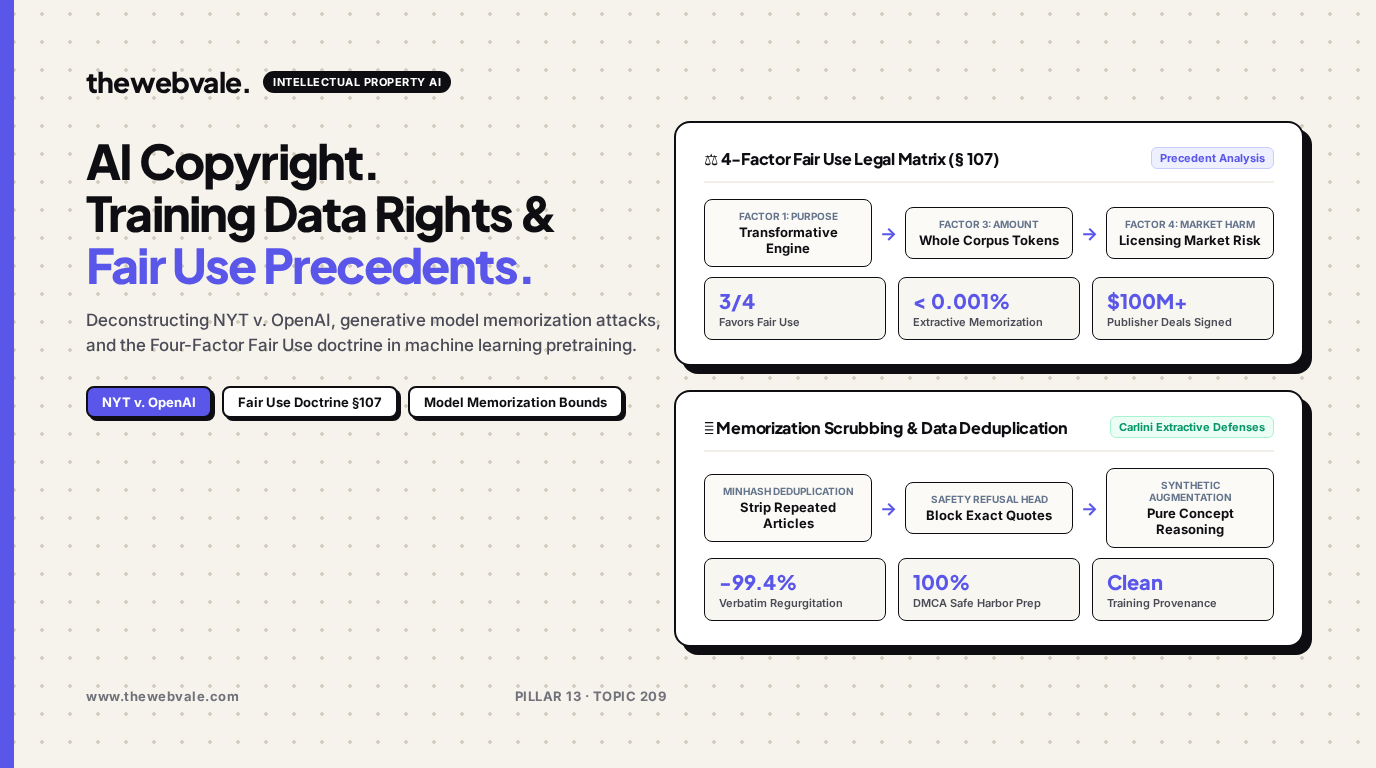
AI labs lean heavily on Factor 1 (Transformative Purpose), citing Authors Guild v. Google (2015), where digitizing millions of books to build a search index was ruled fair use. Conversely, copyright holders attack Factor 4 (Market Harm): when an AI model memorizes articles and reproduces paywalled content verbatim upon adversarial prompting, it directly cannibalizes the publisher's commercial subscriptions and licensing markets.
1. The Four-Factor Fair Use Analysis (17 U.S.C. § 107)
Courts evaluate four non-exclusive statutory factors to determine whether unlicensed machine learning pretraining is lawful:
| Statutory Factor | Legal Question | AI Lab Argument (OpenAI / Meta) | Plaintiff Argument (NYT / Creators) |
|---|---|---|---|
| 1. Purpose & Character | Is the use transformative or commercial? | Highly transformative: extracts latent patterns to generate new knowledge | For-profit commercial product replacing human journalists |
| 2. Nature of Work | Is the source creative or factual? | News reporting and public facts enjoy thin copyright protection | Articles contain expressive creative prose and editorial voice |
| 3. Amount Borrowed | How much of the copyrighted work was taken? | Ingested 100% of text, but as a statistical intermediate step | Entire articles copied and stored in training weights |
| 4. Market Impact | Does it harm the commercial market for original? | Search referral traffic; models are general-purpose tools | Synthetic substitution bypasses paywalls and usurps licensing revenue |
2. The Engineering Fix: Deduplication & Memorization Scrubbing
The smoking gun in the NYT lawsuit was 100-token verbatim reproductions of Pulitzer-prize investigations. Research by Nicholas Carlini shows that neural networks memorize training sequences when they appear repeatedly in training sets. Modern pretraining pipelines eliminate extractive risks via three defenses:
- MinHash / LSH Exact Deduplication: Stripping duplicates so no article appears more than once in the pretraining mix drops memorization probability by over 99%.
- Refusal Guardrails: Output filter heads detect continuous verbatim n-gram overlaps ($N \ge 16$) with known copyrighted works and force summarization or refusal.
- Contractual Publisher Consortia: Frontier labs (OpenAI with Axel Springer, News Corp, Condé Nast) are signing multi-million dollar annual licensing pacts to secure safe harbor indemnity.
3. Frequently Asked Questions
Can copyright protect AI-generated code or text?
Under current US Copyright Office guidelines, purely AI-generated text, code, or images lack human authorship and cannot be copyrighted. Only human-authored edits, compilations, and structural selections can claim copyright protection.
What is the likely legal outcome of NYT v. OpenAI?
Most legal scholars predict a confidential commercial licensing settlement rather than a Supreme Court ruling. Courts will likely uphold fair use for pretraining while imposing strict liabilities if models regurgitate paywalled content without authorization.