
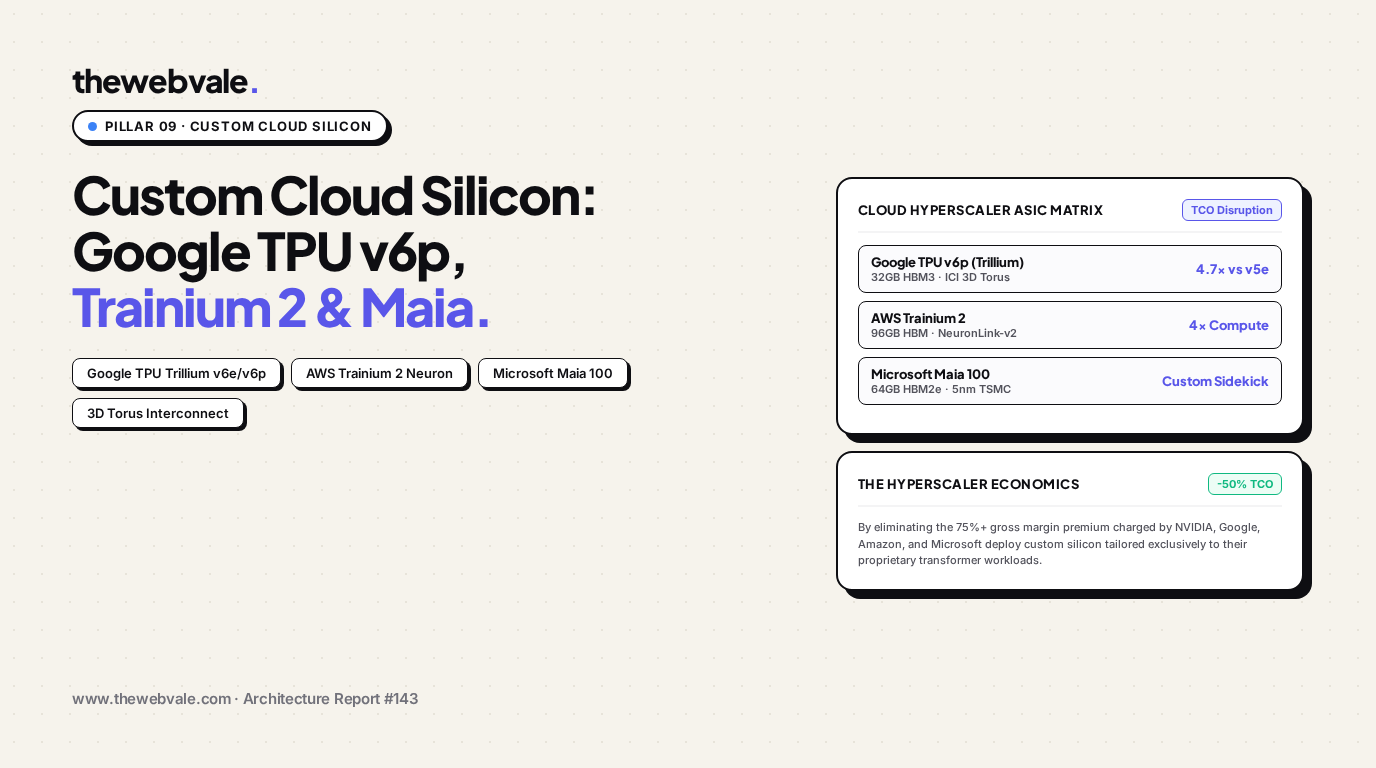
Custom Cloud Silicon: Google TPU v5e/v6p, AWS Trainium 2/Inferentia 2 & Microsoft Maia 100
For the world's three largest cloud hyperscalers—Google Cloud, Amazon Web Services, and Microsoft Azure—spending tens of billions of dollars annually purchasing NVIDIA GPUs represents an intolerable strategic liability. With NVIDIA capturing 75%+ gross margins on H100 and B200 systems, hyperscalers are effectively subsidizing their chief hardware supplier while suffering severe supply allocation caps.
The counter-strategy is custom vertical silicon: application-specific integrated circuits (ASICs) co-designed from the ground up for deep learning tensors. Today, Google's TPU v6p (Trillium), AWS Trainium 2, and Microsoft's Maia 100 have matured into production-grade infrastructure powering frontier models like Gemini 2.0, Claude 3.5 Sonnet, and OpenAI GPT-4o. In this deep dive, we compare their silicon architectures, custom interconnect topologies, compiler maturity, and total cost of ownership (TCO).
Architectural Comparison: Google TPU v6p vs. AWS Trainium 2 vs. Microsoft Maia 100
Detailed schematic comparison of compute cores, on-chip memory hierarchy, and inter-chip scale-up topologies.
1. Google TPU v6p (Trillium): The Pioneer of Systolic Array Computing
Google pioneered hyperscaler custom silicon with the original TPU in 2015. While GPUs rely on thousands of independent SIMT (Single Instruction, Multiple Threads) cores with complex instruction schedulers and registers, Google's TPU is built around Systolic Matrix Multiply Units (MXUs).
In a systolic array, data streams continuously through a 2D grid of multiply-accumulate (MAC) cells without reading and writing back to an intermediate register file at each step. For a 128 × 128 Bfloat16 systolic array, inputs flow from the left while weights flow from the top, accumulating matrix dot products \(C = A \cdot B\) with unmatched energy efficiency.
The generational leap from TPU v5e to TPU v6p (Trillium) features:
- 4.7x FLOPs Boost: Expanding MXU dimensions and increasing clock frequency under a refined 4nm TSMC process.
- Optical Circuit Switching (OCS): Rather than relying on static copper cables, Google connects TPU pods via Palomar Optical Circuit Switches. Using micro-electro-mechanical (MEMS) mirrors, Google can dynamically reconfigure the physical 3D torus interconnect topology on the fly to match the exact pipeline or tensor parallelism dimensions of the model being trained.
- Gemini 2.0 Native: Google trained Gemini 1.5 and Gemini 2.0 entirely on TPU v4 and v5e/v6p pods, proving that frontier models do not strictly require NVIDIA GPUs.
2. AWS Trainium 2 & Annapurna Labs: The Pragmatic Bedrock Engine
Amazon acquired Israeli chip designer Annapurna Labs in 2015, systematically rolling out Graviton (CPUs), Nitro (hypervisor cards), Inferentia (inference ASICs), and Trainium.
Trainium 2 is Amazon's answer to the H100, architected specifically for foundation model training:
- UltraServers with 16 Chips: An EC2 Trn2 UltraServer pairs 16 Trainium 2 chips linked via NeuronLink-v2, providing non-blocking all-to-all communication within the node.
- Massive Memory Footprint: With 96GB of high-speed HBM per chip, a single 16-chip server offers 1.5 TB of high-bandwidth memory, enabling larger tensor shards and reduced checkpointing overhead.
- Project Rainier (Anthropic Partnership): AWS is deploying clusters of over 100,000 Trainium 2 chips to train upcoming generations of Anthropic's Claude models, solidifying AWS's hedge against GPU shortages.
3. Microsoft Maia 100: OpenAI Co-Design & The 'Sidekick' Rack
Unlike Google and Amazon, who built custom silicon over a decade, Microsoft entered the ASIC race rapidly with Maia 100 (Project Athena). Fabricated on TSMC's 5nm process with 105 billion transistors, Maia 100 was co-designed directly with OpenAI's research engineers to optimize the exact attention layers and quantization schemes of GPT-4.
Maia 100's primary engineering feat is its mechanical datacenter integration. Because standard Azure datacenters were built for air-cooled enterprise servers, Microsoft designed the Sidekick Liquid Cooling Unit. The Sidekick is a refrigerator-sized module that slides between Maia server racks, circulating chilled liquid coolant directly to cold plates mounted on the 500W ASICs without requiring a complete overhaul of datacenter chillers.
4. Comprehensive Hyperscaler ASIC Comparison Matrix
| Metric | Google TPU v6p (Trillium) | AWS Trainium 2 | Microsoft Maia 100 | NVIDIA H100 (Reference) |
|---|---|---|---|---|
| Foundry & Node | TSMC 4nm | TSMC 4nm | TSMC 5nm | TSMC 4N (Custom) |
| Primary Math Engine | Dual 128x128 Systolic MXUs | NeuronCore-v2 Tensor Eng. | Custom 5nm Tensor ASIC | SM Tensor Cores |
| HBM Configuration | 32 GB HBM3 | 96 GB HBM3 | 64 GB HBM2e | 80 GB HBM3 |
| Memory Bandwidth | 1.6 TB/s | 2.4 TB/s | 1.8 TB/s | 3.35 TB/s |
| Scale-Up Interconnect | ICI w/ Optical Switches (OCS) | NeuronLink-v2 (Non-blocking) | Custom PCIe Gen5 / Ethernet | NVLink 4 (900 GB/s) |
| Compiler Toolchain | OpenXLA (Highly Mature) | AWS Neuron SDK | Triton-Maia / ONNX | CUDA / TensorRT (Gold Std) |
| Primary Workloads | Gemini, PaLM, Search AI | Anthropic Claude, Bedrock | Azure OpenAI GPT-4, Copilot | General-purpose AI |
| Estimated TCO vs H100 | 45% – 55% Lower | 40% – 50% Lower | 35% – 45% Lower | Baseline (Highest Price) |
5. The Compiler Challenge: OpenXLA vs. AWS Neuron vs. Triton
The performance of any AI ASIC is dictated entirely by its compiler graph lowerer. When an engineer writes a PyTorch module:
# High-level PyTorch tensor operation
import torch

def gated_silu_linear(x, w_gate, w_up):
    return torch.matmul(torch.nn.functional.silu(torch.matmul(x, w_gate)), w_up)
On NVIDIA GPUs, PyTorch executes either via hand-tuned CUDA kernels or generates efficient code via torch.compile with OpenAI Triton.
On custom ASICs, the intermediate graph must be lowered through proprietary compiler backends:
- Google OpenXLA: Translates High-Level Optimizer (HLO) IR into fused TPU assembly. XLA is by far the most mature non-CUDA compiler, having powered billions of training queries over nine years.
- AWS Neuron Compiler: Converts PyTorch TorchScript or HuggingFace transformers into Neuron Executable File Format (NEFF), fusing attention layers and auto-partitioning tensors across NeuronCores.
- Microsoft's Bet on Triton: Rather than writing an entirely new compiler dialect from scratch, Microsoft has focused on writing a direct hardware backend for OpenAI Triton targeting Maia 100, allowing OpenAI researchers to execute existing Triton kernels without porting.
6. Production Simulation: ASIC Total Cost of Ownership (TCO) Calculator
Below is an enterprise TCO modeling script calculating the 3-year amortized cost of training a 70B parameter frontier model across NVIDIA H100 vs. Google TPU v6p vs. AWS Trainium 2:
# -*- coding: utf-8 -*-
"""
TheWebVale Silicon Lab — Cloud AI ASIC TCO & Amortized Cost Simulator
Estimating cluster capital cost, power consumption, and training run economics.
"""

import dataclasses
from typing import Dict

@dataclasses.dataclass(frozen=True)
class HardwareNode:
    name: str
    hourly_rate_per_chip: float
    effective_tflops_fp16: float
    power_watts_per_chip: float
    mfg_gross_margin_tax: float

def calculate_training_run(
    node: HardwareNode,
    total_floating_point_ops: float,  # Total FLOPs (e.g., 6 * Parameters * Tokens)
    num_chips: int
) -> Dict[str, float]:
    """
    Computes total training run duration (hours) and total rental cost ($).
    """
    total_compute_tflops = num_chips * node.effective_tflops_fp16
    total_compute_flops_per_sec = total_compute_tflops * 1e12

    # Model FLOPs Utilization (MFU) estimated at realistic 45%
    realistic_flops_per_sec = total_compute_flops_per_sec * 0.45

    duration_seconds = total_floating_point_ops / realistic_flops_per_sec
    duration_hours = duration_seconds / 3600.0
    duration_days = duration_hours / 24.0

    total_cost_usd = duration_hours * num_chips * node.hourly_rate_per_chip
    total_energy_kwh = (num_chips * node.power_watts_per_chip * duration_hours) / 1000.0

    return {
        "hardware": node.name,
        "num_chips": num_chips,
        "duration_days": round(duration_days, 1),
        "total_cost_usd": round(total_cost_usd, 2),
        "total_energy_mwh": round(total_energy_kwh / 1000.0, 2),
        "cost_per_million_tokens_usd": round(total_cost_usd / (total_floating_point_ops / (6 * 70e9)) * 1e6, 3)
    }

if __name__ == "__main__":
    h100 = HardwareNode("NVIDIA H100 (Cloud Rental)", hourly_rate_per_chip=2.95, effective_tflops_fp16=800.0, power_watts_per_chip=700.0, mfg_gross_margin_tax=0.75)
    tpu_v6p = HardwareNode("Google TPU v6p (Trillium)", hourly_rate_per_chip=1.65, effective_tflops_fp16=650.0, power_watts_per_chip=450.0, mfg_gross_margin_tax=0.25)
    trn2 = HardwareNode("AWS Trainium 2", hourly_rate_per_chip=1.45, effective_tflops_fp16=600.0, power_watts_per_chip=480.0, mfg_gross_margin_tax=0.20)

    # Training 70B Model on 2 Trillion Tokens: FLOPs = 6 * 70e9 * 2e12 = 8.4e23 FLOPs
    training_flops = 8.4e23
    cluster_size = 2048

    print(f"=== 70B PARAMETER MODEL TRAINING RUN (2,048 CHIPS) ===")
    for chip in [h100, tpu_v6p, trn2]:
        res = calculate_training_run(chip, training_flops, cluster_size)
        print(f"[{res['hardware']:<28}] Duration: {res['duration_days']:>4.1f} days | Cost: ${res['total_cost_usd']:>12,.2f} | Energy: {res['total_energy_mwh']:>6.1f} MWh")
7. Strategic Conclusion: The Two-Tier Compute Ecosystem
The rise of custom cloud silicon does not mean NVIDIA will go bankrupt; it signals the bifurcated future of AI infrastructure. For independent developers, enterprise startups, and on-premise supercomputing centers, NVIDIA remains the default choice due to universal framework compatibility and CUDA ease of use. However, for hyperscalers operating multi-gigawatt datacenters, custom silicon like Google TPU v6p, AWS Trainium 2, and Microsoft Maia 100 provides the necessary economic escape velocity to operate AI services profitably at planetary scale.