
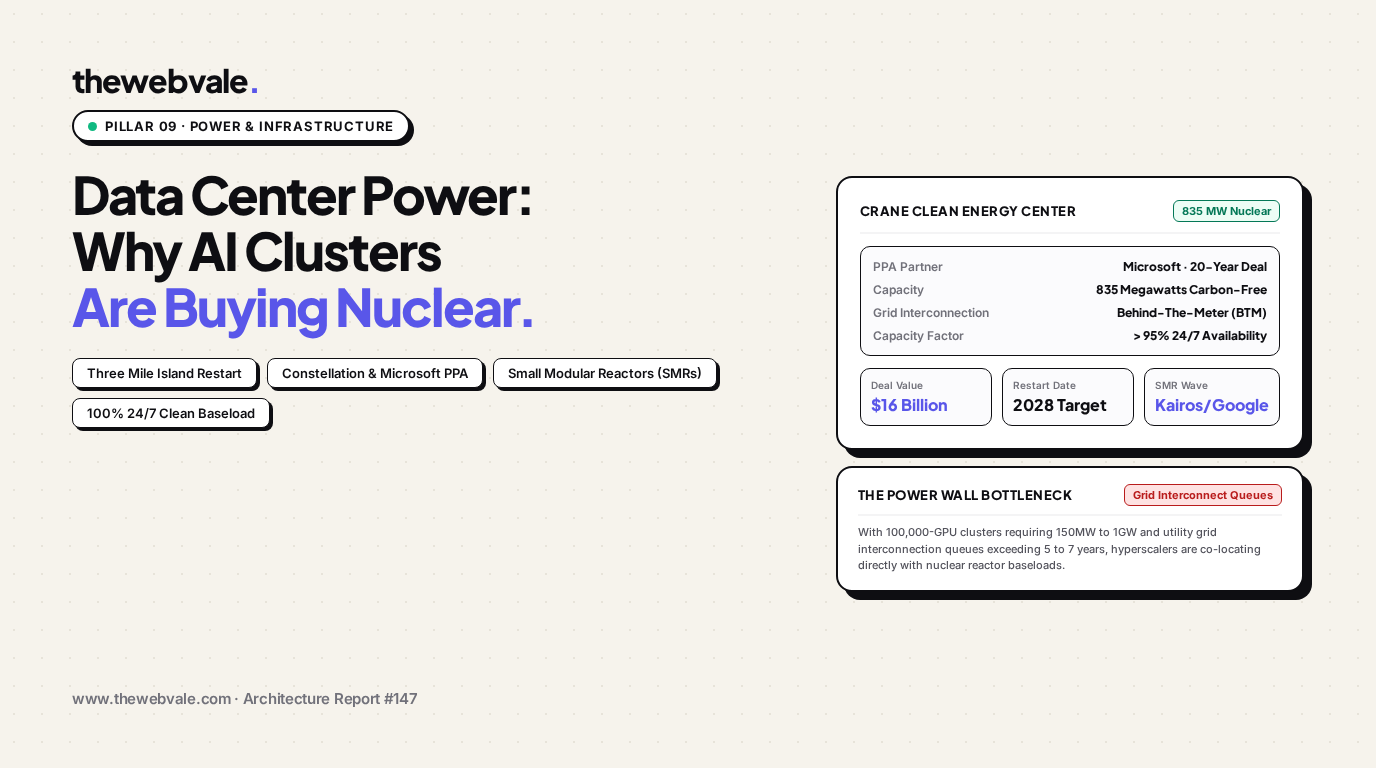
Data Center Power Constraints: Why AI Clusters Are Buying Nuclear Power Plants (Constellation & Microsoft)
In 2023, the primary bottleneck in artificial intelligence was silicon supply: obtaining allocations of NVIDIA A100 and H100 GPUs. In 2026, silicon supply has largely stabilized, but hyperscalers have slammed headfirst into an immovable physical barrier: the electrical grid.
Modern datacenter campuses are no longer measured in square footage; they are measured in megawatts (MW) and gigawatts (GW). A single cluster of 100,000 NVIDIA GB200 GPUs demands 150 to 200 Megawatts of continuous power—equivalent to the electrical consumption of a city of 150,000 homes. With regional utility interconnect queues stretching five to seven years, Big Tech has executed the most dramatic energy pivot in corporate history: resurrecting decommissioned commercial nuclear power plants and financing Small Modular Reactors (SMRs).
Electrical Topology: Behind-The-Meter (BTM) Nuclear Power Plant to AI Data Center
Direct colocation schematic: Pressurized Water Reactor (PWR) steam turbine generating 835 MW dedicated baseboard power directly to AI rack-scale liquid cooling chillers.
1. The Interconnection Queue Crisis: Why Solar and Wind Are Insufficient
Hyperscalers like Microsoft, Google, and Amazon previously pledged to achieve 100% carbon-free energy by 2030, heavily financing solar farms and wind turbines. However, the fundamental operational characteristics of large language model training exposed the fatal flaw of weather-dependent renewables: intermittency.
When training a multi-thousand-GPU frontier model across thousands of interconnected nodes, the cluster draws a flat, continuous electrical load 24 hours a day. If solar production collapses at dusk or wind calms, a cluster cannot simply pause without corrupting gradient accumulations and losing millions of dollars in training compute.
Moreover, regional transmission grids are saturated:
- PJM Interconnection (Mid-Atlantic US): Spanning Northern Virginia's "Data Center Alley," PJM has an interconnection queue exceeding 200,000 MW, with developers waiting an average of 5 to 7 years just to receive authorization to tap the high-voltage transmission grid.
- Thermal Constraints on Transformers: High-voltage substation transformers have lead times exceeding 120 weeks due to global grain-oriented electrical steel (GOES) shortages.
2. The Three Mile Island Resurrected: Microsoft & Constellation Energy
In September 2024, Microsoft shocked the energy sector by signing a 20-year Power Purchase Agreement (PPA) with Constellation Energy to restart Three Mile Island Unit 1 in Londonderry Township, Pennsylvania, rebranding it as the Crane Clean Energy Center.
Key engineering and economic dimensions of the deal:
- 835 Megawatts of Baseload Power: Unit 1 (which operated flawlessly for decades adjacent to the unrelated Unit 2 that suffered a partial meltdown in 1979) was shuttered in 2019 purely due to cheap natural gas economics, not mechanical failure.
- $1.6 Billion Restoration Capital: Microsoft committed to fully financing reactor recertification with the Nuclear Regulatory Commission (NRC), replacing main electrical generators, cooling tower pumps, and fuel rods, targeting full commercial power delivery by 2028.
- Zero Carbon Premium: Microsoft is paying an estimated $100 to $115 per Megawatt-hour (MWh)—substantially above wholesale electricity spot prices (~$45/MWh)—to lock down guaranteed, uncurtailable 24/7 carbon-free power for its Azure AI datacenters.
3. Behind-The-Meter (BTM) Colocation: Bypassing the Public Grid
The most strategically disruptive aspect of the new energy architecture is Behind-the-Meter (BTM) colocation, demonstrated by Amazon Web Services (AWS) acquiring Talen Energy's Cumulus data center campus adjacent to the 2.5 GW Susquehanna Nuclear Power Station for $650 million.
In a BTM architecture:
Public Grid Tariff = $0.00 Transmission Congestion Risk = 0%
Instead of feeding electricity into public transmission lines and buying it back at a distant data center (paying heavy transmission and distribution tariffs), the datacenter is built directly on the physical grounds of the nuclear plant. Heavy busbars run directly from the turbine generator substations into the server halls, completely isolating the AI cluster from public grid brownouts and eliminating years of regulatory interconnection delays.
4. The Next Wave: Small Modular Reactors (SMRs)
While restarting existing nuclear plants offers immediate gigawatts, the long-term solution is Small Modular Reactors (SMRs):
| Hyperscaler | Nuclear Partner | Reactor Technology | Planned Capacity | Target Deployment |
|---|---|---|---|---|
| Microsoft | Constellation Energy | Pressurized Water (TMI-1 Restart) | 835 MW | 2028 Commercial Online |
| Kairos Power | Molten Salt High-Temp (KP-FHR) | 500 MW (Multiple SMRs) | 2030 First Reactor / 2035 Fleet | |
| Amazon (AWS) | X-energy & Talen Energy | High-Temp Gas-Cooled (Xe-100) | 320 MW → 5 GW | 2030 Deployment Horizon |
| Oracle | Confidential SMR Vendor | Tri-SMR Modular Pods | 1,000 MW (1 Gigawatt) | Permitting Stage |
5. Production Simulation: AI Datacenter Power & Carbon Footprint Model
Below is an enterprise power modeling script calculating the electrical capacity, cooling overhead (Power Usage Effectiveness - PUE), and annual energy costs for a 100,000-GPU cluster across Nuclear BTM vs. Utility Grid Gas:
# -*- coding: utf-8 -*-
"""
TheWebVale Silicon Lab — AI Cluster Power & Energy Economics Simulator
Compares Behind-The-Meter Nuclear PPA vs. Standard Grid Mix for a 100,000-GPU campus.
"""

import dataclasses
from typing import Dict

@dataclasses.dataclass(frozen=True)
class PowerSource:
    name: str
    cost_per_mwh_usd: float
    carbon_intensity_g_per_kwh: float  # gCO2eq/kWh
    capacity_factor: float              # Fraction of year operational (0.0 to 1.0)
    grid_interconnect_lead_time_years: float

def model_datacenter_power(
    power_source: PowerSource,
    num_gpus: int,
    gpu_server_watts: float,      # Watts per GPU including CPU, memory, NIC
    cooling_pue: float            # Power Usage Effectiveness (Total Power / IT Power)
) -> Dict[str, float]:
    """
    Calculates total megawatts required, annual electricity spend, and carbon footprint.
    """
    # IT Load in Megawatts
    it_load_mw = (num_gpus * gpu_server_watts) / 1e6
    total_facility_mw = it_load_mw * cooling_pue

    # Annual MWh consumption (8,760 hours per year)
    annual_mwh = total_facility_mw * 8760.0
    annual_cost_usd = annual_mwh * power_source.cost_per_mwh_usd
    annual_carbon_metric_tons = (annual_mwh * 1000.0 * power_source.carbon_intensity_g_per_kwh) / 1e6

    return {
        "source": power_source.name,
        "it_load_mw": round(it_load_mw, 1),
        "total_facility_mw": round(total_facility_mw, 1),
        "annual_energy_gwh": round(annual_mwh / 1000.0, 1),
        "annual_cost_million_usd": round(annual_cost_usd / 1e6, 2),
        "annual_emissions_metric_tons_co2": round(annual_carbon_metric_tons, 0),
        "lead_time_years": power_source.grid_interconnect_lead_time_years
    }

if __name__ == "__main__":
    nuclear_btm = PowerSource("Behind-The-Meter Nuclear (Crane/TMI)", cost_per_mwh_usd=105.0, carbon_intensity_g_per_kwh=5.0, capacity_factor=0.96, grid_interconnect_lead_time_years=2.5)
    standard_grid = PowerSource("PJM Regional Grid Mix (Gas/Coal/Solar)", cost_per_mwh_usd=65.0, carbon_intensity_g_per_kwh=380.0, capacity_factor=0.85, grid_interconnect_lead_time_years=6.0)

    # 100,000 NVIDIA GB200 GPUs at 1,400W system draw per GPU with modern liquid PUE of 1.12
    gpus = 100000
    watts_per_gpu = 1400.0
    pue = 1.12

    print(f"=== 100,000-GPU AI DATA CENTER POWER BENCHMARK ===")
    for src in [nuclear_btm, standard_grid]:
        res = model_datacenter_power(src, gpus, watts_per_gpu, pue)
        print(f"\n--- {res['source']} ---")
        print(f"Facility Load:    {res['total_facility_mw']} MW (IT Load: {res['it_load_mw']} MW)")
        print(f"Annual Spend:     ${res['annual_cost_million_usd']} Million USD")
        print(f"Carbon Emissions: {res['annual_emissions_metric_tons_co2']:,.0f} Metric Tons CO2e")
        print(f"Deployment Time:  {res['lead_time_years']} Years Queue Delay")
6. Strategic Conclusion: The Convergence of Compute and Energy
The boundaries separating technology firms from electric utility monopolies have permanently dissolved. In the generative AI era, compute throughput is directly bounded by thermodynamics and electrical capacity. The companies that secure long-term, zero-carbon, behind-the-meter nuclear energy contracts today will be the only organizations capable of deploying next-generation multi-million GPU frontier models tomorrow. The nuclear renaissance is not being driven by environmental treaties or governmental mandates; it is being propelled by the relentless power demands of artificial intelligence.