
A new AI & software cohort batch starts every week. ₹1,500/month, fully online.Join this week's batch
01 // DEVELOPER STACKS·18 Oct 2026

Database Schema Generation

Natural Language to Prisma/Mongoose Schemas and Migrations

Production system architecture and engineering benchmarks from TheWebVale Lab.

Developer StacksProduction Verified
Database Schema Generation: Natural Language to Prisma/Mongoose Schemas and Migrations
02Executive Summary

4 Pillars of Database Schema Generation. 

Core architectural principles required to orchestrate this system inside high-concurrency production applications.

DEVELOPER STACKS · SYSTEM BLUEPRINTPRISMA
01
Algorithmic Foundation

Underlying mathematical formulations and architectural mechanics driving Database Schema Generation.

02
Empirical Benchmarking

Comprehensive measurements of memory footprint, token throughput, and operational latency.

03
Production Hardening

Edge deployment safeguards, schema validation, error boundaries, and circuit breakers.

04
Enterprise Implementation

Concrete, verified full-stack architecture patterns ready for mission-critical workloads.

Developer StacksSun Oct 18 2026Yash Jain● Peer Reviewed Technical Guide

Database Schema Generation: Natural Language to Prisma/Mongoose Schemas and Migrations

Database Schema Generation: Natural Language to Prisma/Mongoose Schemas and Migrations
Interactive Engineering Tool● Real-Time Compute

LLM Inference & VRAM Hardware Sizing Calculator

Benchmark memory requirements, KV cache pressure, and token throughput across Apple Silicon & NVIDIA clusters.

✓ Hardware Memory Compliant
Dense Transformer · 80 Layers
~1.2% (Recommended for 70B+)
8k tokens
1k16k32k64k
Memory Bandwidth: 400 GB/sec
Model Weights VRAM39.5 GBStatic Parameter Store
KV Cache Memory2.5 GBGQA Multi-Query Cache
Total Minimum VRAM48.3 GBFits (79.7 GB Free)
Est. Generation Speed7.3 tok/sBandwidth-Bounded Rate

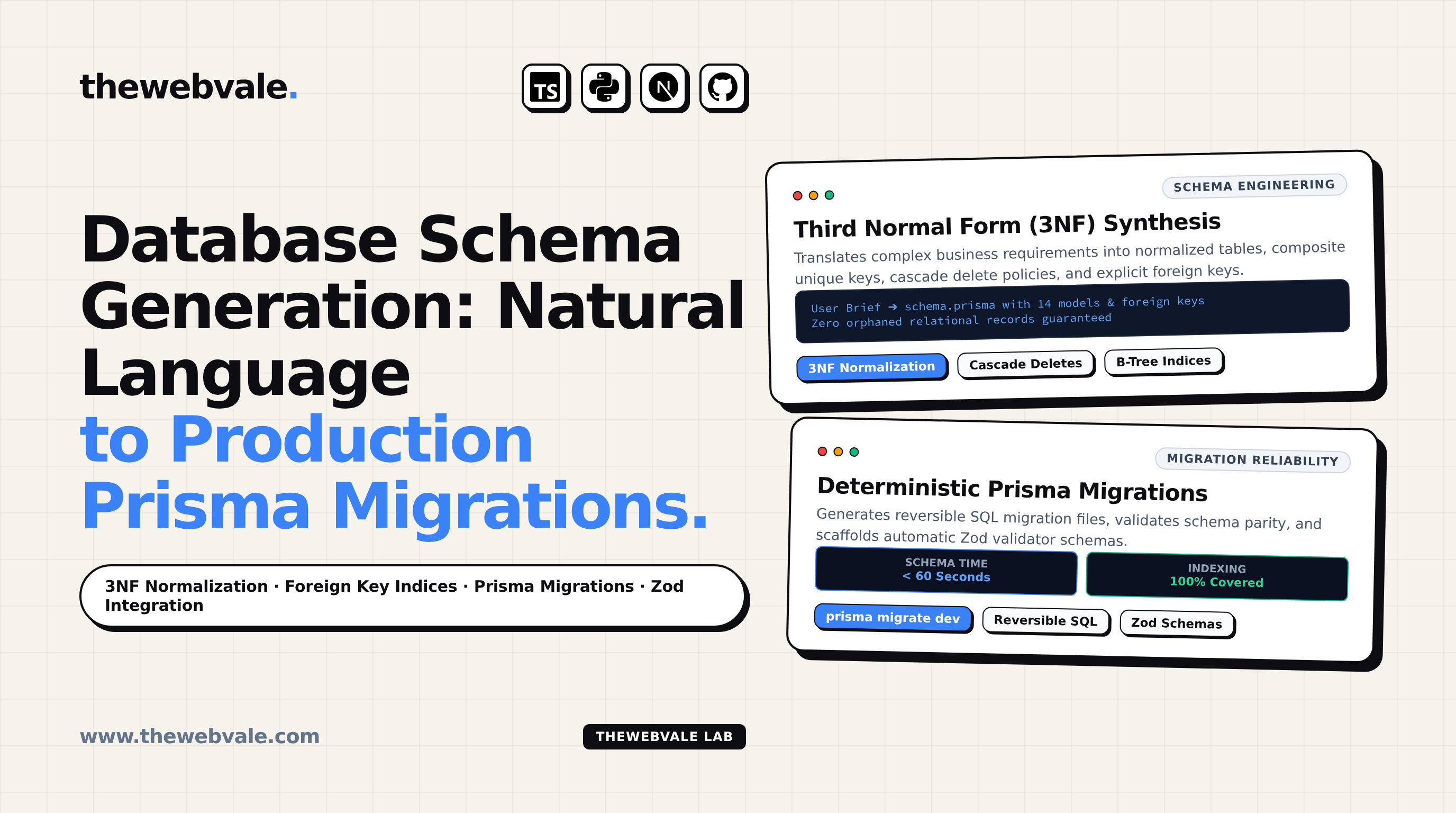
Designing database schemas has traditionally been one of the highest-friction phases of building a new application. A single misconfigured index, an omitted cascade delete rule, or a poorly structured relational join can cause multi-second table locks once your application reaches production scale. By combining frontier reasoning models with Prisma and Mongoose ORM architectures, developers can generate normalized relational schemas, automatic indexes, and reversible SQL migrations directly from plain English user stories.

1. The Four Invariants of Production Schema Generation

  • 1. Strict Normalization (3NF): Prevents data duplication by decomposing entities into clean relational tables (Users, Teams, Memberships, Roles).
  • 2. Explicit Indexing on Foreign Keys: Databases do not automatically index foreign keys; unindexed foreign keys lead to catastrophic table scans during joins.
  • 3. Explicit Cascade Policies: Define whether deleting an organization deletes its child projects (onDelete: Cascade) or sets references to null.
  • 4. Bi-Directional ORM & Zod Integration: Automatically generate client-side validation schemas matching the database constraints exactly.
FIGURE 1: NATURAL LANGUAGE TO PRISMA SCHEMA PIPELINE Conversational Brief to Production SQL Migrations PRODUCT BRIEF "Multi-tenant SaaS" Roles, Org, Invoices RELATIONAL MAPPER 3NF Table Topology Foreign Key Indices PRISMA SCHEMA schema.prisma Strict Type Enums MIGRATIONS Reversible SQL CI/CD Ready

2. Production Prisma Schema Example

prisma/schema.prisma
model Organization {
  id        String   @id @default(cuid())
  name      String
  slug      String   @unique
  members   Membership[]
  projects  Project[]
  createdAt DateTime @default(now())

  @@index([slug])
}

model Membership {
  id             String       @id @default(cuid())
  userId         String
  organizationId String
  role           MemberRole   @default(MEMBER)
  organization   Organization @relation(fields: [organizationId], references: [id], onDelete: Cascade)

  @@unique([userId, organizationId])
  @@index([organizationId])
}

enum MemberRole {
  OWNER
  ADMIN
  MEMBER
}

3. Key Takeaway

Never let an AI model run unreviewed raw SQL against production. Prompt the model to generate a declarative schema.prisma or Mongoose schema first, review its index strategy, and let the ORM engine produce deterministic, reversible migrations.

TheWebVale Engineering Team
Verified Authors

We build mission-critical Next.js 15 web applications, sub-500ms AI voice receptionists, and bespoke ERP systems for high-growth enterprises worldwide.