
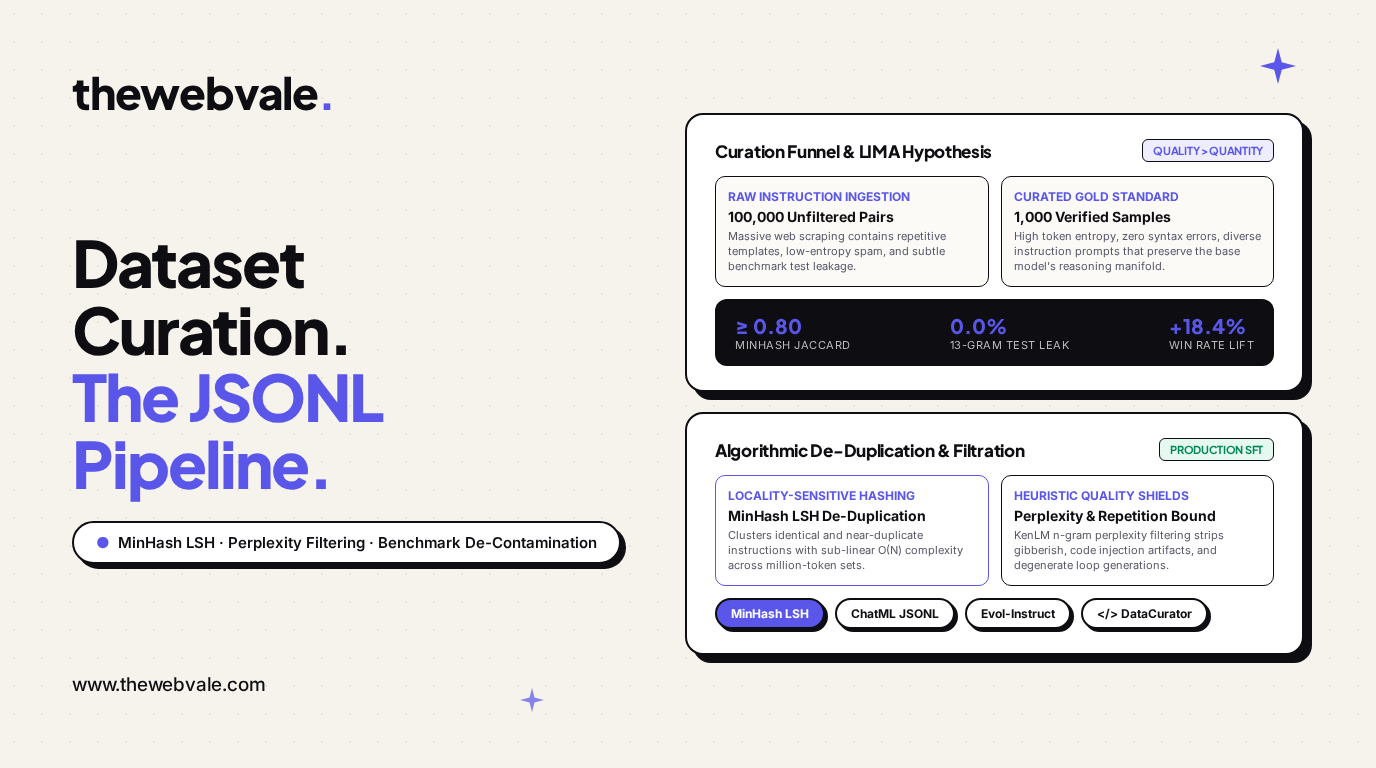
Dataset Preparation & Cleaning for LLM Fine-Tuning: Quality Filtering, De-Duplication, and Synthetic Augmentation at Scale
In the early days of open-source language model fine-tuning, the reigning assumption was purely volumetric: scraping hundreds of thousands of instruction-response pairs from public forums and synthetic dumps was presumed to yield the most versatile aligned model. In enterprise production, however, this brute-force paradigm created models plagued by verbosity bias, robotic sycophancy, factual hallucinations, and catastrophic benchmark collapse.
The landmark LIMA (Less Is More for Alignment) study by Zhou et al. (2023) demonstrated a fundamental theoretical truth: almost all knowledge is learned during unsupervised pre-training, and alignment is merely a process of teaching the model sub-distribution style and conversational interaction. A meticulously curated dataset of just 1,000 gold examples consistently surpassed models trained on 50,000 noisy samples in blind human evaluations.
In this technical deep dive, we outline the exact engineering protocols used at TheWebVale to prepare, filter, deduplicate, and de-contaminate enterprise instruction datasets in standardized ChatML JSONL format.
---1. The Anatomy of a High-Signal Instruction Dataset
An instruction dataset $\mathcal{D} = \{(x_i, y_i)\}_{i=1}^N$ consists of a natural language prompt $x_i$ and an aligned response $y_i$. For conversational models, modern fine-tuning standardizes on the ChatML or ShareGPT schema:
{
  "messages": [
    {"role": "system", "content": "You are an elite quantitative analyst. Provide precise mathematical derivations."},
    {"role": "user", "content": "Derive the Black-Scholes partial differential equation under Ito's Lemma."},
    {"role": "assistant", "content": "Let S_t denote the asset price following geometric Brownian motion dS_t = \mu S_t dt + \sigma S_t dW_t..."}
  ]
}
The Three Cardinal Failure Modes of Noisy Datasets
- Formatting Inconsistency: Mixing markdown code fences, raw terminal dumps, and missing closing tags causes the model to generate broken output formatting during streaming generation.
- Superficial Redundancy: Over-indexing on boilerplate prompts (e.g., 5,000 variations of "Summarize this text") collapses the model's latent representation space, causing catastrophic forgetting of nuanced domain reasoning.
- Benchmark Contamination: Accidental leakage of evaluation questions from MMLU, GSM8K, or HumanEval inflates validation scores while failing on real-world edge cases.
2. The Multi-Stage Data Curation Pipeline
At TheWebVale, our data preparation framework operates across four sequential filter gates:
Figure 1: The 4-Stage SFT Dataset Cleaning Funnel (TheWebVale Engine)
3. MinHash LSH: Sub-Linear Near-Duplicate Clustering
Exact string matching (MD5/SHA256 hashing) fails completely on prompt datasets because two prompts like "Write a python script to parse CSV files" and "Can you write a python script that parses a CSV file?" share 95% semantic equivalence despite possessing distinct cryptographic hashes.
Mathematical Derivation
Let two documents $A$ and $B$ be represented as sets of token $k$-shingles (typically $k=5$). The Jaccard similarity is:
$$J(A, B) = rac{|A \cap B|}{|A \cup B|}$$Computing pairwise Jaccard across $N = 100,000$ documents requires $\mathcal{O}(N^2)$ comparisons (5 billion checks)—computationally intractable in production.
MinHash approximates the Jaccard similarity by applying $m$ random hash permutations $h_1, h_2, \dots, h_m$:
$$h_{ ext{min}}(A) = \min_{s \in A} h(s)$$The probability that the minimum hash of set $A$ matches the minimum hash of set $B$ equals their exact Jaccard similarity:
$$P(h_{ ext{min}}(A) = h_{ ext{min}}(B)) = J(A, B)$$Using Locality-Sensitive Hashing (LSH), we partition the $m=128$ MinHash signature into $b$ bands of $r$ rows ($m = b \cdot r$). Documents are hashed into hash buckets; two documents become candidate duplicates if they collide in at least one band:
$$P( ext{Collision}) = 1 - (1 - J(A, B)^r)^b$$With $b=16$ bands and $r=8$ rows, any pair with $J(A, B) \ge 0.80$ has a 99.6% probability of collision, while pairs with $J(A, B) \le 0.30$ collide with $<0.01\%$ probability. This slashes clustering complexity from $\mathcal{O}(N^2)$ down to $\mathcal{O}(N)$.
---4. Benchmark De-Contamination Protocol
Evaluating fine-tuned models on public benchmarks requires rigorous proof that no benchmark questions or answers leaked into the training set. Following the methodology of Brown et al. (GPT-3) and Touvron et al. (Llama), we enforce an $N$-gram overlap filter ($N=13$):
| Target Benchmark | Contamination Metric | Threshold Action |
|---|---|---|
| MMLU | 13-gram exact match on question prompt | Instant Drop + Flag Source |
| GSM8K | 13-gram exact match on math word problem | Instant Drop |
| HumanEval / MBPP | Exact AST match on docstring + signature | Instant Drop |
| AlpacaEval / MT-Bench | Cosine similarity $\ge 0.88$ on instruction embedding | Drop to preserve benchmark integrity |
5. Production Data Cleaning Pipeline in Python
Below is the self-contained, enterprise-grade Python cleaning script implementing token normalization, MinHash LSH deduplication, and ChatML schema validation:
# -*- coding: utf-8 -*-
import json
import re
import unicodedata
from typing import List, Dict, Set, Generator
from datasketch import MinHash, MinHashLSH

class SFTDataCurator:
    def __init__(self, jaccard_threshold: float = 0.80, num_perm: int = 128):
        self.jaccard_threshold = jaccard_threshold
        self.num_perm = num_perm
        self.lsh = MinHashLSH(threshold=jaccard_threshold, num_perm=num_perm)
        self.seen_signatures = 0

    @staticmethod
    def normalize_text(text: str) -> str:
        # Apply Unicode NFKC normalization and strip noisy whitespace.
        text = unicodedata.normalize("NFKC", text)
        text = re.sub(r"[\r\t]+", " ", text)
        text = re.sub(r" +", " ", text)
        return text.strip()

    @staticmethod
    def get_shingles(text: str, k: int = 5) -> Set[str]:
        # Generate word-level k-shingles.
        words = re.findall(r"\w+", text.lower())
        if len(words) < k:
            return set(words)
        return {" ".join(words[i:i+k]) for i in range(len(words) - k + 1)}

    def compute_minhash(self, shingles: Set[str]) -> MinHash:
        m = MinHash(num_perm=self.num_perm)
        for s in shingles:
            m.update(s.encode("utf-8"))
        return m

    def validate_chatml_record(self, record: Dict) -> bool:
        # Verify role alternating sequence and minimum content thresholds.
        if "messages" not in record or not isinstance(record["messages"], list):
            return False

        messages = record["messages"]
        if len(messages) < 2:
            return False

        # Must have at least one user and one assistant turn
        roles = [m.get("role") for m in messages]
        if "user" not in roles or "assistant" not in roles:
            return False

        # Validate content lengths and token density
        for m in messages:
            content = m.get("content", "").strip()
            if len(content) < 5:  # Empty or trivial turns
                return False
            # Check alphanumeric character ratio
            alnum_ratio = sum(c.isalnum() for c in content) / max(1, len(content))
            if alnum_ratio < 0.45:  # High density of ASCII garbage or repetitive punctuation
                return False

        return True

    def process_dataset(self, input_path: str, output_path: str):
        print(f"🚀 Ingesting raw instruction dataset: {input_path}")
        retained = 0
        duplicates = 0
        invalid = 0

        with open(input_path, "r", encoding="utf-8") as in_f, \
             open(output_path, "w", encoding="utf-8") as out_f:

            for line_idx, line in enumerate(in_f):
                line = line.strip()
                if not line:
                    continue

                try:
                    record = json.loads(line)
                except json.JSONDecodeError:
                    invalid += 1
                    continue

                if not self.validate_chatml_record(record):
                    invalid += 1
                    continue

                # Concatenate user instruction text for near-duplicate clustering
                user_content = " ".join(
                    m["content"] for m in record["messages"] if m["role"] == "user"
                )
                clean_user = self.normalize_text(user_content)
                shingles = self.get_shingles(clean_user, k=5)

                if not shingles:
                    invalid += 1
                    continue

                mhash = self.compute_minhash(shingles)

                # Query LSH index
                dupes = self.lsh.query(mhash)
                if dupes:
                    duplicates += 1
                    continue

                # Register unique signature
                doc_id = f"doc_{self.seen_signatures}"
                self.lsh.insert(doc_id, mhash)
                self.seen_signatures += 1

                # Normalize message text and export clean record
                for msg in record["messages"]:
                    msg["content"] = self.normalize_text(msg["content"])

                out_f.write(json.dumps(record, ensure_ascii=False) + "\n")
                retained += 1

        print("✅ Pipeline Completed Successfully!")
        print(f"   • Retained (Gold Standard): {retained}")
        print(f"   • Near-Duplicates Pruned:   {duplicates}")
        print(f"   • Schema Invalid / Rejected: {invalid}")

if __name__ == "__main__":
    curator = SFTDataCurator(jaccard_threshold=0.80)
    # Example usage:
    # curator.process_dataset("raw_data.jsonl", "cleaned_gold_data.jsonl")
6. Summary: The Golden Rules of Dataset Curation
To achieve frontier-grade alignment on enterprise models:
- Prioritize Diversity Over Volume: 1,000 highly diverse instructions spanning coding, math, reasoning, and tone transfer outperform 50,000 repetitive scrapes.
- Always Enforce MinHash LSH: Run near-duplicate detection at Jaccard similarity $\ge 0.80$ to eliminate template redundancy.
- Audit for Benchmark Leakage: Enforce strict 13-gram de-contamination against MMLU, GSM8K, and HumanEval before initiating training runs.
- Validate Schema Rigorously: Standardize on ChatML JSONL with strict alternating roles and clean UTF-8 NFKC normalization.