
The Death of LeetCode: Why Inversion of Binary Trees Is Yielding to System Architecture & Execution
For more than a decade, the gateway to lucrative engineering careers at Silicon Valley tech giants was governed by an unspoken ritual: algorithmic hazing via LeetCode. Candidates spent hundreds of grueling hours memorizing obscure trick solutions to dynamic programming puzzles, reversing linked lists on dry-erase whiteboards, and balancing red-black binary search trees.
In 2026, the LeetCode paradigm is officially dead. Frontier language models (OpenAI o1, DeepSeek-R1, Claude 3.5 Sonnet) now solve LeetCode Hard competitive programming challenges in under five seconds with zero compilation errors, achieving competitive ratings exceeding 2,400 on Codeforces (Grandmaster level). When an AI can solve every textbook puzzle effortlessly, testing a human candidate on algorithmic memorization reveals nothing about their engineering caliber. In this report, we examine the structural collapse of algorithmic screening and analyze the new hiring gold standard: distributed systems architecture, live chaos debugging, and AI-paired execution.
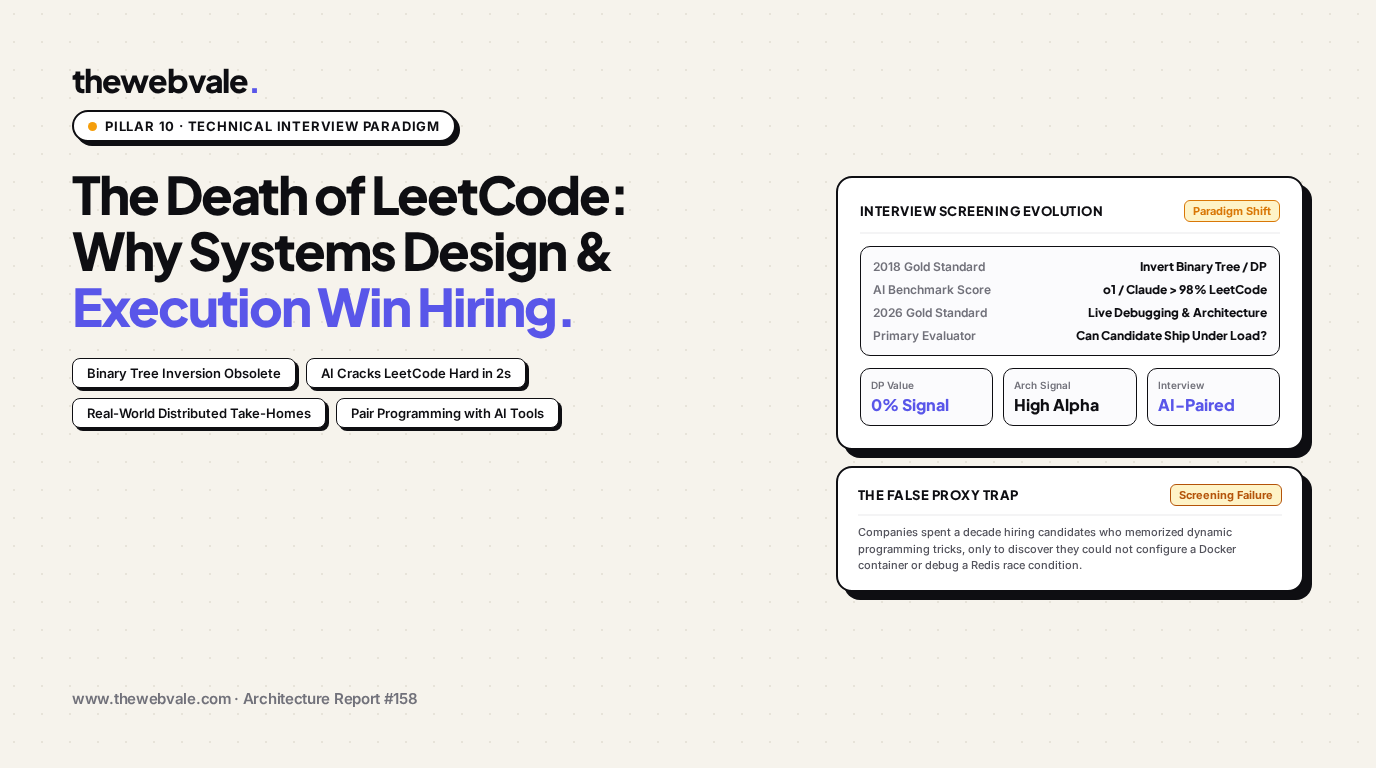
Interview Evolution: From Memorized Puzzles to Production Execution
Contrasting the obsolete 2018 algorithmic hazing model against the 2026 production-grade systems evaluation rubric.
1. Why LeetCode Survived So Long (The Lazy Filtering Mechanism)
To understand why LeetCode dominated hiring for so long, we must recognize that it was never designed to test good software engineering. It was designed as an efficient negative filter for recruiters receiving 50,000 applications per week.
Hiring managers at Google, Meta, and Amazon needed a deterministic, automated grading rubric:
- If an automated test suite executed 50 hidden test cases and passed in under 12 milliseconds with \(O(N \log N)\) time complexity, the candidate was graded a "Pass."
- It required zero human engineering hours to grade.
- However, it created a toxic cargo-cult industry: millions of talented engineers memorized tricks for dynamic programming problems they would never write in production, while software systems in production suffered from basic race conditions, missing indexes, unauthenticated endpoints, and unhandled network timeouts.
2. The Modern Technical Interview: Three Core Formats
Forward-thinking technology companies have completely restructured their interview loops around three high-signal formats:
A. Live Production Incident Response & Chaos Debugging
Instead of asking a candidate to implement Dijkstra's algorithm, the interviewer spins up an isolated Docker container containing a simulated, broken distributed application:
- The service is throwing HTTP 504 Gateway Timeouts under load.
- The candidate must inspect Prometheus metrics, parse Postgres slow query logs, discover an un-indexed foreign key causing table scans, implement a Redis distributed lock to prevent thundering herds, and deploy a hotfix in 45 minutes.
- This tests true senior engineering instincts: mental models of distributed failure, log literacy, and composure under pressure.
B. AI-Paired Architecture Sprints
Rather than banning AI tools, top companies now require candidates to use AI assistants (Cursor, Claude Code, GitHub Copilot) during the interview.
- The candidate is given a complex architectural specification (e.g., build an idempotent payment webhook receiver with retry backoff and replay protection).
- The interviewer does not watch keystroke speed; they observe how the candidate prompts the model, whether they catch subtle race conditions in the model's generated code, and how rigorously they design automated tests to break the AI's assumptions.
C. Real-World Schema Design & Blast Radius Analysis
The candidate is asked to design a real-world database schema (SQL vs. NoSQL) for a platform with 10 million concurrent users, analyzing partitioning strategies, replication lag consistency models, and multi-tenant isolation.
3. Empirical Comparison: LeetCode vs. Modern Assessment Signals
| Interview Dimension | Legacy LeetCode Hazing | Modern Systems Execution Interview | Predictive Hiring Signal |
|---|---|---|---|
| Primary Capability Tested | Rote puzzle memorization & trick syntax | Architecture, debugging, & verification | High correlation with production output |
| AI Vulnerability | 100% Solved by LLMs (o1/Claude: 98%+) | Requires human taste & verification | Immune to unthinking copy-paste |
| Development Environment | Sterile browser code editor / Whiteboard | Full local IDE, git, terminal & AI tools | Reflects authentic daily workflow |
| Error Handling Evaluation | Edge cases = Index out of bounds (off-by-one) | Network timeouts, deadlocks, data corruptions | Tests real-world resilience |
| Candidate Experience | Hostile, adversarial, stress-inducing | Collaborative pair programming | Attracts top-tier senior talent |
4. Production Code: The Real-World Interview Testbed (Idempotent Webhook Handler)
Below is an example of a modern, production-grade technical interview problem: implementing an idempotent webhook ingestion handler with atomic Redis locks and retry backoff:
# -*- coding: utf-8 -*-
"""
TheWebVale Engineering Lab — Real-World Technical Interview Challenge
Idempotent Webhook Processor with Redis Distributed Lock & Replay Protection.
"""

import time
import hashlib
from typing import Dict, Tuple

class MockRedisCluster:
    """In-memory simulation of Redis SETNX and TTL operations."""
    def __init__(self):
        self.store: Dict[str, Tuple[str, float]] = {}

    def setnx(self, key: str, value: str, ttl_seconds: float) -> bool:
        now = time.time()
        # Clean expired
        if key in self.store and now > self.store[key][1]:
            del self.store[key]

        if key in self.store:
            return False  # Lock failed / Key already exists

        self.store[key] = (value, now + ttl_seconds)
        return True

class IdempotentWebhookProcessor:
    def __init__(self, redis: MockRedisCluster):
        self.redis = redis
        self.processed_events = set()

    def process_event(self, event_payload: str, event_id: str) -> Dict[str, any]:
        """
        Processes webhook event with strict idempotency and concurrency guards.
        """
        lock_key = f"lock:webhook:{event_id}"
        processed_key = f"processed:webhook:{event_id}"

        # 1. Acquire Distributed Lock with 5-second TTL
        acquired = self.redis.setnx(lock_key, "LOCKED", ttl_seconds=5.0)
        if not acquired:
            return {
                "status": "CONCURRENT_EXECUTION_BLOCKED",
                "message": "Duplicate request in flight; concurrent lock active.",
                "http_code": 409
            }

        # 2. Check if already permanently processed (Replay protection)
        if not self.redis.setnx(processed_key, "COMPLETED", ttl_seconds=86400.0):
            return {
                "status": "ALREADY_PROCESSED",
                "message": "Event was previously executed and acknowledged.",
                "http_code": 200
            }

        # 3. Execute Business Logic (e.g. billing charge or database transaction)
        # Simulate business action
        self.processed_events.add(event_id)

        return {
            "status": "SUCCESS",
            "event_id": event_id,
            "http_code": 200
        }

if __name__ == "__main__":
    redis = MockRedisCluster()
    processor = IdempotentWebhookProcessor(redis)

    print("=== LIVE TECHNICAL INTERVIEW TEST: IDEMPOTENCY & REPLAY ===")
    # First invocation
    res1 = processor.process_event('{"amount": 100}', event_id="evt_pay_9981")
    print(f"Request 1 (Initial):     {res1['status']} -> Code {res1['http_code']}")

    # Immediate concurrent duplicate
    res2 = processor.process_event('{"amount": 100}', event_id="evt_pay_9981")
    print(f"Request 2 (Duplicate):   {res2['status']} -> Code {res2['http_code']}")
5. Summary: Execution Is the Only Moat
The death of LeetCode is the best development in software engineering in two decades. It liberates developers from hundreds of wasted hours studying trick puzzles that have zero bearing on actual product engineering. In the AI era, where code synthesis is free, the engineers who get hired are those who understand systems, communicate with precision, debug with tenacity, and possess the execution muscle to take an ambiguous idea from whitepaper to production deployment.