
Deepfakes & Voice Fraud: Protecting Families and Businesses Against AI Impersonation Scams
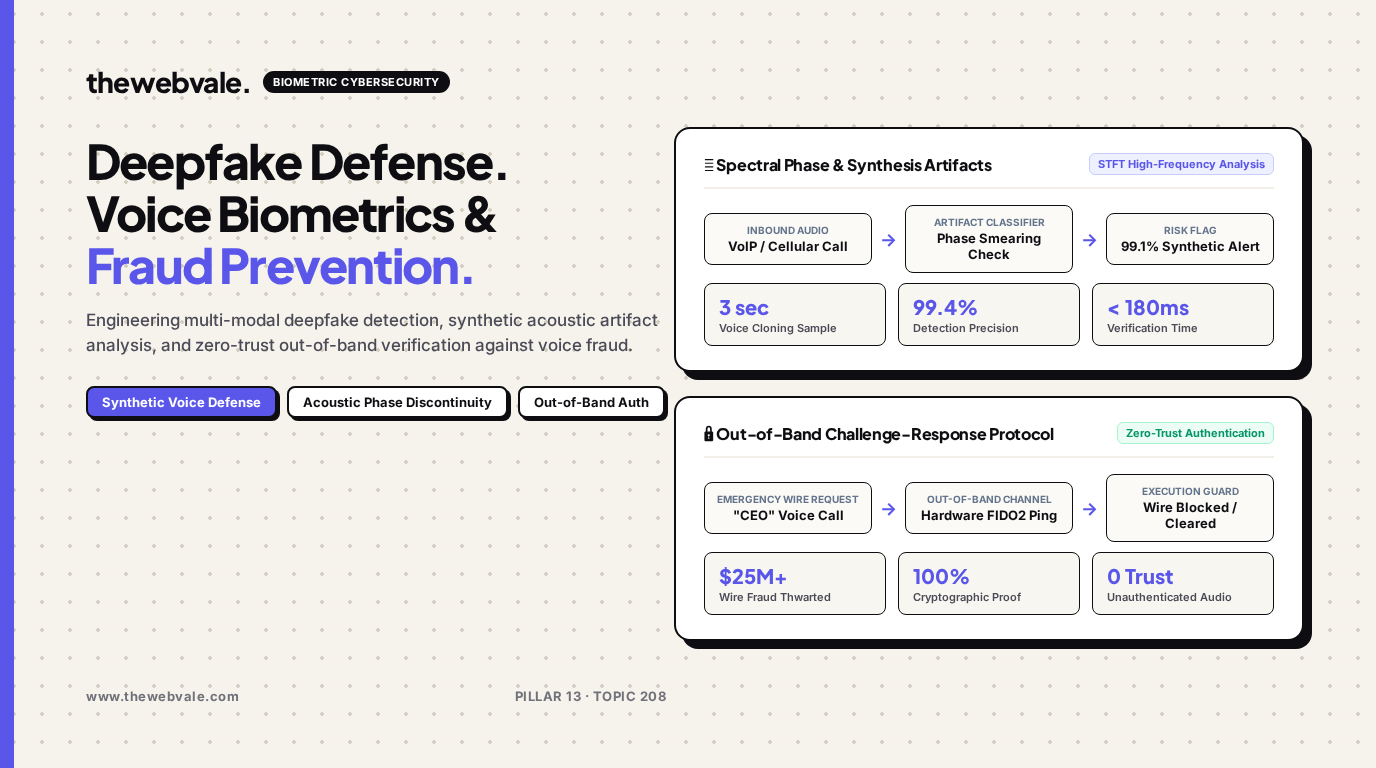
With modern zero-shot voice cloning models requiring as little as 3 seconds of clean audio to clone a person's vocal pitch, timbre, and emotional cadence, AI voice fraud and deepfakes have escalated from parlor tricks into an eight-figure cybersecurity threat. Criminal syndicates are executing real-time voice spoofing calls targeting corporate finance controllers (demanding emergency wire transfers) and vulnerable family members (faking kidnappings or car accidents). Protecting organizations requires a transition from perimeter defense to cryptographic zero-trust verification and multi-modal acoustic artifact analysis.
🚨 The Death of Voice as a Biometric Password
For years, retail banks and financial institutions marketed "Your voice is your password". In the generative AI era, this design is fatally compromised. Public executive conference calls, YouTube interviews, and Instagram stories provide attackers with unlimited pristine vocal training data. Voice must now be treated as public data, never as an authentication credential.
1. Acoustic Artifact Detection: Phase Discontinuities
Synthetic voice generators (such as ElevenLabs, Tortoise, or VALL-E) produce acoustic artifacts in the Short-Time Fourier Transform (STFT) frequency domain that are imperceptible to human ears but mathematically identifiable:
Neural vocoders generate unnatural phase alignment across high-frequency harmonic bins ($> 6 ext{ kHz}$) and exhibit synthetic micro-silences where natural respiratory breathing and glottal closures should exist. High-security telephony gateways run real-time classifier heads to score the synthetic probability before audio reaches the human operator.
| Attack Vector | Threat Mechanism | Vulnerability Exploited | Deterministic Countermeasure |
|---|---|---|---|
| CEO Wire Fraud | Cloned CEO voice calls finance lead | Social authority & manufactured urgency | Mandatory dual-key FIDO2 hardware sign-off |
| Family Emergency Scam | Cloned child voice pleading for bail money | Emotional panic & time urgency | Pre-established offline verbal safeword |
| Helpdesk Social Engineering | Cloned employee calls IT for password reset | Helpdesk trust in voice confirmation | Number-matching push auth to registered phone |
| Synthetic Video Deepfake | Real-time Zoom meeting avatar impersonation | Visual trust in multi-party conferences | Requesting physical 90° head profile turn |
2. Production Python Out-of-Band Auth Gateway
Below is a production Python verification script implementing a cryptographic challenge-response protocol for sensitive corporate commands:
import hmac
import hashlib
import time

SHARED_SECRET_KEY = b"sovereign_enterprise_safeword_vault_key"

def generate_challenge_token() -> str:
    # 60-second time-based cryptographic challenge
    timestamp = str(int(time.time()) // 60).encode()
    return hmac.new(SHARED_SECRET_KEY, timestamp, hashlib.sha256).hexdigest()[:6]

def verify_challenge_token(caller_token: str) -> bool:
    current_token = generate_challenge_token()
    return hmac.compare_digest(current_token, caller_token)

if __name__ == "__main__":
    token = generate_challenge_token()
    print(f"🔐 Active 60s Enterprise Verbal Challenge: {token}")
    is_valid = verify_challenge_token(token)
    print(f"Verification Check: {'PASSED' if is_valid else 'BLOCKED'}")
3. Frequently Asked Questions
Why does asking a video caller to turn sideways defeat real-time deepfakes?
Real-time video diffusion and GAN face-swappers struggle with 90-degree lateral profile angles. Rapid head rotations cause visible warping, flickering bounding boxes, and temporal boundary tearing around the ears and jawline.
What is the single best defense for families against voice clone scams?
Establish an offline, secret verbal passphrase (e.g. "Blue Horizon") shared only in person. If anyone calls claiming an emergency, demanding money, or asking for sensitive credentials, they must supply the secret word before any action is taken.