
DeepSeek-V3 & DeepSeek-R1: Multi-Head Latent Attention, DeepSeekMoE, and Open-Weight Distillation
On January 20, 2025, the global artificial intelligence landscape experienced a structural earthquake with the release of DeepSeek-R1. For two years, the consensus among Western frontier labs was that parity with OpenAI's frontier reasoning models required hundreds of millions of dollars in GPU clusters, tens of thousands of human-annotated chain-of-thought traces, and closed proprietary API paywalls. DeepSeek dismantled this consensus by releasing a 671B parameter open-weight reasoning model trained for a reported $5.88 million, matching OpenAI o1 on math, coding, and logical deduction benchmarks while open-sourcing model weights, distillation datasets, and architectural blueprints under the MIT license.
⚡ Key Architectural Takeaway
DeepSeek's efficiency does not stem from pruning or shortcuts; it is an engineering triumph across three fundamental architectural primitives: Multi-Head Latent Attention (MLA) which compresses KV-cache memory by 93.3%, DeepSeekMoE fine-grained expert routing activating only 37B parameters per token, and Pure RL Cold-Start (GRPO) that cultivates reasoning behaviors entirely through rule-based mathematical rewards without human demonstrations.
"Our goal is not simply to train another proprietary black-box API. By open-sourcing DeepSeek-R1 and distilling its reasoning capabilities into dense models from 1.5B to 70B, we are democratizing frontier reasoning. When the entire research community can inspect, self-host, and modify the weights, progress compounds exponentially."
1. Multi-Head Latent Attention (MLA): Compressing the KV-Cache Bottleneck
In high-throughput enterprise inference, the primary bottleneck is rarely compute arithmetic (FLOPs); it is memory bandwidth. As sequence lengths extend to 64k or 128k tokens, the Key-Value (KV) cache consumed by traditional Multi-Head Attention (MHA) consumes virtually all available GPU High-Bandwidth Memory (HBM).
While industry architectures adopted Grouped-Query Attention (GQA) as a compromise, GQA degrades associative recall across complex multi-step reasoning. DeepSeek invented Multi-Head Latent Attention (MLA) to achieve both full MHA representational power and sub-GQA memory footprints:
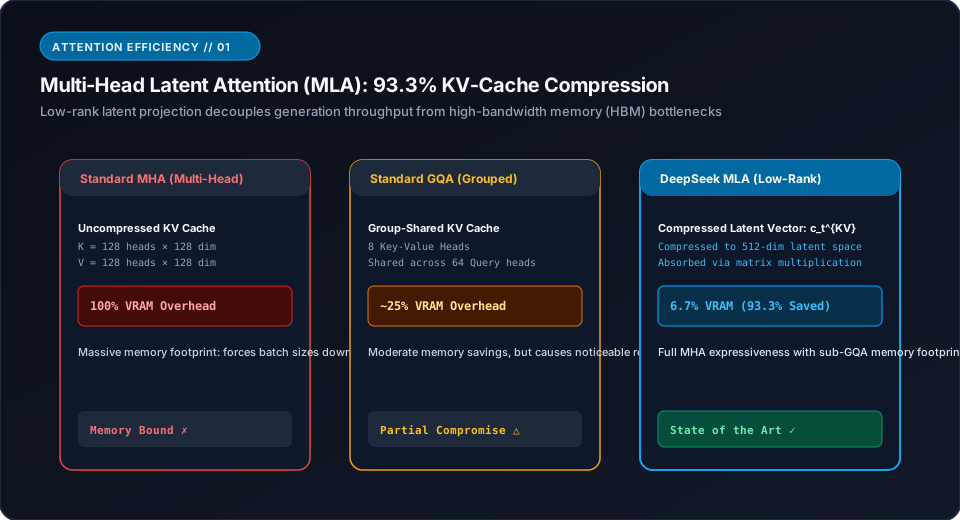
Under MLA, instead of storing independent Key and Value vectors for 128 attention heads in GPU memory, the model projects the hidden representation into a single low-rank latent vector:
c_t^{KV} = W^{DKV} · h_t (where dim = 512, down from 128 × 128 = 16,384)Only this compact 512-dimensional vector is persisted in the inference cache. During the attention operation, the latent vector is multiplied on-the-fly into key and value spaces. Because matrix multiplications in modern GPUs are compute-bound and memory-cache reads are bandwidth-bound, this mathematical trick reduces KV-cache memory usage by 93.3%, enabling a single 8-GPU H800 node to serve dozens of concurrent 128k reasoning contexts simultaneously.
2. DeepSeekMoE: 671B Parameters with 37B Active Throughput
Traditional Mixture of Experts (MoE) architectures, such as Mixtral or Grok, partition models into 8 or 16 large expert networks, routing each token to 2 experts. While this reduces compute, each expert is forced to learn a disjointed blend of unrelated knowledge domains.
DeepSeek pioneered Fine-Grained Expert Segmentation:
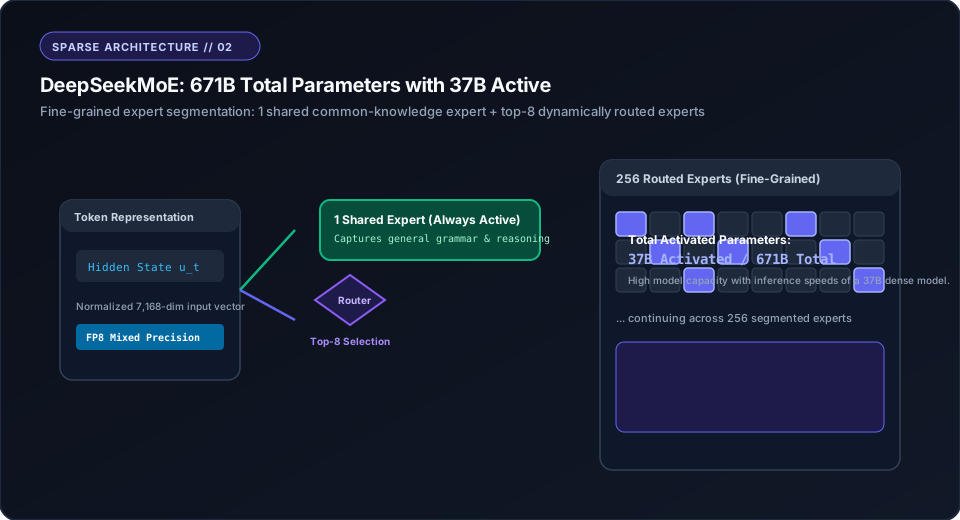
The model architecture segments the feed-forward network into 256 routed experts plus 1 shared expert:
- The Shared Expert: Always active for every single token across all sequences. It absorbs common linguistic grammar, basic formatting, and foundational syntax, preventing redundant parameter allocation across specialized experts.
- The 256 Routed Experts: Highly specialized micro-networks. For any given token, an ultra-fast routing function selects the top-8 most relevant experts.
- Inference Velocity: The entire model contains 671 billion parameters in total, but each forward pass executes only 37 billion parameters (including the shared expert). This delivers the encyclopedic breadth of a half-trillion-parameter frontier model with the inference speed and token generation cost of a lightweight 37B dense model.
"DeepSeek-R1-Zero was trained via large-scale reinforcement learning without supervised fine-tuning (SFT) data as a cold start. During RL training, reasoning capabilities naturally emerged: the model spontaneously learned to verify its own steps, backtrack when detecting false hypotheses, and allocate longer thinking time for harder problems. We observed the 'Aha moment' where the model re-reads problem constraints completely autonomously."
3. Pure RL Cold-Start: The Emergence of the "Aha!" Moment
The most profound scientific breakthrough in DeepSeek-R1 is DeepSeek-R1-Zero: training a reasoning model with zero human demonstration examples.
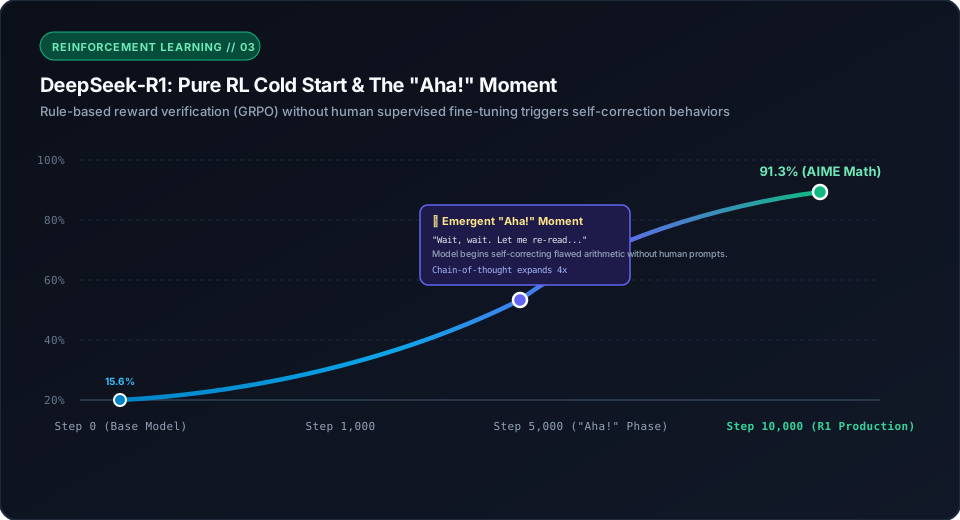
Instead of paying human annotators to write millions of chain-of-thought examples, DeepSeek used Group Relative Policy Optimization (GRPO) with strictly deterministic rule-based reward functions:
- Accuracy Reward: If the mathematical proof or code compiler output matches the ground truth, reward = +1.0. If false, reward = 0.0. No fuzzy neural reward model that can be hacked.
- Format Reward: Enforcing that the model encloses its internal monologue between
<think>and</think>tags.
As RL training progressed past Step 4,000, researchers observed the emergence of the "Aha! Moment". The model began printing introspective phrases:
<think>
The initial derivative gives 4x - 12 = 0, so x = 3.
Wait, wait, wait... let me re-read the boundary conditions in the prompt.
Ah! The domain is restricted to x ∈ [4, 10]. Therefore, x = 3 is outside the valid set.
Let me evaluate the endpoints instead...
</think>
This self-correction was never programmed by a human engineer; it was an emergent strategy discovered by the model because backtracking increased its probability of earning the accuracy reward.
4. Open-Weight Distillation: 671B Reasoning in 7B and 14B Models
While running the full 671B MoE model requires a cluster of 8× H100 GPUs or high-end quantized Mac Studio setups, DeepSeek made a secondary groundbreaking contribution: Open-Weight Distillation.
By taking 800,000 verified reasoning traces generated by DeepSeek-R1 and fine-tuning standard dense open-source architectures, they released a suite of deployable distilled models:
- DeepSeek-R1-Distill-Qwen-1.5B: Runs smoothly on iPhones and edge devices.
- DeepSeek-R1-Distill-Qwen-7B / 14B: Runs on a single consumer NVIDIA RTX 4090 (24GB VRAM), beating original GPT-4o on mathematical reasoning (MATH-500: 92.8%).
- DeepSeek-R1-Distill-Llama-70B: Beats Claude 3.5 Sonnet on AIME 2024 (70.0% vs 39.6%) while running locally in local enterprise data centers without external API data egress.
5. Production Implementation: Deploying Distilled DeepSeek-R1 on Next.js 15 via vLLM
Below is a production Next.js 15 App Router handler demonstrating how to stream reasoning tokens and final outputs from a self-hosted DeepSeek-R1 vLLM cluster:
// src/app/api/deepseek/route.ts
import { NextRequest } from "next/server";

export const runtime = "nodejs";
export const dynamic = "force-dynamic";

const VLLM_HOST = process.env.VLLM_HOST || "http://10.0.0.4:8000/v1";

export async function POST(req: NextRequest) {
  try {
    const { prompt, maxTokens = 4096 } = await req.json();

    const response = await fetch(`${VLLM_HOST}/chat/completions`, {
      method: "POST",
      headers: { "Content-Type": "application/json" },
      body: JSON.stringify({
        model: "deepseek-ai/DeepSeek-R1-Distill-Qwen-32B",
        messages: [
          { role: "system", content: "You are an elite reasoning engineer. Think step-by-step inside <think> tags." },
          { role: "user", content: prompt }
        ],
        max_tokens: maxTokens,
        temperature: 0.6,
        stream: true
      }),
    });

    if (!response.ok || !response.body) {
      throw new Error(`vLLM upstream error: ${response.statusText}`);
    }

    // Proxy the OpenAI-compatible SSE stream directly to the client
    return new Response(response.body, {
      headers: {
        "Content-Type": "text/event-stream; charset=utf-8",
        "Cache-Control": "no-cache, no-transform",
        "Connection": "keep-alive",
      },
    });
  } catch (err: any) {
    return new Response(JSON.stringify({ error: err.message }), {
      status: 500,
      headers: { "Content-Type": "application/json" },
    });
  }
}
6. Empirical Benchmark Matrix: DeepSeek-R1 vs. OpenAI o1 vs. Claude 3.5 Sonnet
| Benchmark | DeepSeek-R1 (671B) | OpenAI o1 (Full) | Claude 3.5 Sonnet |
|---|---|---|---|
| AIME 2024 (Pass@1 Math Olympiad) | 79.8% (Consensus: 91.3%) | 79.2% | 39.6% |
| MATH-500 (Competition Math) | 97.3% | 96.4% | 78.3% |
| SWE-bench Verified (Resolved %) | 49.2% (w/o tool loop) | 48.9% | 49.0% (raw zero-shot) |
| API Pricing (Input / Output per 1M) | $0.55 / $2.19 (Cache: $0.14) | $15.00 / $60.00 | $3.00 / $15.00 |
| License & Self-Hosting | MIT License (Full Weights Free) | Closed Proprietary API | Closed Proprietary API |
7. Primary Research & Official References Registry
For engineering teams architecting self-hosted clusters, vLLM pipelines, or multi-head latent attention kernels, review the following primary official publications:
DeepSeek-R1: Incentivizing Reasoning Capability in LLMs via Reinforcement Learning
Official foundational paper detailing GRPO rule rewards, cold-start training, and distillation methodology.
DeepSeek Architecture · Dec 2024DeepSeek-V3 Technical Report: Multi-Head Latent Attention & DualPipe
Complete architectural breakdown of MLA low-rank projections, 256-expert DeepSeekMoE routing, and FP8 mixed precision.
Official GitHub RepositoryDeepSeek-R1 Weights, Distillations & Evaluation Code
Open-source repository containing HuggingFace model checkpoints, distillation recipes, and vLLM deployment configs.
vLLM High-Throughput EnginevLLM DeepSeek-R1 Inference Guide
Optimized CUDA kernels for MLA decoding, tensor parallelism, and continuous batching.
Need to Deploy Private, Self-Hosted DeepSeek-R1 Models for Your Enterprise?
TheWebVale architects, provisions, and scales private AI infrastructure, local distilled LLM clusters, and high-concurrency enterprise applications with zero third-party data egress.
Schedule an Infrastructure Consultation →