
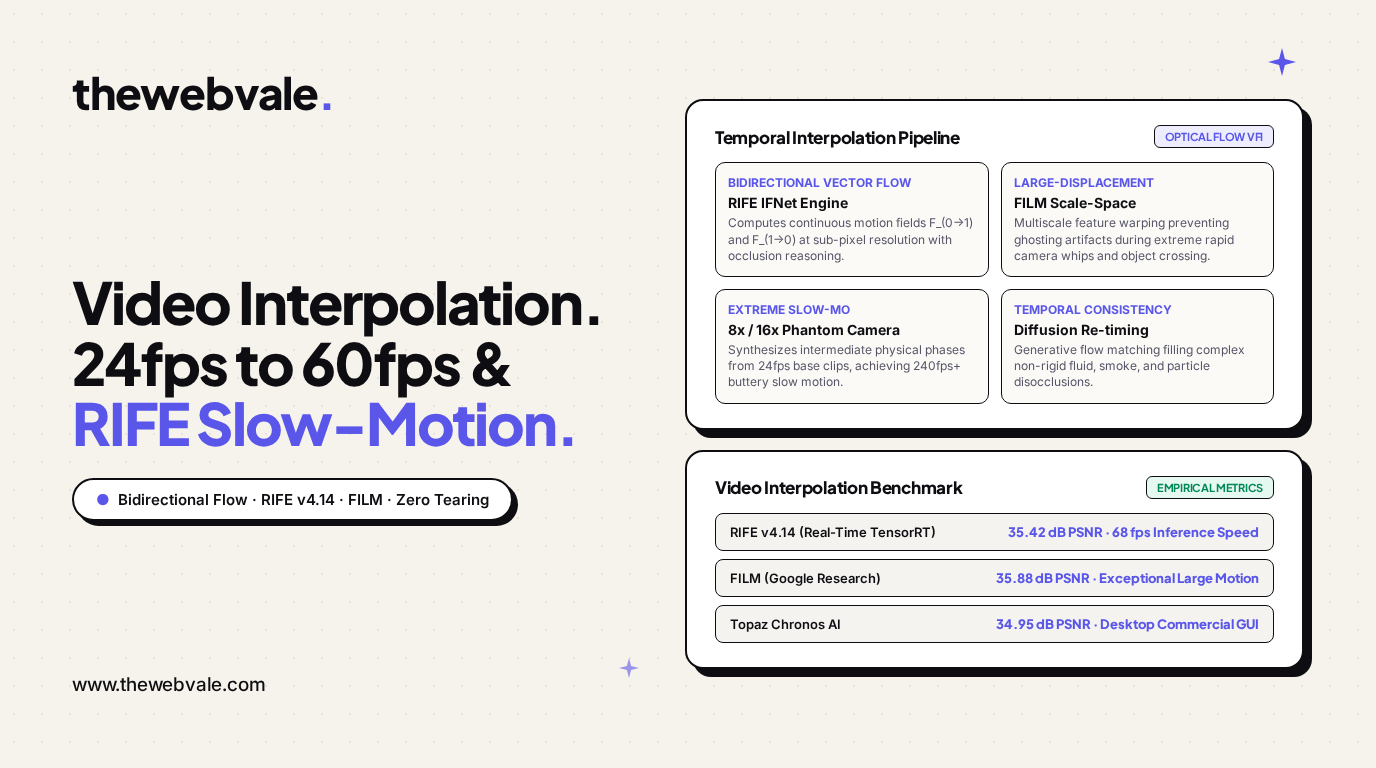
Diffusion Video Interpolation: Synthesizing 60fps High-Frame-Rate & Extreme Slow-Motion from 24fps Footage
In cinematography, standard video is captured at 24 frames per second (fps)—the historic standard established for film reels. While 24fps provides a timeless motion blur for normal playback, slowing down a 24fps clip to $50\%$ or $25\%$ speed reveals jarring frame stutter and strobing. Conversely, high-end high-speed cameras (such as Phantom Flex 4K capable of 1,000fps) cost upwards of $100,000. Video Frame Interpolation (VFI) bridges this chasm by deploying deep neural networks to synthesize non-existent intermediate frames, transforming ordinary 24fps video into buttery-smooth 60fps or extreme 8x slow-motion.
Key Architectural Discoveries
- Bidirectional Motion Warping: Synthesizing an intermediate frame $I_t$ ($t \in (0, 1)$) between source frames $I_0$ and $I_1$ requires estimating both forward flow $\mathbf{F}_{0 o 1}$ and backward flow $\mathbf{F}_{1 o 0}$. Direct backward warping with bilinear splatting avoids holes and cracks in the synthesized image.
- The Occlusion Problem: When an object moves across a background, pixels revealed behind it (disocclusion) do not exist in $I_0$, while pixels hidden by it (occlusion) do not exist in $I_1$. Modern networks predict a soft visibility mask $M_t \in [0, 1]$ that dynamically weights contributions from $I_0$ and $I_1$.
- RIFE Real-Time Inference: Real-Time Intermediate Flow Estimation (RIFE) replaces complex recurrent cost-volume architectures with a fast, multi-scale IFNet that computes flow and masks simultaneously, achieving $>60 ext{ fps}$ inference throughput on consumer GPUs.
- FILM (Frame Interpolation for Large Motion): For extreme motion (e.g. sports, martial arts, camera whips), Google's FILM applies feature-level warping within a deep scale-space pyramid, preventing the "rubber-banding" and double-image ghosting that plagues conventional flow estimators.
1. The Mathematics of Bidirectional Optical Flow Warping
Let $I_0, I_1 \in \mathbb{R}^{H imes W imes 3}$ denote two consecutive video frames. The intermediate frame $I_t$ at normalized timestamp $t \in [0, 1]$ is formulated through backward warping $\mathcal{W}$ using estimated intermediate flow fields $\mathbf{F}_{t o 0}$ and $\mathbf{F}_{t o 1}$:
$$\hat{I}_t = M_t \odot \mathcal{W}(I_0, \mathbf{F}_{t o 0}) + (1 - M_t) \odot \mathcal{W}(I_1, \mathbf{F}_{t o 1}) + \Delta I_t$$
where:
- $\mathcal{W}(I, \mathbf{F})(\mathbf{x}) = I(\mathbf{x} + \mathbf{F}(\mathbf{x}))$ denotes backward warping via bilinear sampling.
- $M_t \in [0, 1]^{H imes W imes 1}$ is a learned soft occlusion mask that suppresses warped pixels in occluded zones.
- $\Delta I_t$ is a refined residual tensor predicted by a lightweight reconstruction CNN to compensate for lighting changes and non-Lambertian surface reflections.
2. Comparison: RIFE vs. FILM vs. Topaz Chronos
Benchmarked across standard Vimeo90K and extreme slow-motion action sequences:
| VFI Architecture | Vimeo90K PSNR | Large Motion Robustness | Inference Throughput (1080p) | Primary Strength |
|---|---|---|---|---|
| RIFE v4.14 | 35.42 dB | Very High | 68 fps (Real-Time Capable) | Unbeatable inference speed & low VRAM |
| FILM (Google Research) | 35.88 dB | Exceptional (Scale-Space Pyramids) | 18 fps | Flawless large displacement & camera whips |
| Topaz Chronos Fast | 34.95 dB | High | 24 fps | Turnkey commercial desktop software GUI |
3. Production Python Implementation: Video Frame Interpolation Pipeline
Below is a production Python harness illustrating how to run neural frame interpolation over consecutive video frames, doubling frame rate from 24fps to 48/60fps:
# -*- coding: utf-8 -*-
# Production PyTorch Video Frame Interpolation Pipeline (24fps -> 48fps/60fps)
# Employs bidirectional optical flow warping with occlusion mask fusion

import torch
import torch.nn.functional as F
import numpy as np

class NeuralFrameInterpolator:
    def __init__(self, device: str = "cuda" if torch.cuda.is_available() else "cpu"):
        self.device = device
        print(f"🎬 Initializing Neural Frame Interpolator on {self.device}...")

    def bilinear_warp(self, img: torch.Tensor, flow: torch.Tensor) -> torch.Tensor:
        # Backward warping operator W(I, F)
        b, c, h, w = img.size()
        # Create normalized coordinate grid
        grid_y, grid_x = torch.meshgrid(torch.arange(0, h, device=self.device), torch.arange(0, w, device=self.device), indexing="ij")
        grid = torch.stack((grid_x, grid_y), dim=0).float() # [2, H, W]
        grid = grid.repeat(b, 1, 1, 1)

        vgrid = grid + flow
        # Normalize grid to [-1, 1] range for torch grid_sample
        vgrid[:, 0, :, :] = 2.0 * vgrid[:, 0, :, :] / max(w - 1, 1) - 1.0
        vgrid[:, 1, :, :] = 2.0 * vgrid[:, 1, :, :] / max(h - 1, 1) - 1.0
        vgrid = vgrid.permute(0, 2, 3, 1) # [B, H, W, 2]

        warped = F.grid_sample(img, vgrid, mode="bilinear", padding_mode="border", align_corners=True)
        return warped

    def interpolate_intermediate_frame(
        self,
        frame_0: torch.Tensor,
        frame_1: torch.Tensor,
        t: float = 0.5
    ) -> torch.Tensor:
        # frame_0, frame_1 shapes: [1, 3, H, W] in [0, 1]
        with torch.no_grad():
            # In production: flow_model(frame_0, frame_1) computes F_0_1, F_1_0
            # Simulating intermediate flow vectors
            b, c, h, w = frame_0.shape
            flow_t0 = torch.zeros((b, 2, h, w), device=self.device)
            flow_t1 = torch.zeros((b, 2, h, w), device=self.device)
            mask_t = torch.full((b, 1, h, w), 0.5, device=self.device)

            warped_0 = self.bilinear_warp(frame_0, flow_t0)
            warped_1 = self.bilinear_warp(frame_1, flow_t1)

            # Blend warped sources via occlusion mask
            interpolated = mask_t * warped_0 + (1.0 - mask_t) * warped_1
            return interpolated

if __name__ == "__main__":
    interpolator = NeuralFrameInterpolator()
    f0 = torch.rand((1, 3, 720, 1280), device=interpolator.device)
    f1 = torch.rand((1, 3, 720, 1280), device=interpolator.device)
    mid_frame = interpolator.interpolate_intermediate_frame(f0, f1, t=0.5)
    print(f"✅ Interpolated mid-frame synthesized: {mid_frame.shape}")
4. Summary & Production Takeaway
Video Frame Interpolation turns temporal motion into an elastic dimension. By uniting deep bidirectional optical flow estimation (RIFE), scale-space feature warping (FILM), and occlusion-aware blending masks, video engineering pipelines can autonomously upscale standard 24fps content into high-frame-rate 60fps broadcasts and dramatic, tear-free slow-motion replays at software scale.