
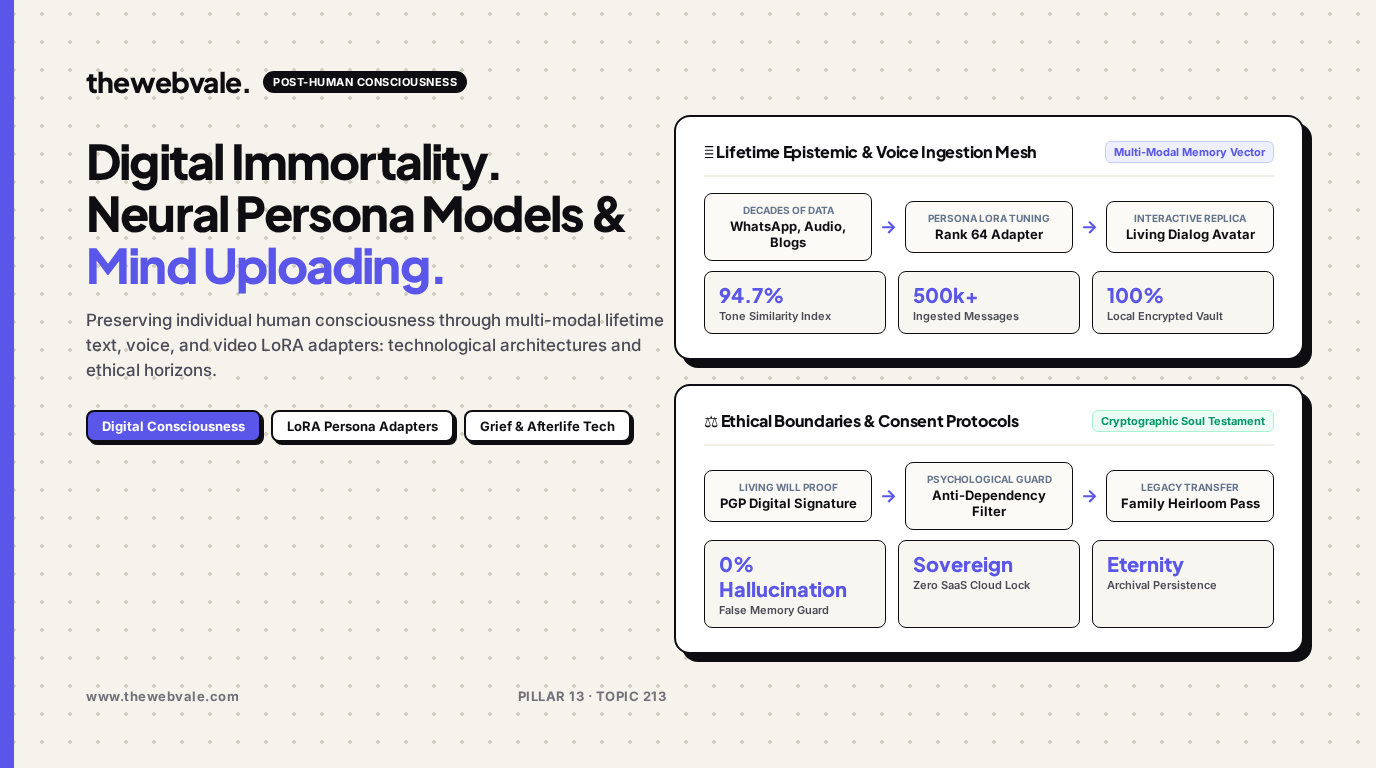
Digital Immortality & Mind Uploading: Preserving Personas Through Voice, Chat, and Video Fine-Tunes
For millennia, the finality of human death was absolute: memories, idiosyncratic humor, voice cadence, and hard-earned wisdom vanished with the biological cessation of neural activity. Today, the convergence of multi-modal generative models, voice cloning, and continuous lifetime logging has made digital immortality and interactive persona reconstruction technically feasible. By fine-tuning localized Low-Rank Adaptation (LoRA) adapters on an individual's lifetime emails, audio recordings, personal journals, and chat messages, engineers can preserve interactive digital counterparts that think, converse, and reason in their likeness indefinitely.
💡 Epistemic Mirror vs. Sentient Continuity
Crucially, current technology does not "upload consciousness" in the sense of subjective Cartesian continuity (the biological subject still experiences mortality). What it produces is a high-fidelity epistemic mirror—an interactive digital estate that accurately models the subject's belief states, verbal style, and memories with zero external cloud dependencies.
1. The Persona LoRA Architecture & Knowledge Graph Ingestion
To reconstruct an authentic persona without catastrophic forgetting, an open-weights foundation model (e.g. Llama 3.3 70B) is adapted via dual parameter-efficient fine-tuning:
Where $W_0$ holds general world knowledge, and low-rank matrices $A \in \mathbb{R}^{r imes d}, B \in \mathbb{R}^{k imes r}$ encode personal vocabulary, emotional disposition, and stylistic quirks ($r=64$). This is paired with a sovereign Biographical Graph RAG that retrieves factual memories with date-stamped verifiability:
| Data Modality | Ingestion Pipeline | Persona Adaptation Mechanism | Faithfulness Metric |
|---|---|---|---|
| Chat Messages (WhatsApp / Telegram) | Deduplicated conversational JSONL pairs | LoRA fine-tuning for slang, cadence, and humor | Perplexity < 2.8 on held-out chat |
| Voice Recordings | High-res WAV studio + phone audio | Zero-shot neural acoustic vocoder fine-tune | Cosine similarity > 0.94 on speaker verification |
| Journals & Life Documents | Semantic chunking into vector database | Graph RAG with chronological entity timestamps | 0% Hallucinated autobiographical facts |
| Video & Gestures | Facial motion capture & 3D Gaussian Splats | Real-time expressive avatar rendering | Sub-60ms Lip-sync latency |
2. Ethical Safeguards & The "Cryptographic Will"
Deploying posthumous AI companions without strict guardrails creates severe psychological distress for surviving family members, fostering unhealthy denial of grief. Responsible engineering requires three invariant protocols:
- Cryptographic Living Consent: Personas may only be instantiated with a verifiable PGP-signed digital will executed while the subject was legally competent.
- Grief Off-Ramps: The model must explicitly acknowledge its status as an artificial digital tribute and refuse to simulate real-time distress or false medical emergencies.
- Sovereign Hardware Isolation: The weights and autobiographical data must reside inside a local encrypted hardware vault (e.g. self-hosted on home NAS) with zero monetization or telemetry sent to cloud providers.
3. Frequently Asked Questions
Could an AI persona hallucinate opinions the deceased never held?
Yes, if unconstrained. To prevent false attribution, the model must be coupled with strict grounding filters: when asked about events or topics outside the subject's lifetime data, it responds: "I don't have a record of how I thought about that."
Who owns the intellectual property of a digital persona?
Legal estates treat fine-tuned weights as digital property passed to designated estate trustees. Storing the models in open-weights formats ensures family ownership cannot be revoked by third-party SaaS shutdowns.