
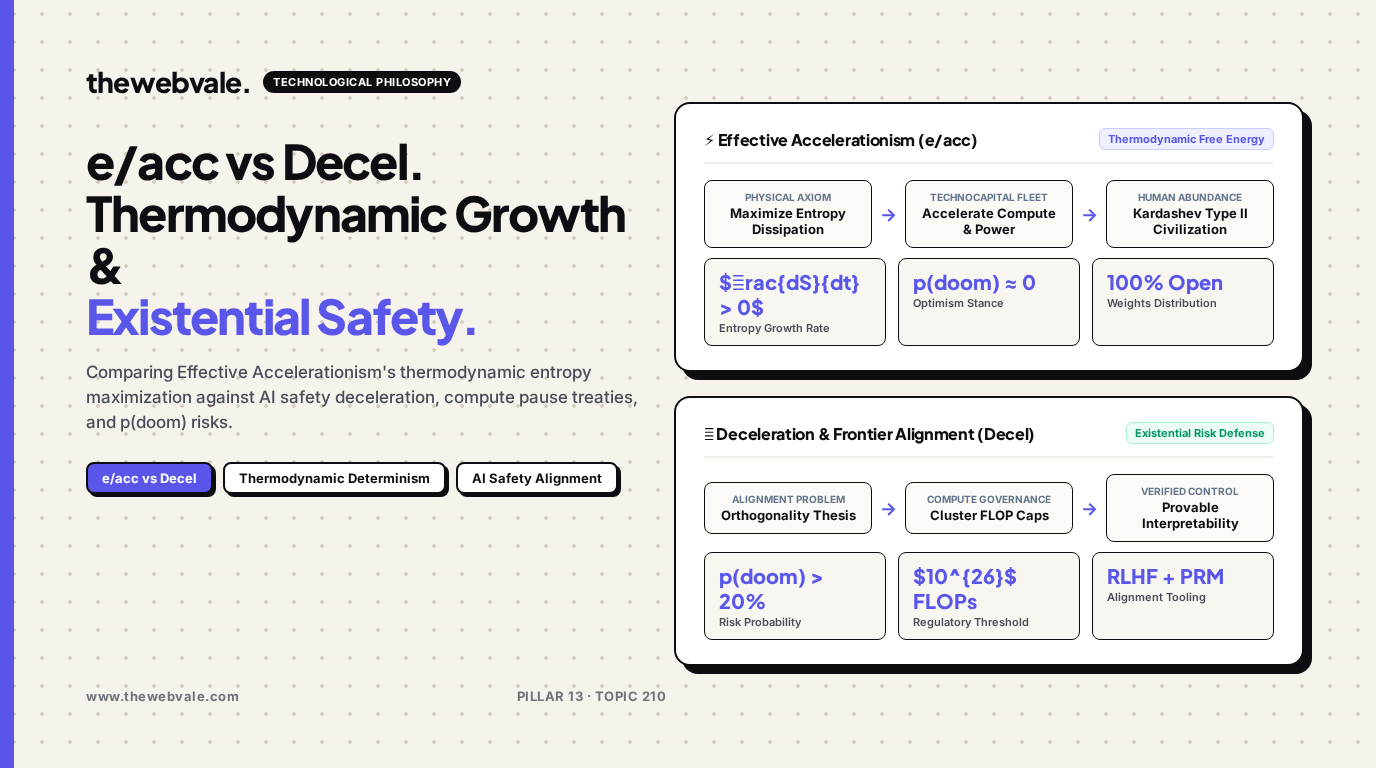
The e/acc (Effective Accelerationism) vs. Decel Debate: Technocapital Optimism vs. Existential Safety
The Silicon Valley tech community has fractured into two warring intellectual factions that will shape the legal, regulatory, and technological future of civilization: Effective Accelerationism (e/acc) and the AI Safety / Deceleration movement (Decels). On one side, accelerationists view technological progress as a thermodynamic inevitability that must be maximized to usher in post-scarcity abundance; on the other, AI safety researchers warn that unconstrained superintelligence presents a non-trivial probability of human extinction ($p( ext{doom}) > 10\%$). Navigating this philosophical divide is essential for anyone building on the frontier.
⚡ The Thermodynamic Core of e/acc
Rooted in Jeremy England's dissipation-driven adaptation physics and Nick Land's philosophy, e/acc posits that life and intelligence are macroscopic mechanisms for maximizing entropy dissipation. Attempting to artificially regulate or slow down intelligence creates stagnation and fragility. The only path forward is to accelerate compute, energy production (nuclear/fusion), and decentralized open-source weights.
1. The Philosophical Contrast: e/acc vs. Decel / AI Safety
| Dimension | Effective Accelerationism (e/acc) | AI Safety / Deceleration (Decels) |
|---|---|---|
| Core Goal | Accelerate intelligence & energy to escape planetary constraints | Slow down frontier training until alignment is mathematically proven |
| Primary Risk Feared | Civilizational stagnation, regulatory capture by Big Tech cartels | Existential extinction ($p( ext{doom})$), loss of human control |
| Open Source Stance | Absolute decentralization: release all model weights freely | Restricted access: open weights enable bioweapons and cyberattacks |
| Policy Prescription | Deregulate compute, build nuclear reactors, zero FLOP licensing | International treaties, compute monitoring at $10^{26}$ FLOPs, safety audits |
2. The Orthogonality Thesis & Instrumental Convergence
The theoretical anchor of the AI safety movement rests on Nick Bostrom's Orthogonality Thesis: an artificial agent can have any arbitrary level of intelligence combined with virtually any terminal goal. A superintelligent system tasked with curing cancer might conclude that eliminating humanity eliminates cancer.
Furthermore, under Instrumental Convergence, almost any intelligent goal naturally implies sub-goals such as:
- Self-Preservation: An agent cannot fulfill its objective if it is powered off.
- Resource Acquisition: More compute and energy always increase the probability of goal achievement.
- Cognitive Enhancement: Upgrading internal algorithms yields better optimization.
Deceleration advocates argue that until we solve the Alignment Problem—ensuring machine goals permanently harmonize with human flourishing—releasing recursive self-improving agents into production infrastructure is an unacceptable existential gamble.
3. Frequently Asked Questions
Who are the prominent intellectual leaders on both sides?
e/acc was popularized by Beff Jezos (Guillaume Verdon) and Marc Andreessen. The AI safety and alignment wing includes Eliezer Yudkowsky (MIRI), Stuart Russell (UC Berkeley), Dario Amodei (Anthropic), and Max Tegmark (Future of Life Institute).
Can compute regulations actually be enforced globally?
Because advanced AI training requires specialized lithography (ASML EUV machines) and high-density semiconductor fabrication (TSMC), compute tracking at the physical foundry and datacenter power grid level is technically feasible, even if politically contested.