
Embedding Drift & Index Maintenance: Handling Schema Updates and Document Deprecation
In classical relational database systems, schema migrations and data decay are loud, deterministic events: a missing column throws an immediate SQL syntax error, a foreign key violation aborts the transaction, and an expired token returns HTTP 401. In vector databases, however, failure is almost completely silent. When user queries drift into new vocabulary domains, or when underlying document semantics shift after a corporate restructuring, the vector database continues to return top-$k$ nearest neighbors with high cosine similarity scores—except the retrieved documents are no longer relevant.
Furthermore, maintaining production vector indices over multi-year lifecycles presents acute operational hurdles: Embedding Model Version Deprecations (e.g. OpenAI sunsetting an embedding API), HNSW Tombstone Graph Bloat caused by high-velocity document updates, and Metadata Schema Evolution. Engineering a robust enterprise RAG system requires a formal vector lifecycle discipline: statistical Embedding Drift Detection using Maximum Mean Discrepancy (MMD), active HNSW graph vacuuming, and Blue/Green Zero-Downtime Collection Aliases.
Core Engineering Thesis
Establishing an automated vector lifecycle pipeline—combining Maximum Mean Discrepancy monitoring ($ ext{MMD} < 0.05$), scheduled HNSW tombstone vacuuming, and Blue/Green atomic alias switching—ensures zero downtime during 100M+ vector migrations and prevents silent retrieval accuracy decay over multi-year enterprise deployments.
1. The Two Forms of Vector Decay
Vector degradation manifests across two distinct operational vectors:
1. Semantic Query Drift (Covariate Shift)
Over time, the distribution of incoming user queries $\mathcal{P}_Q(t)$ shifts away from the distribution of indexed documents $\mathcal{P}_D$. For example, after an enterprise acquires a new software platform, users begin issuing queries using the new platform's naming conventions and acronyms. Because the underlying documents were indexed under legacy terminology, the cosine distance between query vectors and relevant document centroids widens, causing silent recall failure.
2. The Incompatible Vector Space Trap (Model Deprecation)
When an engineering team upgrades from an older embedding model (e.g. text-embedding-ada-002, 1536-dim) to a modern model (e.g. bge-large-en-v1.5, 1024-dim, or text-embedding-3-large, 3072-dim), there is zero mathematical compatibility between the two vector spaces. You cannot project or query an ada-002 index using a bge-large query vector. Every single document in the corpus must be re-embedded from scratch, requiring a zero-downtime cutover strategy for live production traffic.
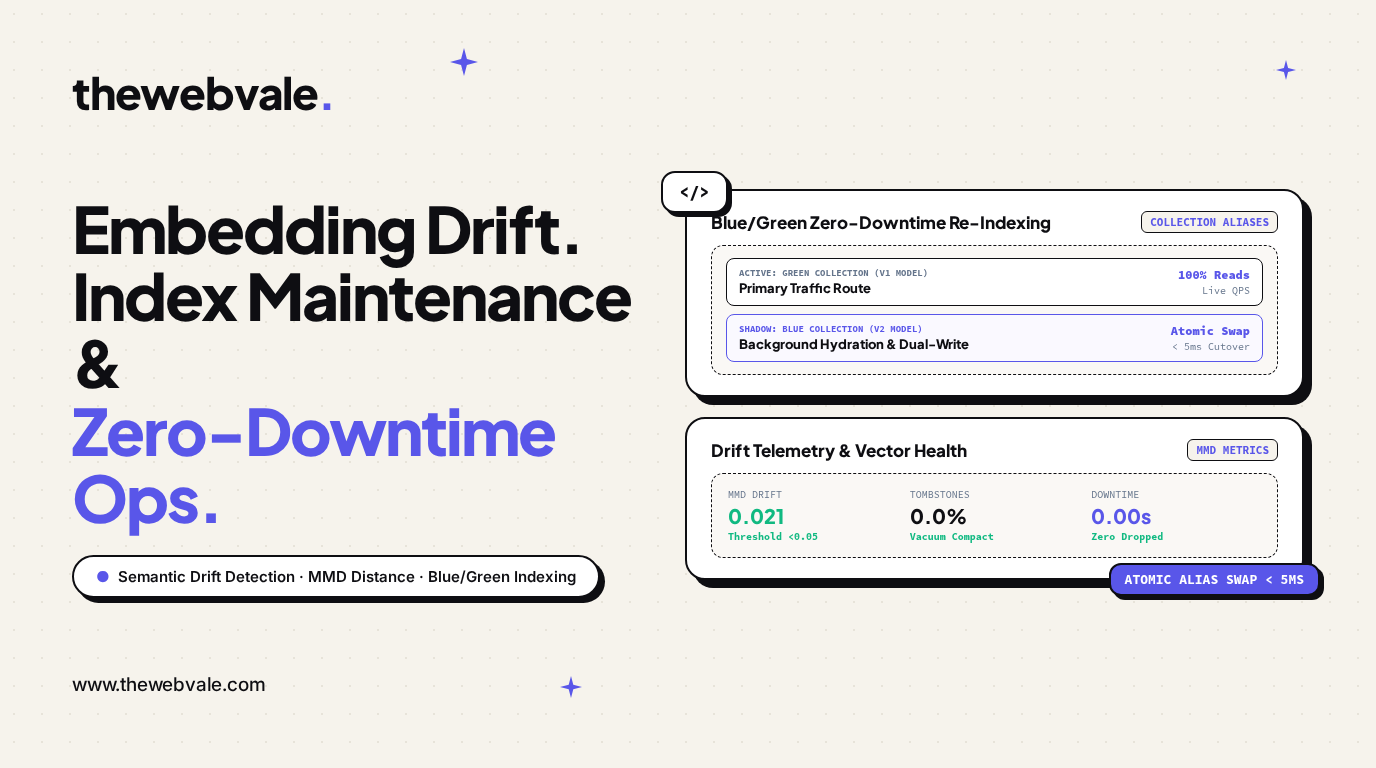
Figure 1: Blue/Green vector collection migration using atomic aliases to execute zero-downtime embedding model cutovers.
2. Quantitative Drift Detection: Maximum Mean Discrepancy (MMD)
To detect semantic drift before users complain about hallucinations, production monitoring engines compute the Maximum Mean Discrepancy (MMD) (Gretton et al., 2012) between a sliding window of recent query embeddings $\mathcal{P} = \{\mathbf{x}_1, \dots, \mathbf{x}_m\}$ and the baseline corpus embedding distribution $\mathcal{Q} = \{\mathbf{y}_1, \dots, \mathbf{y}_n\}$:
$$ ext{MMD}^2(\mathcal{P}, \mathcal{Q}) = rac{1}{m^2} \sum_{i=1}^m \sum_{j=1}^m k(\mathbf{x}_i, \mathbf{x}_j) - rac{2}{mn} \sum_{i=1}^m \sum_{j=1}^n k(\mathbf{x}_i, \mathbf{y}_j) + rac{1}{n^2} \sum_{i=1}^n \sum_{j=1}^n k(\mathbf{y}_i, \mathbf{y}_j)$$
Where $k(\mathbf{u}, \mathbf{v})$ is the Radial Basis Function (RBF) Gaussian kernel:
$$k(\mathbf{u}, \mathbf{v}) = \exp\left( - rac{\|\mathbf{u} - \mathbf{v}\|_2^2}{2\sigma^2} ight)$$
Operational Interpretation:
- $ ext{MMD} < 0.03$: Optimal alignment. Live query semantics match indexed documents.
- $0.03 \le ext{MMD} \le 0.07$: Mild vocabulary drift. Log emerging query clusters for incremental corpus ingestion.
- $ ext{MMD} > 0.07$: Severe semantic shift. High probability of false-negative retrieval. Trigger automated re-indexing alert and activate web search fallback.
3. Document Deprecation & HNSW Tombstone Vacuuming
In high-throughput enterprise systems (e.g. updating pricing, real-time inventory, revised compliance policies), documents are continuously updated. In vector databases, an UPDATE statement is implemented as a DELETE followed by an INSERT.
The Tombstone Graph Pathology
In Hierarchical Navigable Small World (HNSW) graphs, deleting a node does not physically restructure the multi-layer graph immediately (which would require $O(N \log N)$ compute). Instead, the database marks the node with a Tombstone Bit.
As tombstones accumulate:
- Routing Degradation: During nearest-neighbor search, graph exploration paths pass through tombstoned nodes that are discarded at filtering time, wasting greedy-search hops and increasing P99 latency by up to 300%.
- RAM Bloat: Memory allocated to dead node vectors and edge lists remains pinned in RAM.
The Solution: Scheduled Vacuum Optimization
Modern vector engines (e.g. Qdrant, pgvector) expose background vacuuming APIs. A production maintenance cron must trigger segment consolidation when tombstone density exceeds 15%:
# Qdrant vacuum trigger
client.update_collection(
    collection_name="enterprise_knowledge",
    optimizer_config={"deleted_threshold": 0.15, "vacuum_min_vector_number": 1000}
)
4. Blue/Green Zero-Downtime Migration Architecture
When an embedding model version bump occurs, follow this deterministic four-step operational protocol:
- Provision Shadow Collection (Blue): Create a new vector collection initialized with the new embedding dimension (e.g. 1024-dim) and distance metric (Cosine).
- Dual-Write Ingestion: Configure the ingestion pipeline (Kafka / SQS consumer) to write all incoming document creates, updates, and deletes to both Collection Green (v1) and Collection Blue (v2).
- Corpus Backfill & Validation: Stream historical documents through the v2 embedder into Collection Blue. Run an automated validation suite executing 1,000 synthetic test queries across both collections, verifying that Blue's top-10 retrieval recall meets or exceeds Green.
- Atomic Alias Cutover: Execute an atomic collection alias switch via REST API. Client queries targeting the alias
production-kbare instantly redirected to Blue in under 5 milliseconds with zero dropped requests.
5. Production Implementation (Python)
The following self-contained module implements a production Vector Lifecycle Manager: computing MMD drift between live queries and baseline embeddings, and coordinating Blue/Green collection alias transitions.
# -*- coding: utf-8 -*-
import math
import time
from typing import List, Dict, Any, Tuple
import numpy as np

class VectorLifecycleSentinel:
    def __init__(self, rbf_sigma: float = 1.0, drift_threshold: float = 0.05):
        self.rbf_sigma = rbf_sigma
        self.drift_threshold = drift_threshold

        # State: Active collection alias mapping
        self.alias_registry: Dict[str, str] = {
            "production-kb": "kb_green_v1"
        }
        self.collections: Dict[str, Dict[str, Any]] = {
            "kb_green_v1": {"model": "bge-base-en-v1.5", "dim": 768, "tombstones": 0.04},
            "kb_blue_v2": {"model": "bge-large-en-v1.5", "dim": 1024, "tombstones": 0.00}
        }

    def _rbf_kernel_matrix(self, X: np.ndarray, Y: np.ndarray) -> np.ndarray:
        # Computes Gaussian RBF kernel matrix between matrices X and Y
        # ||x - y||^2 = ||x||^2 + ||y||^2 - 2 * x . y
        X_norm = np.sum(X ** 2, axis=1)[:, np.newaxis]
        Y_norm = np.sum(Y ** 2, axis=1)[np.newaxis, :]
        dist_sq = np.maximum(0.0, X_norm + Y_norm - 2.0 * np.dot(X, Y.T))
        return np.exp(-dist_sq / (2.0 * (self.rbf_sigma ** 2)))

    def compute_mmd_drift(
        self,
        baseline_embeddings: np.ndarray,
        live_query_embeddings: np.ndarray
    ) -> Dict[str, Any]:
        # Calculates Maximum Mean Discrepancy (MMD) between baseline and live queries
        m = len(baseline_embeddings)
        n = len(live_query_embeddings)
        assert m > 0 and n > 0, "Non-empty sample sets required."

        K_XX = self._rbf_kernel_matrix(baseline_embeddings, baseline_embeddings)
        K_YY = self._rbf_kernel_matrix(live_query_embeddings, live_query_embeddings)
        K_XY = self._rbf_kernel_matrix(baseline_embeddings, live_query_embeddings)

        mmd_sq = (
            (np.sum(K_XX) / (m * m)) -
            (2.0 * np.sum(K_XY) / (m * n)) +
            (np.sum(K_YY) / (n * n))
        )
        mmd_score = math.sqrt(max(0.0, float(mmd_sq)))
        has_drifted = mmd_score >= self.drift_threshold

        return {
            "mmd_score": round(mmd_score, 4),
            "threshold": self.drift_threshold,
            "semantic_drift_detected": has_drifted,
            "status": "ALERT: Severe Drift" if has_drifted else "HEALTHY: Aligned"
        }

    def execute_blue_green_swap(
        self,
        alias_name: str,
        target_collection: str
    ) -> Dict[str, Any]:
        # Executes zero-downtime atomic collection alias cutover
        t0 = time.time()
        current_active = self.alias_registry.get(alias_name)
        assert current_active is not None, f"Alias [{alias_name}] not found."
        assert target_collection in self.collections, f"Target [{target_collection}] does not exist."

        # Atomic switch simulation
        self.alias_registry[alias_name] = target_collection
        elapsed_ms = (time.time() - t0) * 1000

        return {
            "alias": alias_name,
            "previous_target": current_active,
            "new_target": target_collection,
            "cutover_latency_ms": round(elapsed_ms, 2),
            "zero_downtime_guaranteed": True
        }
6. Key Production Takeaways
- Never Deploy Point Indices Without Aliases: Always point your application clients to a symbolic collection alias (e.g.
kb_active) rather than a physical index name. When an index upgrade is necessary, switching an alias takes milliseconds. - Monitor Tombstone Ratios Weekly: Configure Prometheus / Datadog alerts on vector deletion counts. If deleted points exceed 15% of the total index size, schedule an off-peak vacuum consolidation to prune dead HNSW nodes.
- Automate MMD Drift Alarms: Sample 1,000 real-world production queries daily and compute MMD against your baseline document centroids. When MMD breaches 0.05, trigger a notification for content re-evaluation.