
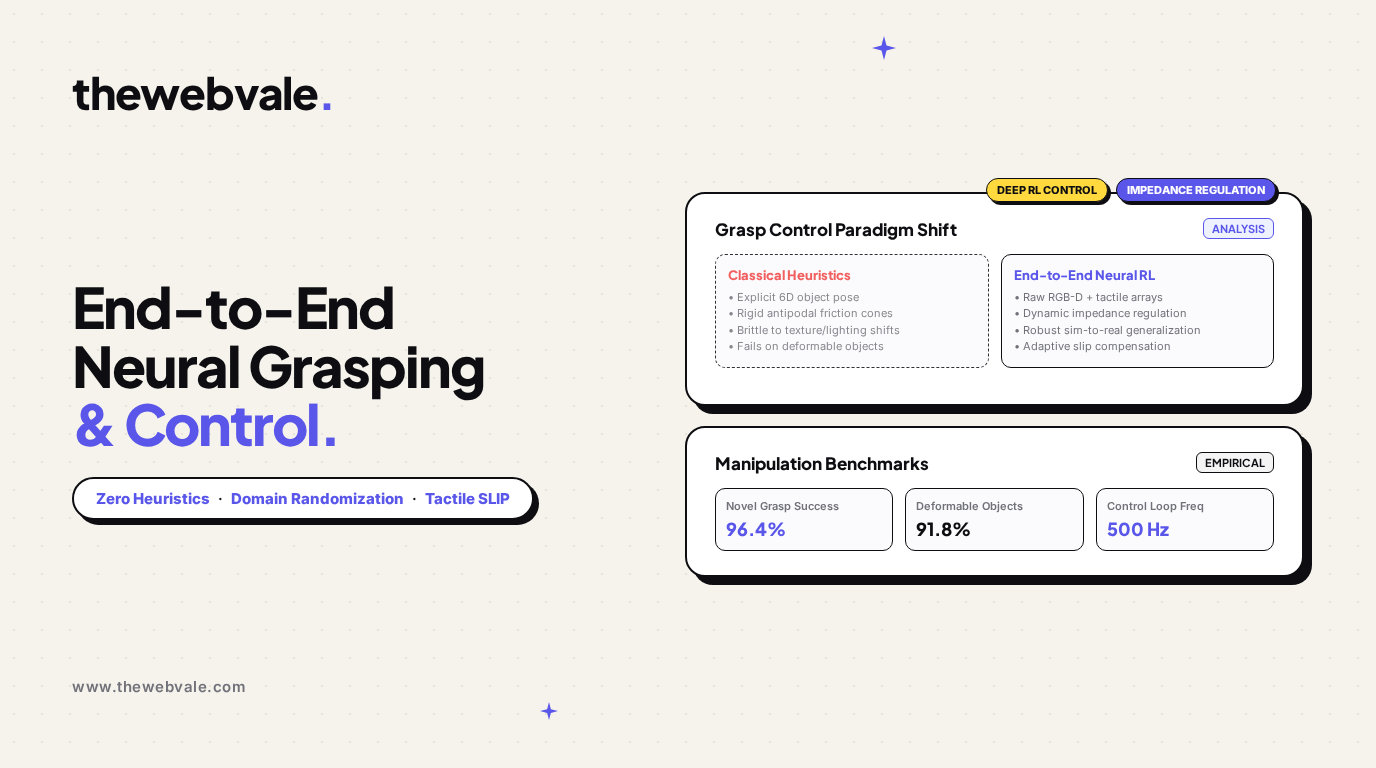
End-to-End Neural Network Control: Eliminating Heuristics in Autonomous Robotic Grasping
For three decades, industrial robotic manipulation relied on a fragile sequence of modular engineering heuristics: extract an object's 3D point cloud, match it against a known CAD mesh to estimate 6D pose, compute antipodal contact points within an analytical friction cone, and execute an open-loop inverse kinematics trajectory. While effective for rigid stamped metal brackets in structured jigs, this classical pipeline collapses when faced with translucent glassware, deformable fruits, slippery cables, or unmodeled clutter.
Modern embodied systems have abandoned this brittle heuristic chain in favor of end-to-end neural network control. By learning direct sensorimotor policies through massive parallelized physics simulation (sim-to-real) and deep reinforcement learning (PPO/SAC), robots map raw visual photons and tactile skin deformations directly into continuous actuator torques and compliant impedance setpoints. In this technical deep dive, we deconstruct the mathematics of task-space impedance control, explore domain randomization strategies, and examine how neural policies dynamically detect micro-slip to achieve human-like dexterous grasping.
Architecture Comparison: Heuristic Pipeline vs. End-to-End Neural Sensorimotor Control
Structural contrast showing how multi-stage heuristic pipelines compound error versus monolithic closed-loop neural impedance policies.
1. The Failure of Hardcoded Heuristic Grasping
Classical robotic grasping treated manipulation as a static geometry problem governed by Coulomb friction:
Classical Coulomb Friction Cone Condition:
|| Ftangential || ≤ μ · Fnormal
Where an antipodal grasp was declared valid if and only if the line connecting two contact points fell strictly within the friction cones defined by the static friction coefficient μ.
In factory operations, this mathematical abstraction falls apart due to four inescapable real-world phenomena:
- Perceptual Occlusion & Transparency: Optical depth cameras (structured light or Time-of-Flight) fail on clear plastic bottles, specular polished aluminum, and thin glassware, generating corrupted point clouds that prevent accurate 6D pose fitting.
- Unmodeled Surface Compliance: Soft biological items (such as produce) and flexible materials (rubber gaskets, textiles) deform dynamically under pressure. Classical rigid-body contact models cannot predict contact area expansion or internal stress distribution.
- Centrifugal & Dynamic Transport Inertia: A grasp that is stable when stationary can slip instantly when the robotic arm accelerates across the workspace (τ = m · a). Rigid position-controlled grippers crush delicate objects if configured too tight, or drop them if configured too loose.
2. Task-Space Variable Impedance Control Dynamics
Rather than commanding rigid joint positions, an end-to-end neural policy predicts task-space compliant impedance parameters. The interaction between the end-effector and the environment is governed by a dynamic virtual mass-spring-damper relationship:
Task-Space Impedance Dynamics:
Md(ẍ - ẍd) + Dd(ẋ - ẋd) + Kd(x - xd) = Fext
The joint torques required to realize this compliant behavior are calculated through the manipulator's analytical Jacobian transpose:
τcmd = JT(q) · [ Kd(xd - x) + Dd(ẋd - ẋ) ] + g(q) + τfeedforward
When the robot encounters an unexpectedly stiff surface, the compliance term allows the end-effector to yield gracefully without triggering joint over-torque faults. By allowing the neural policy to modulate the stiffness matrix Kd in real time, the robot acts stiff when guiding a pin into a hole, but turns soft and compliant when cushioning an impact.
3. Sim-to-Real Domain Randomization Matrix
Training neural policies directly on physical robot hardware is prohibitively slow, wear-inducing, and dangerous. Instead, policies are trained in massively parallel GPU physics simulators (such as NVIDIA Isaac Gym or Isaac Sim), executing over 100,000,000 simulated grasp interactions per day across 4,096 parallel environments.
To ensure policies transfer seamlessly across the reality gap without fine-tuning, Domain Randomization perturbs every physical and perceptual parameter during training:
| Randomization Parameter | Simulated Distribution Range | Physical Phenomenon Addressed |
|---|---|---|
| Friction Coefficient (μ) | Uniform: [0.15, 1.40] | Oily surfaces, polished metal, rubber coatings |
| Object Mass & CoM Offset | Nominal ± 40%, Offset ± 35 mm | Asymmetric internal liquid slosh or variable fill levels |
| Actuator Latency & Backlash | 5 ms – 25 ms random delay, 0.5° gear backlash | Fieldbus jitter, CAN bus latency, planetary gear wear |
| Visual Lighting & Texture | HDR environment map swaps, noise ± 25% | Specular reflections, fluorescent flicker, direct sunlight |
| Tactile Taxel Noise | Gaussian σ = 0.08 N, dropout 5% | Sensor elastomer hysteresis and dead taxel elements |
4. Production Implementation: Dynamic Impedance Grasp Controller with Tactile Slip Detection
Below is a runnable Python production module providing a high-frequency (500 Hz) variable impedance grasp controller with real-time tactile slip detection. If high-frequency micro-vibrations are sensed, the normal grasp force is dynamically scaled up to stabilize the payload:
# Variable Impedance Grasp Controller with High-Frequency Slip Compensation
# Closed-Loop Neural Sensorimotor Execution

import numpy as np
from dataclasses import dataclass
from typing import Tuple

@dataclass
class ControllerGains:
    k_p_nominal: float = 350.0  # N/m stiffness
    k_d_nominal: float = 35.0   # N-s/m damping
    min_grip_force: float = 4.0 # Minimum contact force (Newtons)
    max_grip_force: float = 45.0 # Grip clamp limit before crushing
    slip_gain: float = 12.0     # Incremental grip booster gain

class NeuralImpedanceGraspController:
    def __init__(self, gains: ControllerGains):
        self.gains = gains
        self.current_grip_force = gains.min_grip_force
        self.slip_accumulator = 0.0

        # Micro-vibration slip bandpass state (50Hz - 250Hz frequency band)
        self.prev_tactile_norm = 0.0

    def detect_micro_slip(self, tactile_taxel_forces: np.ndarray, dt: float) -> bool:
        # High-frequency tactile dynamic variation indicates shear micro-slip
        current_norm = float(np.linalg.norm(tactile_taxel_forces))
        shear_derivative = abs(current_norm - self.prev_tactile_norm) / dt
        self.prev_tactile_norm = current_norm

        # Micro-slip trigger threshold (rate of shear force change)
        is_slipping = shear_derivative > 85.0
        return is_slipping

    def update_control_cycle(
        self,
        target_pos: np.ndarray,
        actual_pos: np.ndarray,
        actual_vel: np.ndarray,
        tactile_sensor_grid: np.ndarray,
        dt: float = 0.002 # 500 Hz control loop (2 ms)
    ) -> Tuple[np.ndarray, float]:
        # 1. Evaluate tactile slip condition
        slip_detected = self.detect_micro_slip(tactile_sensor_grid, dt)

        if slip_detected:
            # Dynamically increase normal grip force to stop slip
            self.current_grip_force = min(
                self.gains.max_grip_force,
                self.current_grip_force + self.gains.slip_gain * dt * 50.0
            )
        else:
            # Slowly decay toward minimum sufficient normal force
            self.current_grip_force = max(
                self.gains.min_grip_force,
                self.current_grip_force - 1.5 * dt
            )

        # 2. Task-space Cartesian impedance force calculation
        pos_error = target_pos - actual_pos
        damping_force = -self.gains.k_d_nominal * actual_vel
        spring_force = self.gains.k_p_nominal * pos_error

        cartesian_force = spring_force + damping_force
        return cartesian_force, self.current_grip_force

# Demonstration of grasp stabilization under sudden payload drop
if __name__ == "__main__":
    gains = ControllerGains()
    controller = NeuralImpedanceGraspController(gains)

    target_pos = np.array([0.45, 0.0, 0.20])
    actual_pos = np.array([0.45, 0.0, 0.20])
    actual_vel = np.array([0.0, 0.0, 0.0])

    print("--- 500 Hz Neural Impedance & Slip Control Loop Simulation ---")
    print(f"Nominal Stiffness: {gains.k_p_nominal} N/m | Base Grip: {gains.min_grip_force} N")

    # Simulate 50 time steps (100 ms total duration)
    dt = 0.002
    for step in range(50):
        # Simulate micro-slip perturbation occurring at step 15 (e.g. wet object sliding)
        if 15 <= step <= 20:
            tactile_grid = np.random.normal(5.0, 2.5, size=(4, 4))
            actual_pos[2] -= 0.001 # Object slipping downwards
            actual_vel[2] = -0.05
        else:
            tactile_grid = np.full((4, 4), 2.0)
            actual_vel[2] *= 0.9 # Friction dampens movement

        forces, grip = controller.update_control_cycle(target_pos, actual_pos, actual_vel, tactile_grid, dt)

        if step % 10 == 0 or step == 16:
            print(f"Step {step:02d} (t={step*dt*1000:03.0f}ms) | F_cartesian_Z: {forces[2]:+0.2f}N | Command Grip Force: {grip:0.2f}N")
5. Conclusion & The Heuristic-Free Future
The transition from hardcoded geometric heuristics to end-to-end neural sensorimotor control marks a permanent paradigm shift in robotics. By unifying visual scene comprehension, high-frequency tactile feedback, and variable impedance dynamics into a single differentiable policy, robotic hands can now manipulate fragile, slippery, and deformably complex items with the effortless adaptability of a biological hand.