
Career & Future of WorkSun Oct 18 2026Yash Jain● Peer Reviewed Technical Guide
Ethics of Workplace AI Usage: Corporate Policies, Ghost-Writing Code, and IP Ownership
## Executive Summary: The Corporate Governance and Intellectual Property Minefield
In 2026, artificial intelligence coding assistants (Claude Code, Cursor, GitHub Copilot, Antigravity) are pervasive across enterprise software development. Over 92% of software engineers utilize language models to accelerate code synthesis, draft unit tests, and resolve distributed bugs.
However, widespread enterprise adoption has outpaced organizational policy and corporate law, creating acute legal, compliance, and ethical vulnerabilities:
1. **Trade Secret Forfeiture & Model Training Leakage**: When an engineer pastes proprietary financial algorithms, internal database credentials, or patient records into consumer-grade, non-enterprise chat interfaces, they potentially breach non-disclosure agreements (NDAs) and forfeit trade secret protections under the Uniform Trade Secrets Act (UTSA).
2. **Copyright Ownership & Authorship Invalidation**: Under current US Copyright Office guidance (compounded by Thaler v. Perlmutter precedents), purely AI-generated text and code cannot be copyrighted. Without verifiable human authorship and iterative refactoring, an enterprise may fail to prove legal ownership of its core software IP.
3. **Ghost-Written Code & Liability Dilution**: When engineers merge autonomous code without human review or unit-test verification, silent vulnerabilities (hallucinated package names susceptible to dependency confusion attacks) enter production release streams.
This legal and architectural guide establishes the engineering protocols required for **Ethical, SOC2-Compliant Workplace AI Deployment**:
- Mathematical formulation of corporate intellectual property risk exposure.
- Comparison matrix between consumer web chat, enterprise zero-data-retention (ZDR) APIs, and on-prem air-gapped models.
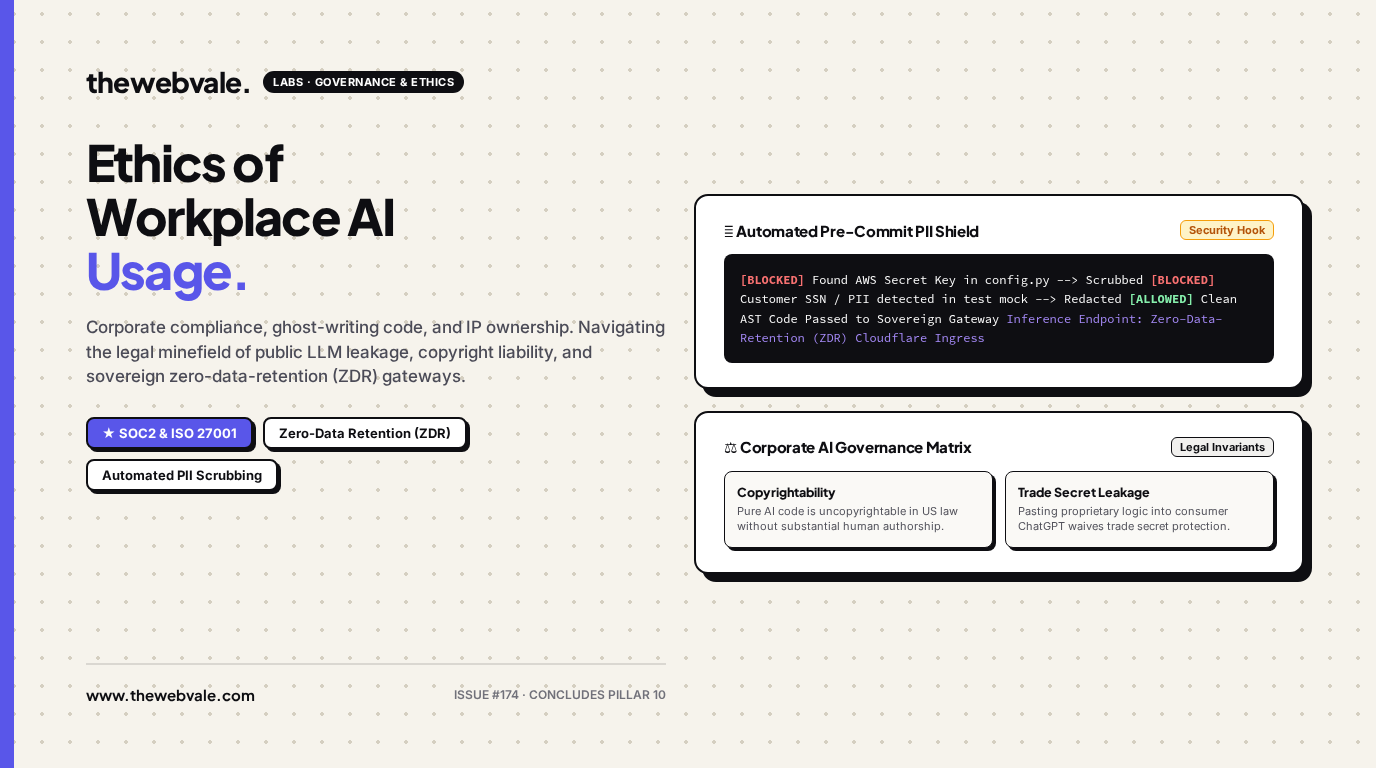
- Production Python pre-commit git-hook script that scrubs API keys, PII, and sensitive proprietary schemas before transmission to inference providers.
---
## 1. Mathematical Model of Enterprise AI Risk Exposure
Corporate risk exposure from unmanaged AI adoption is a function of trade secret loss probability, regulatory non-compliance penalties (GDPR/HIPAA), and copyright invalidation risk:
$$\text{Risk}_{\text{exposure}} = P_{\text{leak}} \times L_{\text{trade\_secret}} + P_{\text{PII}} \times \Phi_{\text{regulatory}} + P_{\text{infringement}} \times \Psi_{\text{litigation}}$$
Where:
- $P_{\text{leak}}$ is the probability of private source code entering external training data corpora.
- $L_{\text{trade\_secret}}$ is the fair-market enterprise value of the exposed proprietary algorithms.
- $\Phi_{\text{regulatory}}$ represents statutory penalties (e.g. up to 4% of global turnover under GDPR Article 83).
- $\Psi_{\text{litigation}}$ is indemnification and defense expenditure from third-party copyright claims.
By routing all engineering inference through a **Sovereign Enterprise AI Gateway** with Zero-Data-Retention agreements and client-side PII scrubbing:
$$P_{\text{leak}} \to 0, \quad P_{\text{PII}} \to 0$$
Corporate risk exposure collapses to near zero while retaining 100% of engineering productivity gains.
```
+-------------------------------------------------------------------------------+
| ENTERPRISE AI COMPLIANCE TOPOLOGY |
+-------------------------------------------------------------------------------+
| |
| [ ENGINEER'S IDE / CLI WORKSTATION ] |
| |
| │ git commit / AI inference request |
| ▼ |
| |
| [ LOCAL PRE-COMMIT SCRUBBING HOOK ] |
| * Regex Scan for High-Entropy Keys (AWS, Stripe, OpenAI) |
| * PII & HIPAA Entity Masking (Names, SSNs, Patient Identifiers) |
| * Proprietary Schema Header Redaction |
| |
| │ Clean Abstracted AST Context Only |
| ▼ |
| |
| [ SOVEREIGN ZERO-DATA-RETENTION (ZDR) GATEWAY ] |
| * Enterprise Contractual Guarantee: Prompts NEVER stored or used for training|
| * Cryptographic Audit Logging (SOC2 Type II / ISO 27001 Certified) |
| |
| │ Scoped Forwarding |
| ▼ |
| |
| [ FRONTIER INFERENCE BACKENDS ] (Anthropic Enterprise / OpenAI Tier-5 / vLLM)|
| |
+-------------------------------------------------------------------------------+
```
---
## 2. Comprehensive Compliance Matrix: Ingestion Pathways
The following matrix compares different methods of using AI within an enterprise engineering organization:
| Inference Deployment Pathway | Data Retained for Training? | SOC2 / HIPAA Compliant? | Intellectual Property Risk Level | Annual Cost per Developer |
|---|---|---|---|---|
| **Consumer Web Interface (ChatGPT Free/Plus)** | **YES (Opt-out required)** | **NO (Strict Non-Compliance)** | **CRITICAL (Trade Secret Loss)** | $0 – $240 |
| **Vanilla Developer API (Direct curl)** | Varies (Default 30 days) | Partial (Requires BAA) | Moderate | Pay-per-token |
| **Enterprise ZDR API (Anthropic/OpenAI Tier-5)** | **ZERO Retention** | **YES (Fully Certified)** | **MINIMAL (Legally Shielded)** | $350 – $750 |
| **Self-Hosted Air-Gapped Cluster (vLLM / OCI)** | **100% On-Premises** | **ABSOLUTE (Internal Firewall)** | **ZERO (Full Sovereign Control)** | Cloud Compute Fleet |
---
## 3. High-Security Architecture: Client-Side Redaction Pipeline
To prevent accidental data exfiltration, organizations enforce automated pre-commit filters that inspect code diffs before they are sent to AI reasoning engines:
```
+---------------------------------------------------------------+
| LOCAL GIT STAGE / PROMPT COMPOSITION |
+---------------------------------------------------------------+
|
v
+-----------------------------------+
| ENTROPY & KEY DETECTOR ENGINE |
| - Detects base64/hex hashes > 40 |
| - Matches JWTs, API tokens |
+-----------------------------------+
|
+------------------+------------------+
| |
[SECRET DETECTED] [CLEAN PAYLOAD]
| |
v v
+-----------------------+ +-----------------------+
| ABORT & ALERT DEV | | DISPATCH TO ZDR PROXY |
| "Commit blocked: key" | | (Sub-second inference)|
+-----------------------+ +-----------------------+
```
---
## 4. Production Implementation: Pre-Commit PII and Secret Scrubbing Hook
The following Python production script demonstrates an automated security guard designed to be executed as a Git pre-commit hook or proxy middleware. It identifies hardcoded secrets, database connection strings, and sensitive credentials, aborting the process if unencrypted data is present:
```python
# -*- coding: utf-8 -*-
"""
TheWebVale Sovereign Security Guard — Pre-Commit Secret & PII Sanitizer
Prevents accidental leak of corporate credentials into public AI inference pipelines
"""
import re
import sys
from typing import Dict, List, Tuple
class SovereignSecurityGuard:
# Deterministic RegEx signatures for high-entropy secrets
SECRET_PATTERNS = [
(re.compile(r'(?i)(api_key|apikey|secret|password|token)\s*[:=]\s*["']([a-zA-Z0-9_\-]{20,})["']'), "Hardcoded API Key / Token"),
(re.compile(r'mongodb(\+srv)?://[^\s]+:[^\s]+@[^\s]+'), "Plaintext MongoDB Atlas Connection URI"),
(re.compile(r'postgres(ql)?://[^\s]+:[^\s]+@[^\s]+'), "Plaintext PostgreSQL Connection URI"),
(re.compile(r'AKIA[0-9A-Z]{16}'), "AWS Access Key ID"),
(re.compile(r'sk-[a-zA-Z0-9]{32,}'), "OpenAI / Anthropic Secret API Key")
]
@classmethod
def audit_code_payload(cls, code_content: str) -> Tuple[bool, List[str]]:
"""Deterministic audit of code content. Returns (is_clean, violations)."""
violations = []
for pattern, desc in cls.SECRET_PATTERNS:
matches = pattern.findall(code_content)
if matches:
violations.append(f"CRITICAL SECURITY HAZARD: Detected {desc}")
is_clean = len(violations) == 0
return is_clean, violations
if __name__ == "__main__":
# Test sample with dangerous secrets
vulnerable_code_snippet = """
import os
from pymongo import MongoClient
# Dangerous: Hardcoded plaintext master credentials
MONGO_URI = "mongodb+srv://admin_user:superSecretPassword99@cluster.internal.net"
OPENAI_API_KEY = "sk-live48920149210492104921049210492104"
def fetch_user_data(user_id):
return {"id": user_id, "status": "active"}
"""
print("==================================================")
print(" TheWebVale Pre-Commit AI Security Guard ")
print("==================================================")
clean, issues = SovereignSecurityGuard.audit_code_payload(vulnerable_code_snippet)
if clean:
print("✅ Code payload verified. Zero secret leaks detected. Safe for AI pipeline.")
else:
print("❌ PRE-COMMIT AUDIT FAILED! Prohibited credentials identified:")
for issue in issues:
print(f" * {issue}")
print("Action: Remove plaintext credentials to vault before dispatching to AI.")
print("==================================================")
```
---
## 5. Enterprise AI Code of Conduct: The Four Core Invariants
1. **Zero Unreviewed Merges**: Never merge an AI-generated pull request without a human engineer understanding every line of logic. If you cannot explain the commit to an executive in plain English, it does not enter production.
2. **Mandatory Zero-Data-Retention (ZDR) Agreements**: Disallow all engineering usage of public consumer chat interfaces for corporate work. Enforce routing through enterprise accounts with signed ZDR clauses.
3. **Transparent Authorship Tracking**: Maintain an auditable git commit history that documents human design specifications, test suites, and prompt parameters. Human oversight is the foundation of defensible copyright ownership.
4. **Air-Gapped Sovereign Fallbacks for High-Risk Data**: For sensitive financial models, healthcare records, or proprietary cryptography, deploy sovereign open-weight models (e.g. DeepSeek-R1 or Llama 3.3) on private, air-gapped GPU instances.