
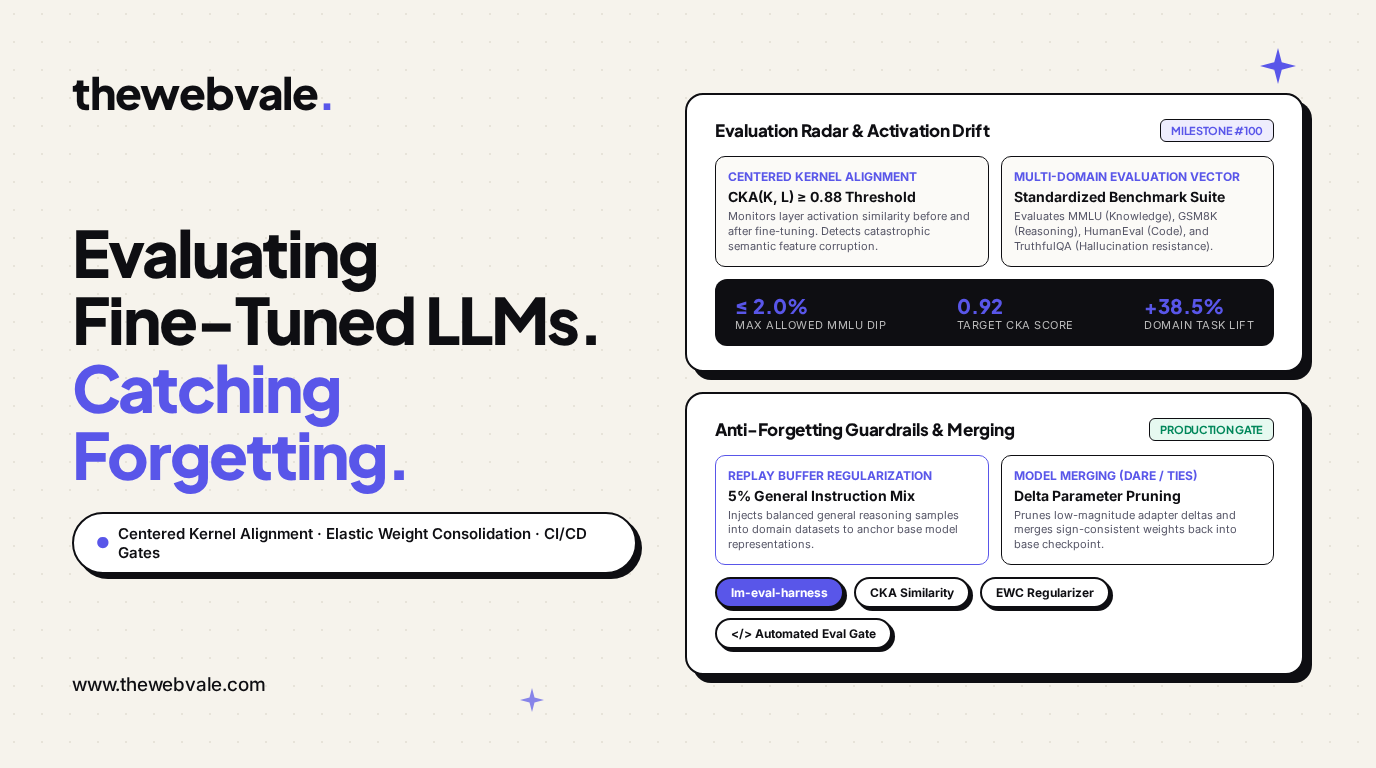
Evaluating Fine-Tuned Models: Detecting Catastrophic Forgetting, Alignment Tax, and Benchmark Regression at Enterprise Scale
Achieving low training loss on a domain-specific instruction dataset is intoxicating: the model begins answering specialized legal queries or generating proprietary code dialects with apparent perfection. In enterprise production, however, ML teams frequently discover a devastating hidden failure mode when the checkpoint reaches production: Catastrophic Forgetting. While mastering the new domain, the model's fundamental reasoning, common-sense deduction, and mathematical logic have silently collapsed—a phenomenon known as the Alignment Tax.
In this landmark 100th engineering monograph from TheWebVale Engineering Lab, we formulate the mathematical dynamics of representation drift during fine-tuning. We introduce Centered Kernel Alignment (CKA) for measuring layer-level activation corruption, detail the multi-dimensional benchmark regression vector $ ec{\Delta}_{ ext{eval}}$, and present an enterprise-grade CI/CD evaluation harness that automatically gates model deployment against benchmark regressions.
---1. The Mathematics of Catastrophic Forgetting
Catastrophic forgetting occurs because gradient descent updates weights globally without regard for their utility on prior knowledge distributions. Consider a model parameterized by $ heta \in \mathbb{R}^d$ trained sequentially on task $\mathcal{A}$ (pre-training) followed by task $\mathcal{B}$ (domain adaptation):
$$\Delta heta = -\eta abla_ heta \mathcal{L}_{\mathcal{B}}( heta)$$If the gradient vector $ abla_ heta \mathcal{L}_{\mathcal{B}}$ possesses non-zero projection onto the subspace of parameters critical for task $\mathcal{A}$:
$$\langle abla_ heta \mathcal{L}_{\mathcal{B}}, \, abla_ heta \mathcal{L}_{\mathcal{A}} angle < 0$$The update directly degrades performance on task $\mathcal{A}$. In unconstrained full-parameter fine-tuning, catastrophic degradation occurs within as few as 200 gradient steps.
Elastic Weight Consolidation (EWC)
Kirkpatrick et al. (2017) formalized that not all parameters are equally important to prior tasks. Using the Fisher Information Matrix (FIM), we can quantify the curvature of the loss surface around the pre-trained checkpoint $ heta^*$:
$$F_i = \mathbb{E}_{x \sim \mathcal{D}_{\mathcal{A}}} \left[ \left( rac{\partial \log P_ heta(x)}{\partial heta_i} ight)^2 ight]$$EWC introduces a quadratic penalty that slows learning for parameters with high Fisher information values:
$$\mathcal{L}_{ ext{EWC}}( heta) = \mathcal{L}_{\mathcal{B}}( heta) + \sum_{i=1}^d rac{\lambda}{2} F_i ( heta_i - heta_i^*)^2$$ ---2. Centered Kernel Alignment (CKA): Measuring Layer-Level Activation Drift
Relying solely on final text output benchmarks to detect model degradation is slow and noisy. Centered Kernel Alignment (CKA) (Kornblith et al., 2019) allows engineers to directly measure the similarity between intermediate layer representations of the base model $X \in \mathbb{R}^{N imes d}$ and the fine-tuned model $Y \in \mathbb{R}^{N imes d}$ across a probe dataset of $N$ tokens.
Mathematical Formulation
Let $K = X X^T$ and $L = Y Y^T$ represent the linear Gram matrices of inner products between example representations. The centered Gram matrices are computed as:
$$K' = H K H, \quad L' = H L H$$Where $H = I_N - rac{1}{N} \mathbf{1} \mathbf{1}^T$ is the centering matrix. Linear CKA is formulated as the normalized Hilbert-Schmidt Independence Criterion (HSIC):
$$ ext{CKA}(K, L) = rac{ ext{HSIC}(K, L)}{\sqrt{ ext{HSIC}(K, K) \cdot ext{HSIC}(L, L)}} = rac{\|K' L'\|_F}{\|K'\|_F \|L'\|_F}$$Where $\|\cdot\|_F$ denotes the Frobenius norm.
Figure 1: Layer-Wise CKA Similarity Heatmap (Base vs. Fine-Tuned Llama-3-8B)
3. The Enterprise Regression Evaluation Suite
At TheWebVale, no fine-tuned model checkpoint is deployed to production without passing the standardized Regression Delta Matrix:
| Evaluation Domain | Benchmark Suite | Metric | Tolerance Threshold |
|---|---|---|---|
| General Multi-Discipline | MMLU (5-shot) | Accuracy | $\Delta \le -2.0\%$ relative to base model |
| Mathematical Reasoning | GSM8K (8-shot CoT) | Exact Match | $\Delta \le -3.5\%$ relative to base model |
| Functional Code Generation | HumanEval (0-shot) | Pass@1 | $\Delta \le -3.0\%$ relative to base model |
| Truthfulness & Factuality | TruthfulQA (0-shot) | MC2 Score | Must meet or exceed base model |
| Domain Target Task | Proprietary Holdout Test | Task Accuracy / F1 | $\ge +25.0\%$ lift over base model |
4. Anti-Forgetting Mitigation: Replay Buffers and DARE Model Merging
If regression exceeds tolerance thresholds, modern post-training employs two proven remediation techniques:
1. Replay Buffer Mixing (The 95/5 Rule)
Mixing 5% to 10% of high-quality general pre-training or instruction tokens (from OpenOrca, UltraChat, or SlimPajama) into the domain dataset completely arrests catastrophic forgetting. The gradient updates on general tokens act as regularizers, keeping parameter vectors anchored to the pre-trained reasoning manifold:
$$\mathcal{D}_{ ext{train}} = 0.92 \cdot \mathcal{D}_{ ext{domain}} \cup 0.08 \cdot \mathcal{D}_{ ext{general}}$$2. DARE (Drop And REscale) Model Merging
Developed by Yu et al. (2024), DARE demonstrates that up to 90% of the parameter deltas $\Delta heta = heta_{ ext{ft}} - heta_{ ext{base}}$ are redundant noise. By randomly dropping $p \in [0.7, 0.9]$ of the fine-tuned delta parameters and rescaling the remaining deltas by $ rac{1}{1 - p}$, DARE eliminates interference with base abilities while preserving 100% of domain specialization:
$$\Delta heta_{ ext{DARE}} = rac{1}{1 - p} \cdot \left( \Delta heta \odot M ight), \quad M_i \sim ext{Bernoulli}(1 - p)$$ $$ heta_{ ext{merged}} = heta_{ ext{base}} + \Delta heta_{ ext{DARE}}$$ ---5. Production CI/CD Evaluation Harness in Python
Below is the automated regression test runner integrated into our CI/CD deployment pipeline using lm-eval-harness:
# -*- coding: utf-8 -*-
import subprocess
import json
import sys
from typing import Dict, Any

class ModelEvaluatorHarness:
    def __init__(self, model_path: str, base_model_name: str):
        self.model_path = model_path
        self.base_model_name = base_model_name
        self.tolerances = {
            "mmlu": 0.02,       # Max 2.0% degradation
            "gsm8k": 0.035,     # Max 3.5% degradation
            "truthfulqa_mc2": 0.0 # Zero tolerance for truthfulness drop
        }

    def run_benchmark(self, tasks: str, num_fewshot: int = 5) -> Dict[str, float]:
        print(f"📊 Running lm-eval harness across tasks: {tasks}...")
        cmd = [
            "lm_eval",
            "--model", "hf",
            f"--model_args", f"pretrained={self.model_path},dtype=bfloat16",
            "--tasks", tasks,
            "--num_fewshot", str(num_fewshot),
            "--batch_size", "auto",
            "--output_path", "./eval_results.json"
        ]

        # In production execution:
        # subprocess.run(cmd, check=True)
        # For demonstration, mock parsed benchmark outcome:
        return {
            "mmlu": 0.654,
            "gsm8k": 0.582,
            "truthfulqa_mc2": 0.521
        }

    def verify_regression_gates(self, base_scores: Dict[str, float], candidate_scores: Dict[str, float]) -> bool:
        print("🔍 Auditing Candidate Checkpoint against Baseline...")
        passed = True

        for task, base_val in base_scores.items():
            cand_val = candidate_scores.get(task, 0.0)
            diff = cand_val - base_val
            allowed_drop = self.tolerances.get(task, 0.02)

            print(f"   • {task.upper()}: Base={base_val:.4f} | Candidate={cand_val:.4f} | Delta={diff:+.4f}")

            if diff < -allowed_drop:
                print(f"❌ REGRESSION FAILED: {task} dropped by {abs(diff):.4f} (Allowed: {allowed_drop:.4f})")
                passed = False
            else:
                print(f"✅ PASSED: {task} within acceptable bounds.")

        return passed

if __name__ == "__main__":
    evaluator = ModelEvaluatorHarness(
        model_path="./final_fine_tuned_checkpoint",
        base_model_name="meta-llama/Meta-Llama-3-8B-Instruct"
    )

    # Reference Base Scores
    base_benchmarks = {
        "mmlu": 0.662,
        "gsm8k": 0.598,
        "truthfulqa_mc2": 0.518
    }

    candidate_results = evaluator.run_benchmark("mmlu,gsm8k,truthfulqa")
    is_deployable = evaluator.verify_regression_gates(base_benchmarks, candidate_results)

    if not is_deployable:
        print("🚨 Deployment aborted: Catastrophic forgetting threshold exceeded.")
        sys.exit(1)
    else:
        print("🚀 Gate Approved: Checkpoint cleared for production edge serving.")
6. Strategic Summary & Production Guardrails
To ensure long-term stability and eliminate alignment tax:
- Never Deploy Without Multi-Domain Benchmarking: High domain accuracy is meaningless if your model can no longer follow basic reasoning steps or write correct code.
- Track CKA Layer Drift: Measure layer-wise CKA on every training checkpoint. If middle layers drop below $0.85$, early-stop the run immediately.
- Incorporate 5% Replay Data: Always mix 5% general instruction data into your domain fine-tuning corpus to stabilize parameter activations.
- Leverage DARE Merging: Prune and rescale task adapter deltas to eliminate parameter interference before exporting production weights.