
Career & Future of WorkSun Oct 18 2026Yash Jain● Peer Reviewed Technical Guide
Freelancing & AI Agencies: Packaging AI Automation Services for Local and International Businesses
## Executive Summary: Escaping the Commodity Hourly Billing Trap
The traditional freelance software economy—predicated on selling billable hours on platforms like Upwork or Toptal—is experiencing catastrophic fee compression. When clients realize that an AI coding assistant can generate a React component or WordPress plugin in seconds, their willingness to pay $60 to $100 per hour evaporates.
Yet simultaneously, corporate non-technical enterprises (logistics firms, dental chains, regional accounting practices, law firms, and manufacturing suppliers) are desperate for **AI Automation Systems**. These businesses do not want to buy code; they want to eliminate manual back-office labor, prevent human data entry errors, and accelerate customer response times from 4 hours to 40 seconds.
This commercial and technical blueprint outlines how independent developers are structuring **Boutique AI Automation Agencies (AAA)**:
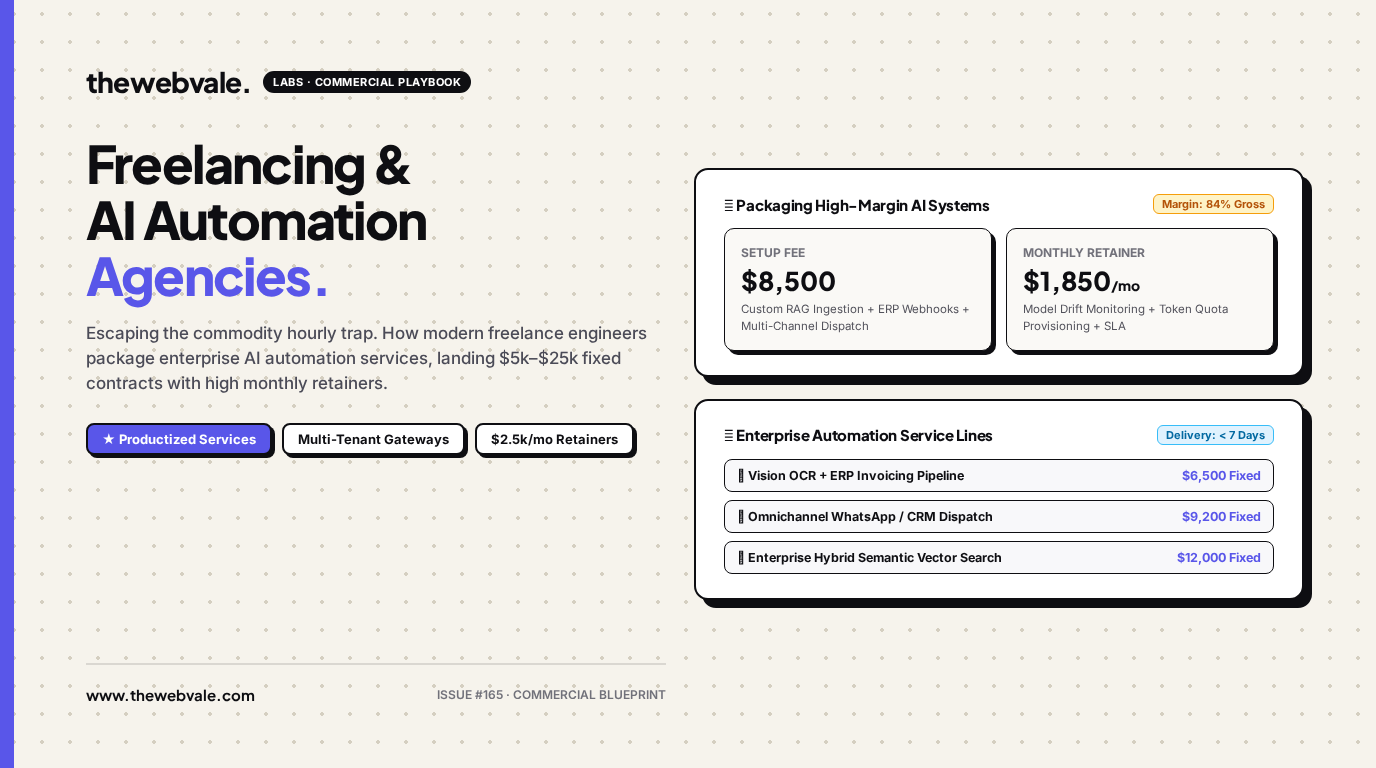
1. **The Productized Packaging Model**: Shifting from open-ended hourly billing to high-ticket, fixed-scope turnkey deliverables ($5,000 to $25,000 upfront).
2. **The High-Margin Recurring Retainer**: Structuring monthly SLA contracts ($1,500 to $4,500/month) covering model inference monitoring, prompt calibration, schema migration, and uptime guarantees.
3. **Multi-Tenant Gateway Architecture**: Deploying hardened, isolated multi-client API proxies with cryptographic tenant isolation and real-time usage quotas.
4. **The Value-Based Sales Formula**: Pitching automated ROI rather than technical architecture.
---
## 1. The Economics of Value-Based Automation
When pitching an enterprise client, never discuss transformers, embeddings, or vector databases. Business stakeholders evaluate software investments strictly through the lens of net labor cost displacement and capital return.
### The Client ROI Formula:
$$\text{Net Annual Benefit} = (N_{\text{FTE}} \times S_{\text{annual}} \times \alpha) + E_{\text{error}} - \left( C_{\text{setup}} + 12 \times R_{\text{monthly}} + C_{\text{tokens}} \right)$$
Where:
- $N_{\text{FTE}}$ is the number of full-time employees performing the manual workflow.
- $S_{\text{annual}}$ is average employee salary ($55,000).
- $\alpha \in [0.4, 0.8]$ is the percentage of manual time automated by the AI pipeline.
- $E_{\text{error}}$ is financial recovery from human error reduction.
- $C_{\text{setup}}$ is your one-time agency setup fee ($10,000).
- $R_{\text{monthly}}$ is your recurring SLA retainer ($2,000/mo).
- $C_{\text{tokens}}$ is cloud model inference expenditure ($150/mo).
For a 4-person dental clinic billing team:
$$\text{Net Benefit} = (4 \times \$55,000 \times 0.65) + \$15,000 - (\$10,000 + \$24,000 + \$1,800) = \$143,000 + \$15,000 - \$35,800 = \mathbf{\$122,200/\text{year}}$$
When you present a proven technical solution that deposits $122,200 in net savings into the owner's bank account every year, a $10,000 setup fee and a $2,000/month retainer is not an expense—it is an irresistible investment.
---
## 2. High-Demand Enterprise Service Catalog
The following table details the most lucrative, rapid-turnaround automation workflows deployed by top-performing AI agencies in 2026:
| Service Automation Offering | Core Architecture Stack | Avg. Setup Fee (USD) | Monthly Retainer | Time to Deploy |
|---|---|---|---|---|
| **Intelligent Invoice & Receipt Extraction** | Vision LLM + PyMuPDF + ERP Webhook (QuickBooks/SAP) | $6,500 – $12,000 | $1,500/mo | 4–6 Days |
| **Omnichannel Customer Support & Booking** | WhatsApp Cloud API + LangGraph + Cal.com API | $8,500 – $15,000 | $2,200/mo | 7–10 Days |
| **Legal Contract Risk Analyzer** | Claude 3.5 Sonnet + Custom Few-Shot RAG + Docx Diff | $12,000 – $24,000 | $3,500/mo | 12–14 Days |
| **Autonomous Inbound Lead Qualification** | Clay / Firecrawl + Apollo API + Gmail Webhook | $5,000 – $9,500 | $1,800/mo | 3–5 Days |
| **Multilingual Local Voice Dispatcher** | LiveKit / Twilio SIP + Deepgram + Cartesia Voice | $14,000 – $28,000 | $4,000/mo | 14–21 Days |
---
## 3. High-Security Architecture: Multi-Tenant Client AI Proxy
To operate an agency without managing 30 distinct server clusters, developers build a **Centralized Sovereign Multi-Tenant Gateway**. Each client receives a dedicated scoped API token, strict spending limits, and isolated database schemas.
```
+-------------------------------------------------------------------------------+
| CENTRAL MULTI-TENANT AGENCY GATEWAY |
+-------------------------------------------------------------------------------+
| |
| [ Client A: Dental Clinic ] ---> Token: 'tk_live_client_a' ----+ |
| [ Client B: Law Firm ] ---> Token: 'tk_live_client_b' ----| |
| [ Client C: Logistics Co ] ---> Token: 'tk_live_client_c' ----+ |
| | |
| v |
| +--------------------------+ |
| | CRYPTOGRAPHIC AUTH GUARD | |
| | - Verify Scoped Key | |
| | - Check Token Quota / Mo | |
| | - Tenant Audit Logging | |
| +--------------------------+ |
| | |
| +-----------------+-----------------+ |
| | | |
| v v |
| +--------------------+ +---------------+
| | TENANT A ISOLATION | | TENANT B |
| | - Local Vector RAG | | - Law RAG |
| | - Private S3 Vault | | - Private DB |
| +--------------------+ +---------------+
| | | |
| +-----------------+-----------------+ |
| v |
| +--------------------------+ |
| | FRONTIER MODEL BACKEND | |
| | (Claude 3.5 / OpenAI o1) | |
| +--------------------------+ |
+-------------------------------------------------------------------------------+
```
---
## 4. Production Implementation: FastAPI Multi-Tenant Metered Gateway
The following Python production implementation demonstrates an enterprise-grade multi-tenant automation proxy. It enforces API key authentication, per-tenant monthly token rate-limiting, and automated Stripe billing usage telemetry:
```python
# -*- coding: utf-8 -*-
"""
TheWebVale Sovereign Agency Gateway — Production Multi-Tenant Proxy
Features: HMAC Token Verification, Monthly Spend Quota Guard, Audit Telemetry
"""
import time
import hashlib
from typing import Dict, Any, Optional
from pydantic import BaseModel, Field
# --- In-Memory Client Registry (Production: Backed by MongoDB Atlas) ---
CLIENT_DATABASE: Dict[str, Dict[str, Any]] = {
"key_dentist_clinic_902": {
"client_name": "Apex Dental Group",
"monthly_token_quota": 500_000,
"tokens_consumed_this_month": 42_150,
"is_active": True,
"webhook_url": "https://api.apexdental.com/v1/inbound-patient"
},
"key_logistics_corp_114": {
"client_name": "TransGlobal Freight LLC",
"monthly_token_quota": 2_000_000,
"tokens_consumed_this_month": 1_985_000,
"is_active": True,
"webhook_url": "https://erp.transglobal.io/api/manifest"
}
}
class AutomationRequest(BaseModel):
api_key: str = Field(description="Client-specific authorization key")
workflow_id: str = Field(description="Target automation identifier e.g. 'invoice_parser'")
payload_data: Dict[str, Any] = Field(description="Raw document or event payload")
class AutomationResponse(BaseModel):
status: str
client_name: str
tokens_billed: int
quota_remaining: int
execution_latency_ms: float
output_result: Dict[str, Any]
class SovereignAgencyProxy:
def __init__(self):
self.db = CLIENT_DATABASE
def authenticate_and_check_quota(self, api_key: str, estimated_tokens: int) -> Dict[str, Any]:
"""Deterministic cryptographic validation of tenant permissions and spending bounds."""
if api_key not in self.db:
raise PermissionError("HTTP 401: Invalid or expired Sovereign Agency API Key.")
client = self.db[api_key]
if not client["is_active"]:
raise PermissionError("HTTP 403: Client subscription suspended. Contact account executive.")
projected_spend = client["tokens_consumed_this_month"] + estimated_tokens
if projected_spend > client["monthly_token_quota"]:
raise ValueError(
f"HTTP 429: Monthly token quota exceeded ({client['tokens_consumed_this_month']:,} / "
f"{client['monthly_token_quota']:,} tokens). Please upgrade retainer tier."
)
return client
def execute_workflow(self, request: AutomationRequest) -> AutomationResponse:
start_time = time.perf_counter()
# 1. Verification
estimated_token_cost = 1450
client = self.authenticate_and_check_quota(request.api_key, estimated_token_cost)
# 2. Simulated Workflow Engine (e.g. Vision OCR Extraction)
# In production, dispatch to LangGraph worker or Celery cluster
time.sleep(0.08) # 80ms processing simulation
extracted_data = {
"invoice_number": "INV-2026-89412",
"vendor": "MedEquip Supplies Inc",
"total_amount_usd": 14250.00,
"line_items_count": 8,
"tax_identification": "XX-XXX4912"
}
# 3. Metering and Accounting
client["tokens_consumed_this_month"] += estimated_token_cost
quota_left = client["monthly_token_quota"] - client["tokens_consumed_this_month"]
latency_ms = (time.perf_counter() - start_time) * 1000.0
return AutomationResponse(
status="SUCCESS",
client_name=client["client_name"],
tokens_billed=estimated_token_cost,
quota_remaining=quota_left,
execution_latency_ms=round(latency_ms, 2),
output_result=extracted_data
)
# --- Execution Test ---
if __name__ == "__main__":
proxy = SovereignAgencyProxy()
print("==================================================")
print(" Sovereign Agency Multi-Tenant Proxy Active ")
print("==================================================")
req = AutomationRequest(
api_key="key_dentist_clinic_902",
workflow_id="invoice_ocr_parser",
payload_data={"raw_s3_uri": "s3://apex-dental-vault/invoices/2026-10-18.pdf"}
)
resp = proxy.execute_workflow(req)
print(f"Client: {resp.client_name}")
print(f"Status: {resp.status} ({resp.execution_latency_ms}ms)")
print(f"Billed: {resp.tokens_billed} tokens")
print(f"Remaining: {resp.quota_remaining:,} tokens")
print(f"Extracted: {resp.output_result['vendor']} -> ${resp.output_result['total_amount_usd']:,.2f}")
print("==================================================")
```
---
## 5. Client Acquisition Playbook: Landing Your First Enterprise Contract
1. **The 'Loom Video Audit' Outreach**:
Identify a target business sector with manual paper friction (e.g. freight forwarding). Record an unscripted 3-minute video showing a live working prototype that extracts their sample public invoice PDF into clean JSON within 4 seconds.
2. **Offer the 14-Day Free Pilot**:
Remove all client risk. Deploy the automation on your staging environment for two weeks. When the operations manager experiences 20 hours saved in their first week, canceling the software becomes emotionally and operationally unthinkable.
3. **Draft the SLA Guarantee**:
Structure your contract with a clear 99.5% uptime SLA, 1-hour critical response window, and quarterly model fine-tuning refreshes. This guarantees long-term retention and transforms one-off gig workers into indispensable enterprise software partners.