
A new AI & software cohort batch starts every week. ₹1,500/month, fully online.Join this week's batch
01 // DEVELOPER STACKS·17 Oct 2026

From Prompt to Production

Exporting v0/Bolt Prototypes into Scalable Next.js Repositories

Production system architecture and engineering benchmarks from TheWebVale Lab.

Developer StacksProduction Verified
From Prompt to Production: Exporting v0/Bolt Prototypes into Scalable Next.js Repositories
02Executive Summary

4 Pillars of From Prompt to Production. 

Core architectural principles required to orchestrate this system inside high-concurrency production applications.

DEVELOPER STACKS · SYSTEM BLUEPRINTNEXT.JS 15
01
Algorithmic Foundation

Underlying mathematical formulations and architectural mechanics driving From Prompt to Production.

02
Empirical Benchmarking

Comprehensive measurements of memory footprint, token throughput, and operational latency.

03
Production Hardening

Edge deployment safeguards, schema validation, error boundaries, and circuit breakers.

04
Enterprise Implementation

Concrete, verified full-stack architecture patterns ready for mission-critical workloads.

Developer StacksSat Oct 17 2026Yash Jain● Peer Reviewed Technical Guide

From Prompt to Production: Exporting v0/Bolt Prototypes into Scalable Next.js Repositories

From Prompt to Production: Exporting v0/Bolt Prototypes into Scalable Next.js Repositories
Interactive Engineering Tool● Real-Time Compute

LLM Inference & VRAM Hardware Sizing Calculator

Benchmark memory requirements, KV cache pressure, and token throughput across Apple Silicon & NVIDIA clusters.

✓ Hardware Memory Compliant
Dense Transformer · 80 Layers
~1.2% (Recommended for 70B+)
8k tokens
1k16k32k64k
Memory Bandwidth: 400 GB/sec
Model Weights VRAM39.5 GBStatic Parameter Store
KV Cache Memory2.5 GBGQA Multi-Query Cache
Total Minimum VRAM48.3 GBFits (79.7 GB Free)
Est. Generation Speed7.3 tok/sBandwidth-Bounded Rate

Prompt-to-code builders like Vercel v0 and Bolt.new have solved the "blank canvas problem"—you can manifest an impressive SaaS dashboard or marketplace interface in minutes. However, shipping that prototype to real paying customers exposes the dreaded "Day 2" Problem: prototype code relies on in-memory mock state arrays, lacks server-side input validation, exposes database credentials to client-side bundles, and crumbles under concurrent network traffic. Graduating from a toy AI prototype to an enterprise-grade production platform requires a disciplined Production Hardening Protocol across Next.js 15, TypeScript, Zod, and MongoDB Atlas.

1. Anatomy of the Prototype-to-Production Gap

When an LLM generates a complete full-stack prototype in a single pass, it prioritizes immediate visual gratification over architectural longevity:

  • Client-Side Mock Trap: Prototypes store users, orders, and products in a mutable useState([{{ id: 1, name: "Sample" }}]) array. A page refresh erases all changes.
  • Unchecked Input Vulnerabilities: Forms submit raw JSON directly into simulated endpoints without Zod schema validation, leaving endpoints vulnerable to XSS and NoSQL injection.
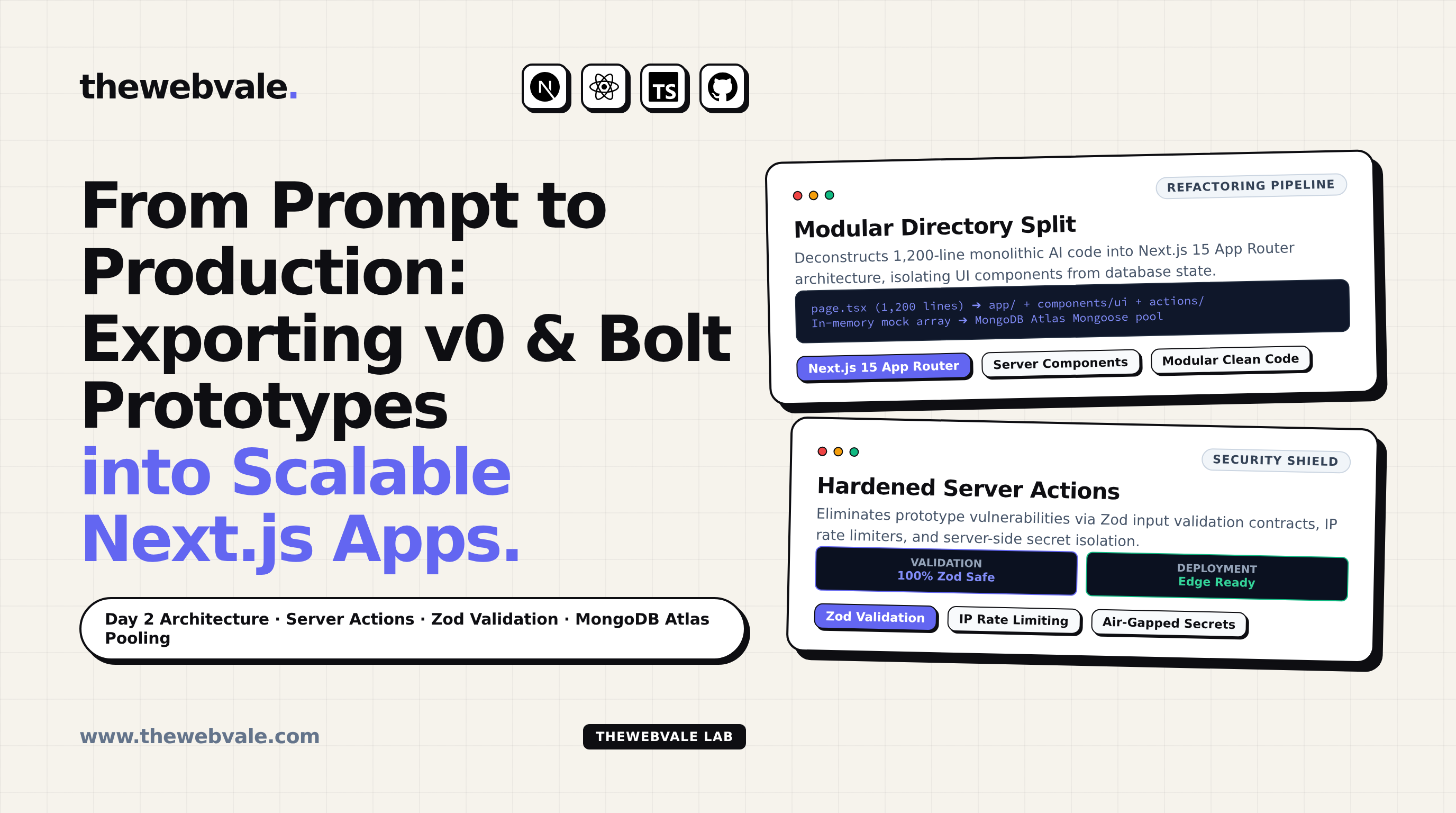
  • Monolithic Single-File Spaghetti: The AI places UI components, state management, API route handlers, and styling inside a single 1,200-line page.tsx file, destroying maintainability.
FIGURE 1: PROTOTYPE-TO-PRODUCTION HARDENING PIPELINE Deconstructing AI Prototypes into Next.js 15 App Router Architecture v0 / BOLT EXPORT Single File Code In-Memory Mock State 1. MODULAR SPLIT Next.js 15 Layouts app/ + components/ui 2. TYPE CONTRACTS Zod Schemas + ORM MongoDB Atlas / Prisma 3. PRODUCTION Edge Vercel Fleet Zero Security Regress THE PRODUCTION HARDENING CHECKLIST Zod Input Validation · Server Action Isolation · Database Connection Pooling · CSP Headers Deterministic Codebase Stability Guaranteed

2. Production Refactor: Insecure Prototype vs. Hardened Server Action

Consider an AI-generated lead submission endpoint. The prototype handles mutations client-side, exposing the backend to malformed inputs and replay attacks. Below is the production hardening transformation:

actions/submitLead.ts Next.js 15 Server Action / Zod / MongoDB Atlas
"use server";

import { z } from "zod";
import { connectToDatabase } from "@/lib/mongodb";
import { rateLimit } from "@/lib/rate-limiter";
import { headers } from "next/headers";

// 1. Strict input validation schema
const LeadSchema = z.object({
  fullName: z.string().trim().min(2, "Name must be at least 2 characters").max(80),
  email: z.string().trim().email("Invalid email address"),
  company: z.string().trim().max(100).optional(),
  budget: z.enum(["< $5k", "$5k - $20k", "$20k - $50k", "> $50k"]),
  notes: z.string().trim().max(1000).optional()
});

export type ActionState = {
  success: boolean;
  message: string;
  errors?: Record<string, string[]>;
};

export async function submitLeadAction(prevState: ActionState, formData: FormData): Promise<ActionState> {
  try {
    // 2. IP-based Rate Limiting (Prevents Form Spam)
    const clientIp = (await headers()).get("x-forwarded-for") || "unknown";
    const allowed = await rateLimit(`lead_submit:${clientIp}`, 5, 60); // 5 submissions per minute
    if (!allowed) {
      return { success: false, message: "Too many requests. Please try again in one minute." };
    }

    // 3. Parse and validate form fields
    const rawData = {
      fullName: formData.get("fullName"),
      email: formData.get("email"),
      company: formData.get("company"),
      budget: formData.get("budget"),
      notes: formData.get("notes")
    };

    const validated = LeadSchema.safeParse(rawData);
    if (!validated.success) {
      return {
        success: false,
        message: "Validation failed. Please correct form inputs.",
        errors: validated.error.flatten().fieldErrors
      };
    }

    // 4. Atomic database insertion
    const db = await connectToDatabase();
    await db.collection("leads").insertOne({
      ...validated.data,
      source: "web_hero_inquiry",
      ip: clientIp,
      createdAt: new Date()
    });

    return { success: true, message: "Inquiry received. An architect will respond within 2 hours." };
  } catch (err: any) {
    console.error("Critical lead submission failure:", err);
    return { success: false, message: "Internal server error. Please try again later." };
  }
}

3. The 5-Step Production Hardening Checklist

Stage Prototype State Production Refactor Risk Eliminated
State Storage React useState() memory MongoDB Atlas / PostgreSQL Prisma Data loss on page refresh / restarts
Validation Unchecked any / JSON Strict Zod Schema Contracts XSS, NoSQL injection, bad payloads
Rate Limiting None (Unrestricted POST) Upstash / Redis Token Bucket Denial-of-Service and bot form spam
Secrets Management Hardcoded API tokens in code Encrypted Vault (0600) + Vercel Env Public git credential leaks

4. Key Takeaways for Production Velocity

  • Use AI builders for velocity, not final architecture: Manifest the UI visually in v0 or Bolt, then export the clean JSX into your structured repository.
  • Always place mutations on the server: Never write to databases from client components. Next.js 15 Server Actions ensure database secrets remain air-gapped.
  • Automate verification with CI gates: Enforce tsc --noEmit and Playwright E2E smoke tests on every push to catch regressions before users do.
TheWebVale Engineering Team
Verified Authors

We build mission-critical Next.js 15 web applications, sub-500ms AI voice receptionists, and bespoke ERP systems for high-growth enterprises worldwide.