
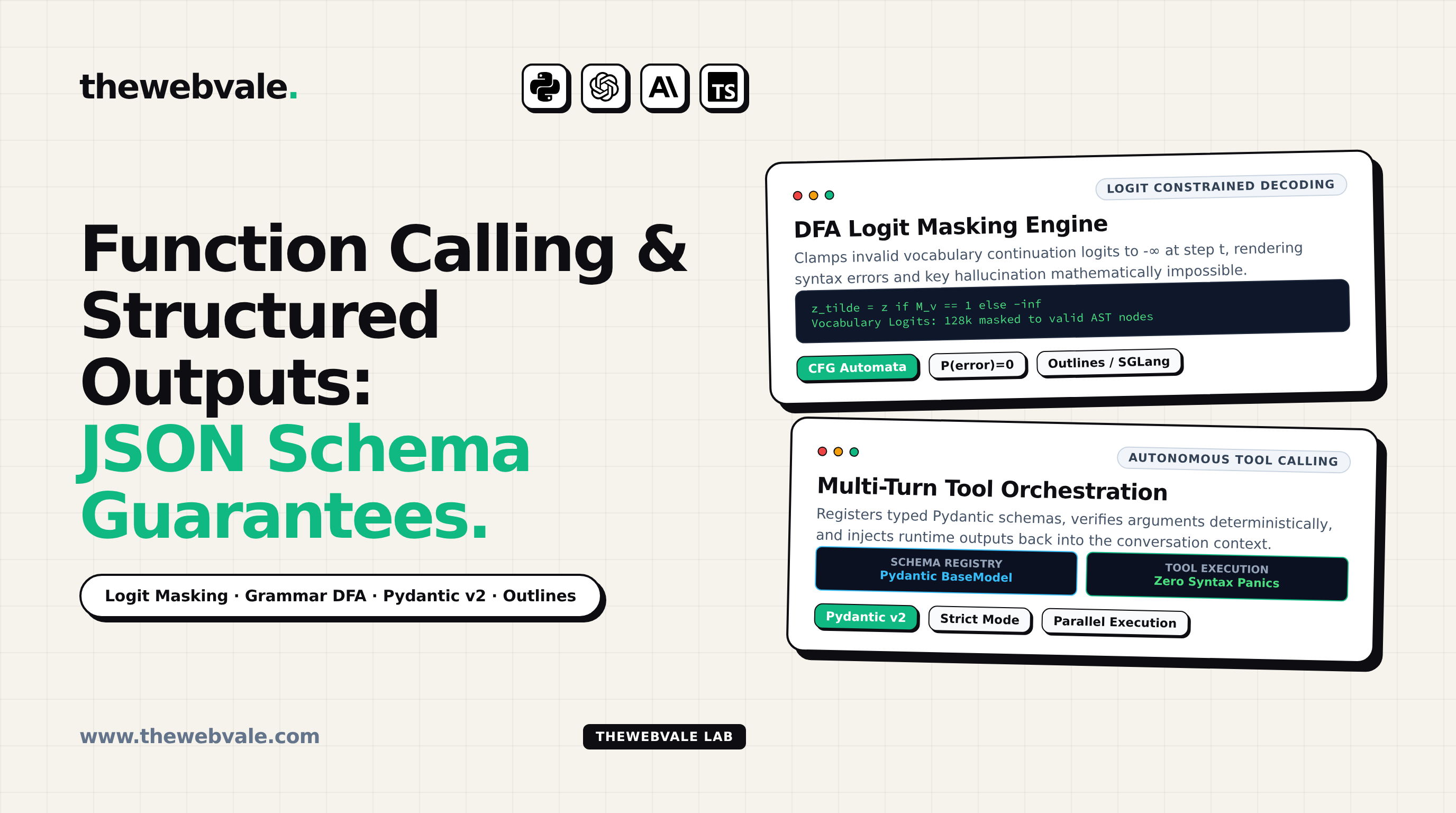
Function Calling & Structured Outputs: Enforcing JSON Schema Guarantees via LLMs
For years, integrating Large Language Models into traditional software stacks felt like playing Russian roulette with a compiler. Software engineers would append desperate pleas to their prompts: "Please return valid JSON only. Do not include markdown codeblocks or conversational preamble." Invariably, at 3:00 AM in production, the model would output a trailing comma, unescaped double quotes, or an introductory greeting—crashing downstream deserializers. In 2024–2025, the industry resolved this brittleness with Constrained Decoding & Structured Outputs. By coupling Context-Free Grammars (CFGs) directly to the transformer's logit sampling layer, modern runtimes guarantee 100% syntactical compliance with arbitrary JSON schemas.
1. The Mathematics of Constrained Decoding: Logit Masking via Automata
Standard LLM decoding computes a Softmax distribution over the entire vocabulary $\mathcal{V}$ (typically 128,000+ tokens):
In Constrained Decoding (implemented in engines like Outlines, SGLang, and vLLM), a Deterministic Finite Automaton (DFA) or Context-Free Grammar (CFG) tracks the exact parser state of the generated prefix $w_{<t}$. At each generation step $t$:
- The grammar compiler queries the DFA: "Given the JSON syntax produced so far, which tokens in $\mathcal{V}$ form a valid continuation?"
- A binary mask vector $M \in \{0, 1\}^{|\mathcal{V}|}$ is constructed, where $M_v = 1$ if token $v$ conforms to the schema, and $0$ otherwise.
- Invalid logits are clamped to negative infinity before Softmax:
$$\tilde{z}_v = \begin{cases} z_v & \text{if } M_v = 1 \\ -\infty & \text{if } M_v = 0 \end{cases}$$
Because tokens that would violate the schema receive probability zero, it is mathematically impossible for the model to emit invalid JSON or hallucinated keys.
2. Function Calling Protocol: Tool Resolution & Schema Registration
When an LLM executes real-world actions (e.g. querying a SQL database, placing an order, or dispatching an email), it engages in a three-stage exchange:
3. Production Python Harness: Pydantic v2 Structured Extraction with Outlines
Below is a complete, production-grade example using Pydantic v2 to enforce typed data extraction with deterministic schema validation:
from pydantic import BaseModel, Field, HttpUrl
from enum import Enum
from openai import OpenAI
class RiskLevel(str, Enum):
LOW = "low"
MEDIUM = "medium"
CRITICAL = "critical"
class SecurityIncidentExtraction(BaseModel):
incident_id: str = Field(description="Standard CVE or internal incident ticket string")
affected_services: List[str] = Field(description="List of internal microservices impacted")
risk_level: RiskLevel
estimated_downtime_minutes: int = Field(ge=0, description="Non-negative downtime estimate")
mitigation_steps: List[str] = Field(min_length=1, description="Ordered remediation sequence")
client = OpenAI()
def extract_incident_report(raw_log: str) -> SecurityIncidentExtraction:
# Native OpenAI Structured Outputs: Guarantees 100% adherence to SecurityIncidentExtraction
completion = client.beta.chat.completions.parse(
model="gpt-4o-2024-08-06",
messages=[
{"role": "system", "content": "Extract structured security diagnostics from unformatted incident alerts."},
{"role": "user", "content": raw_log}
],
response_format=SecurityIncidentExtraction,
)
return completion.choices[0].message.parsed
4. Production Engineering Best Practices
When deploying structured outputs in mission-critical applications:
- Use Strict Mode Everywhere: In both OpenAI and self-hosted vLLM/Outlines engines, enable
strict: true. This prohibits additional properties and enforces non-optional fields. - Minimize Schema Depth: Deeply nested JSON schemas with hundreds of properties slow down grammar compilation. Keep schemas flat and modular.
- Isolate Function Execution: Never allow an LLM tool call to execute arbitrary code or shell commands without deterministic sandboxing and human-in-the-loop review for high-impact mutations.