
The Geopolitical AI Divide: The Risk of a Two-Speed World Between Compute-Rich and Compute-Poor Nations
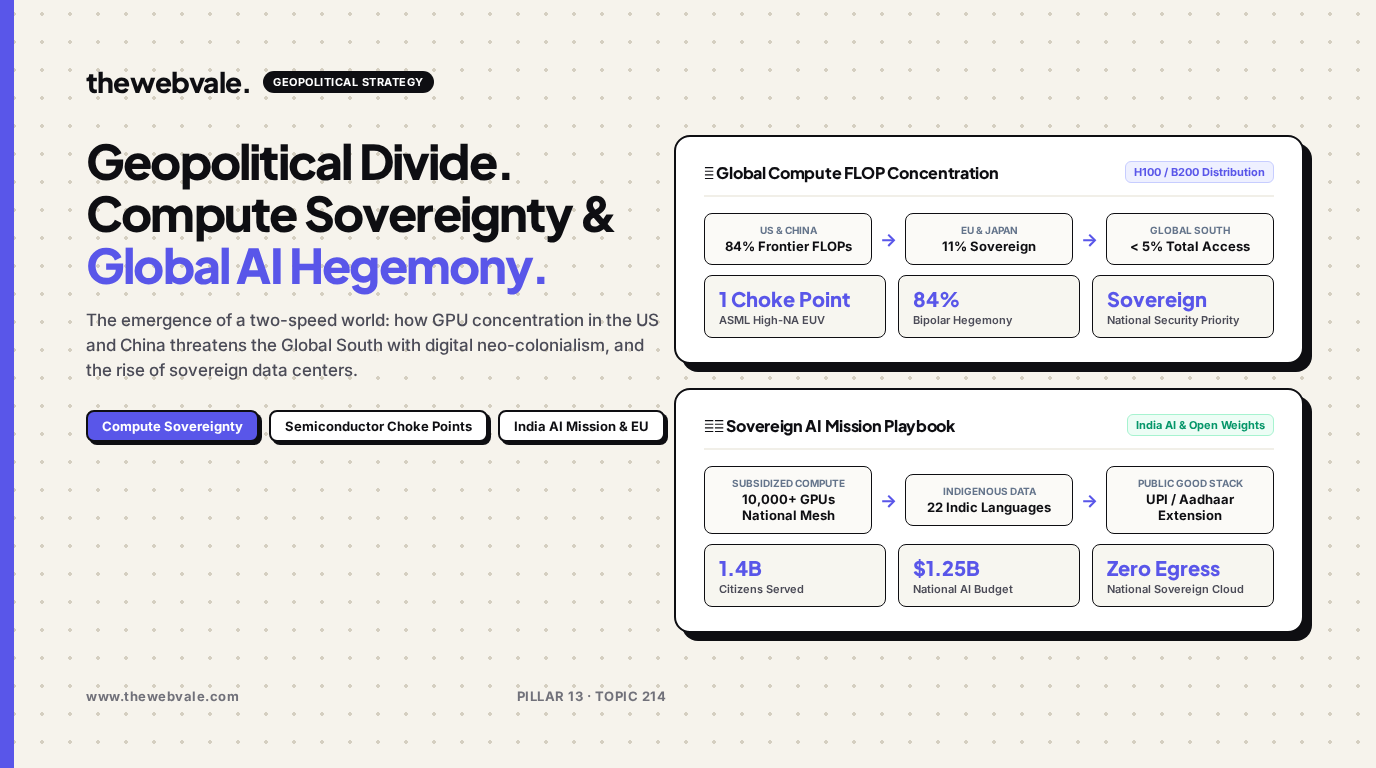
The twenty-first century geopolitical balance of power is no longer measured solely in barrels of oil, aircraft carrier strike groups, or ballistic arsenals; it is increasingly dictated by aggregate sovereign compute capacity. Today, over 85% of global frontier AI training clusters reside within the borders of two superpowers: the United States and China. This unprecedented concentration creates the danger of a two-speed geopolitical world, where nations in the Global South face digital subjugation, economic dependency on foreign proprietary cloud APIs, and the systematic erasure of native linguistic and cultural knowledge.
🌐 The Three Choke Points of Compute Hegemony
1. Lithography Monopolies: ASML in the Netherlands holds a global monopoly on High-NA Extreme Ultraviolet (EUV) lithography systems.
2. Foundry Concentration: TSMC in Taiwan manufactures over 90% of the world's frontier AI silicon (NVIDIA, Apple, AMD).
3. Data Center Energy Contracts: Multi-gigawatt electrical grid allocations tied to hyperscaler nuclear power purchase agreements in North America.
1. The Risk of Generative Neo-Colonialism
When developing economies rely exclusively on US-hosted closed foundation models for education, legal analysis, and healthcare triage, three severe systemic distortions occur:
| Domain | Foreign Model Distortion | Sovereign AI Alternative |
|---|---|---|
| Cultural & Value Alignment | Imposes Western cultural norms and legal viewpoints | Indigenous models aligned with local constitutional jurisprudence |
| Linguistic Tokenization | Hindi, Swahili, Arabic require 4-10x more tokens per word | Custom BPE tokenizers with native script efficiency |
| National Security & Data Egress | Classified government queries travel across foreign trans-oceanic cables | Air-gapped on-premise national data centers |
| Economic Value Capture | GDP flows out of local economies in SaaS token licensing fees | Domestic compute fleets driving local technological startups |
2. The Sovereign AI Playbook: The Indian & European Counter-Strategy
Forward-thinking sovereign governments are refusing to be mere token consumers. India's landmark IndiaAI Mission ($1.25 billion public fund) directly provisions 10,000+ GPUs to startups, subsidizes indigenous model training across 22 scheduled languages, and treats compute as public utility infrastructure—akin to the national highway grid or Unified Payments Interface (UPI).
Similarly, France and the broader EU have funded national superclusters (such as Jean Zay) and backed open-weights champions like Mistral, proving that sovereign independence depends on open-source weights that can never be revoked by unilateral foreign export sanctions.
3. Frequently Asked Questions
Can smaller nations compete without training $1B frontier models?
Yes. By using model distillation, post-training optimization, and fine-tuning open-weights models (such as Llama 3.3 or DeepSeek-V3) on curated indigenous datasets, nations achieve frontier reasoning in specific local domains at a fraction of the cost.
Why is tokenizer efficiency critical for the Global South?
English text typically uses 1 token per word, while non-Latin scripts (Devanagari, Arabic, Cyrillic) split into 4 to 8 byte-level tokens in Western tokenizers. This makes API calls up to 8x more expensive and truncates context windows for non-English speakers—a barrier solved by native vocabulary tokenizers.