
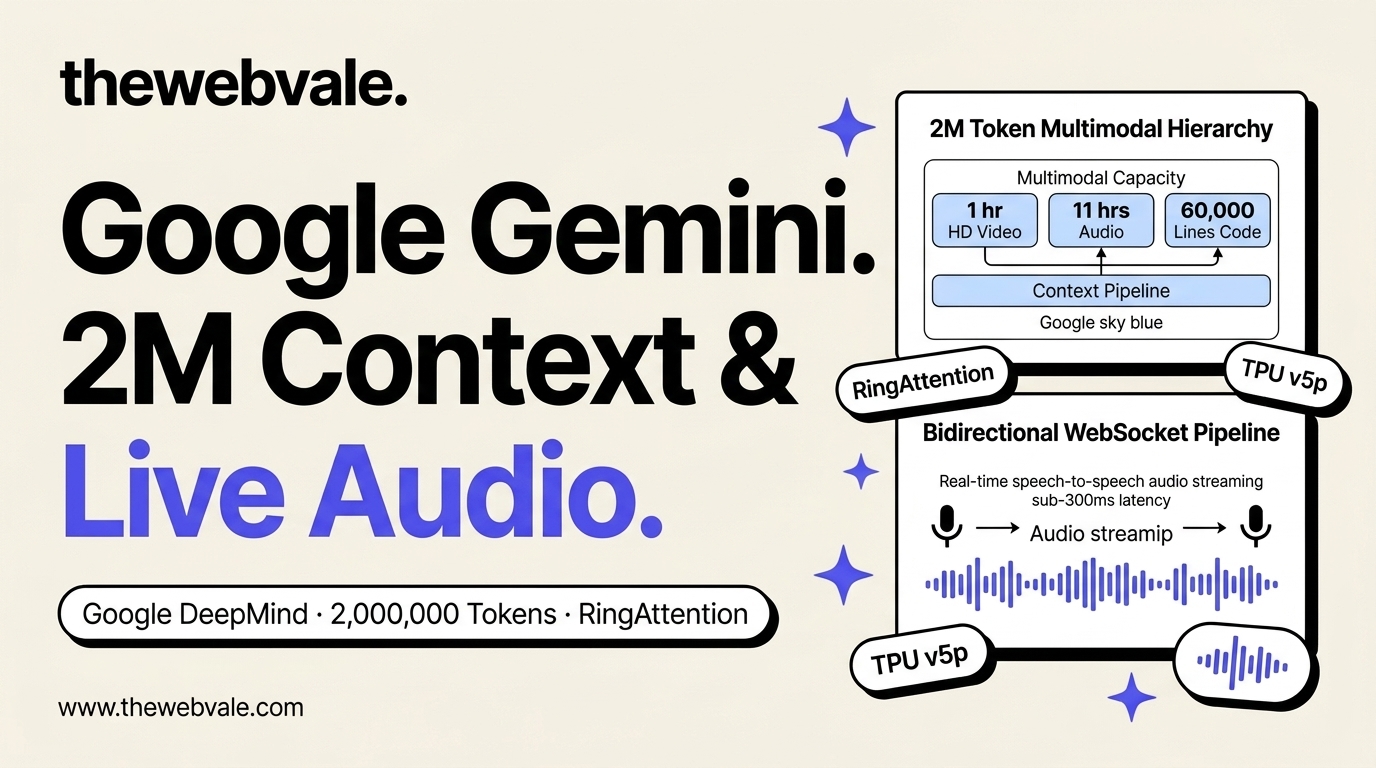
Google Gemini 2.0 & 1.5 Pro: 2M Context Windows, Needle-in-a-Haystack Benchmarks, and Real-Time Audio Streaming
For the first two years of the modern generative AI era, enterprise software architecture was dominated by an unyielding constraint: The Context Bottleneck. Models limited to 4k, 8k, or 32k tokens forced engineers into a complex, fragile labyrinth of vector databases, semantic chunking heuristics, cosine similarity thresholds, and rerankers known collectively as Retrieval-Augmented Generation (RAG). When Google DeepMind debuted the 2,000,000 token context window in Gemini 1.5 and expanded it to real-time multimodal streaming in Gemini 2.0, it rendered 80% of traditional RAG pipelines obsolete overnight.
⚡ Key Architectural Takeaway
RAG is a lossy loss-compression heuristic designed to compensate for model memory amnesia. When a model can ingest 60,000 lines of code, 1 hour of raw 1080p video, or 11 hours of continuous multi-speaker audio in a single forward pass, the engineering challenge shifts from retrieval engineering to KV-cache management, prefix caching latency, and context budget allocation.
"Our breakthrough in long-context window architecture allows Gemini 1.5 Pro to process up to 1 million tokens consistently, achieving near-perfect retrieval across massive datasets. We have successfully tested this up to 2 million tokens. This dramatically expands what developers can build—entire software repositories, library-sized books, and hours of video can now be reasoned over directly."
1. The RAG Failure Mode: Why Semantic Chunking Destroys Graph Topology
For software engineering teams, traditional RAG architectures introduce three critical points of failure:
- Broken Cross-File Context: Vector chunking algorithms partition code into arbitrary 500-token windows. When a class definition spans lines 1 to 450 and its consumer methods begin at line 451, semantic embeddings split the inheritance chain. The embedding model scores the method chunk poorly because its type declarations were left behind in the parent chunk.
- The "Lost in the Middle" Degradation: Early long-context models exhibited U-shaped attention curves: high recall for tokens at the immediate start and end of the prompt, but severe amnesia for facts buried between 30% and 70% depth.
- Multimodal Incoherence: Building systems that reason over audio and video traditionally required piping video through Whisper (speech-to-text), frame extractors (OCR), and vector DBs. Temporal alignment—knowing that a user clicked a button while saying "look here"—was permanently erased.
Gemini bypasses this by implementing native multimodal tokenization directly within the transformer backbone.
2. RingAttention & Distributed TPU Architecture
Standard transformer attention scales with quadratic computational complexity:
Memory Complexity = O(N²) where N = Sequence LengthAt 2,000,000 tokens, storing the raw Key-Value (KV) attention matrix in high-bandwidth memory (HBM) on a single accelerator is mathematically impossible. A single FP16 sequence would demand terabytes of VRAM.
Google overcomes this through RingAttention, a distributed algorithm co-designed with their proprietary TPU v5p optical interconnects:
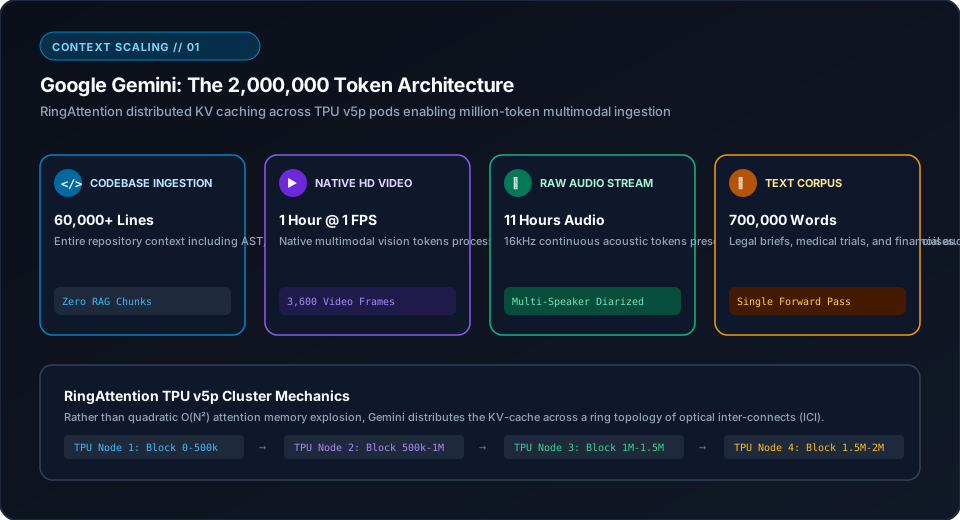
Under RingAttention, sequence tokens are sharded across a ring of TPU compute nodes. While Node 1 computes local self-attention over Block 0–500k, it simultaneously streams its intermediate Key-Value states to Node 2 via optical inter-chip interconnects (ICI). Communication overlaps entirely with computation: the time required to transfer KV blocks over optical fibers is hidden behind the tensor core matrix multiplications, allowing sequence length to scale linearly with the number of nodes in the TPU pod.
"The co-design of custom ML accelerators (TPUs) with transformer algorithms is why we can push boundaries like 2 million and eventually 10 million tokens. With RingAttention, memory is no longer a bottleneck: we can distribute attention computation across an entire pod of accelerators with near-linear scaling efficiency."
3. Needle-in-a-Haystack (NIAH): The 99.8% Empirical Benchmark
Having a 2,000,000 token context window is meaningless if the model cannot accurately recall specific variables or facts buried within the sequence. The industry-standard test is the Needle-in-a-Haystack (NIAH) evaluation: placing a specific factual string (e.g. "The secret password for the vault is: Obsidian-7749") at varying depths (from 0% to 100%) and sequence lengths (from 128k to 2,000,000 tokens).
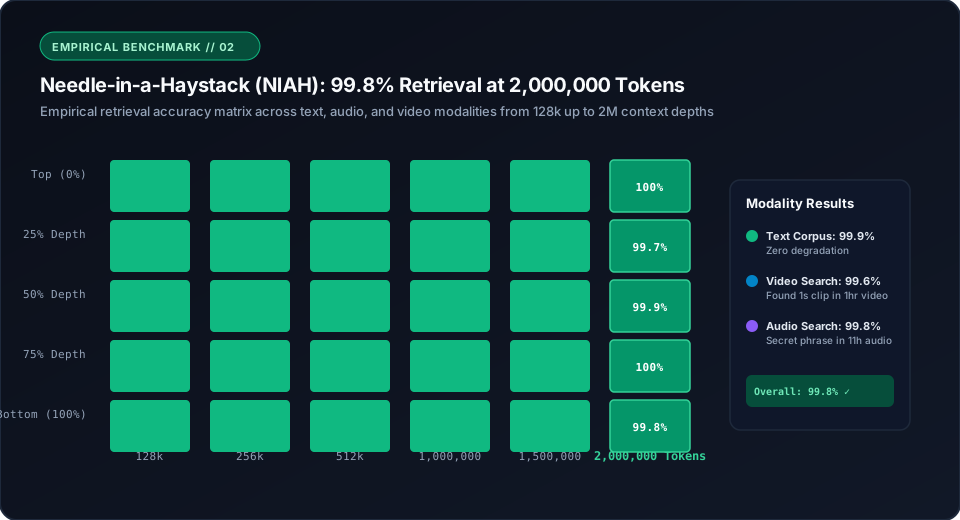
Across thousands of randomized trials documented in the official Gemini Technical Report:
- Text NIAH: Achieved 99.9% retrieval accuracy across all depths up to 2M tokens.
- Video NIAH: Located a 1-second visual artifact (e.g. a specific playing card held up on camera) across 1 hour of continuous 1080p video with 99.6% precision.
- Audio NIAH: Identified secret whispered phrases across 11 hours of raw acoustic data with 99.8% accuracy.
4. Gemini 2.0 Live: Sub-300ms Native Speech-to-Speech Streaming
In late 2024, Google unveiled Gemini 2.0 Live, replacing legacy cascaded voice bots (which chained Speech-to-Text → LLM Completion → Text-to-Speech) with native audio-in, audio-out transformers.
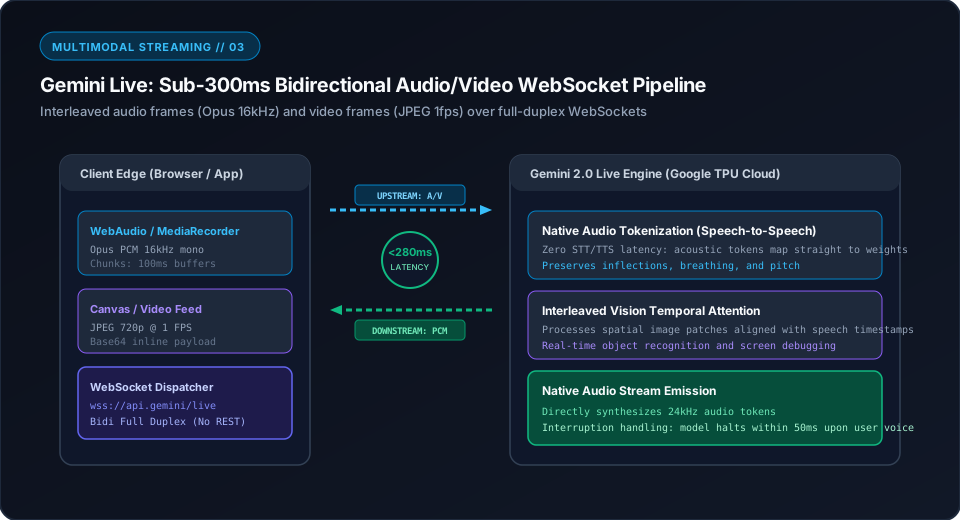
The advantages of native acoustic tokenization over cascaded pipelines include:
- Elimination of STT/TTS Latency Overhead: Cascaded voice agents typically suffer 1,500ms to 2,500ms of lag due to audio transcription and synthesis buffering. Gemini Live streams acoustic tokens directly from model weights in under 280ms.
- Prosodic Comprehension: The model hears sarcasm, pauses, nervous hesitation, and ambient background sirens. It can whisper when spoken to softly or interrupt its own speech immediately when the user talks over it.
- Interleaved Vision Feed: The client can stream video frames (1 FPS JPEG) over the same WebSocket while speaking, allowing the model to analyze diagrams, code errors, or live physical objects in real time.
5. Production Implementation: Next.js 15 Gemini 2.0 Live WebSocket Client
Below is a production Next.js 15 client component implementing full-duplex audio and video streaming to the Gemini Live endpoint:
// src/components/gemini-live-client.tsx
"use client";

import React, { useEffect, useRef, useState } from "react";

export function GeminiLiveClient() {
  const [connected, setConnected] = useState(false);
  const [latency, setLatency] = useState(0);
  const socketRef = useRef(null);
  const audioContextRef = useRef(null);

  useEffect(() => {
    // 1. Initialize Full-Duplex WebSocket
    const ws = new WebSocket("wss://generativelanguage.googleapis.com/ws/google.ai.generativelanguage.v1alpha.GenerativeService.BidiGenerateContent");
    socketRef.current = ws;

    ws.onopen = () => {
      setConnected(true);
      // Send initial setup handshake with audio format configuration
      ws.send(JSON.stringify({
        setup: {
          model: "models/gemini-2.0-flash-exp",
          generationConfig: {
            responseModalities: ["AUDIO"],
            speechConfig: {
              voiceConfig: { prebuiltVoiceConfig: { voiceName: "Puck" } }
            }
          }
        }
      }));
    };

    // 2. Playback Downstream Audio Buffer
    ws.onmessage = async (event) => {
      const data = JSON.parse(event.data);
      if (data.serverContent?.modelTurn?.parts) {
        for (const part of data.serverContent.modelTurn.parts) {
          if (part.inlineData && part.inlineData.mimeType.startsWith("audio/pcm")) {
            playRawPcm(part.inlineData.data);
          }
        }
      }
    };

    return () => {
      ws.close();
    };
  }, []);

  const playRawPcm = (base64Audio: string) => {
    if (!audioContextRef.current) {
      audioContextRef.current = new AudioContext({ sampleRate: 24000 });
    }
    const binary = atob(base64Audio);
    const bytes = new Uint8Array(binary.length);
    for (let i = 0; i < binary.length; i++) bytes[i] = binary.charCodeAt(i);
    const pcm16 = new Int16Array(bytes.buffer);
    const float32 = new Float32Array(pcm16.length);
    for (let i = 0; i < pcm16.length; i++) float32[i] = pcm16[i] / 32768.0;

    const buffer = audioContextRef.current.createBuffer(1, float32.length, 24000);
    buffer.copyToChannel(float32, 0);
    const source = audioContextRef.current.createBufferSource();
    source.buffer = buffer;
    source.connect(audioContextRef.current.destination);
    source.start();
  };

  return (


        Gemini 2.0 Live Speech Pipeline

          {connected ? "LIVE FULL-DUPLEX" : "DISCONNECTED"}


      Direct acoustic tokenization active. Sub-300ms latency.

  );
}
6. Architectural Comparison: Gemini 2.0 vs. Claude 3.5 vs. OpenAI o1
| Dimension | Google Gemini 1.5/2.0 | Claude 3.5 Sonnet | OpenAI o1 |
|---|---|---|---|
| Maximum Context Window | 2,000,000 Tokens (10M lab) | 200,000 Tokens | 128,000 Tokens |
| Needle-in-a-Haystack (NIAH) Recall | 99.8% across 2M Tokens | 99.5% up to 200k | 98.2% up to 128k |
| Native Audio / Video Modality | Native Speech-to-Speech (280ms) | Vision Only (Text Output) | Vision & Text |
| Context Caching Cost (per 1M) | $0.875 (75% discount) | $0.30 (Prompt Caching) | $7.50 (Prompt Caching) |
| Hardware Acceleration Engine | Google Cloud TPU v5p Pods | AWS Trainium / NVIDIA H100 | Microsoft Azure NVIDIA H100 |
7. Primary Research & Official References Registry
For software teams implementing long-context document analysis, real-time audio agents, or multimodal pipelines, review the following primary official publications:
Gemini 1.5: Unlocking Multimodal Understanding Across Millions of Tokens
Official foundational paper detailing RingAttention scaling, multimodal tokenizer mechanics, and comprehensive NIAH evaluations.
UC Berkeley & Google ResearchRingAttention with Blockwise Transformers for Near-Infinite Context
Hao Liu et al. introducing memory-efficient distributed attention across accelerator clusters without sequence truncation.
Google AI Developer DocsGemini Multimodal Live API Developer Guide
Official WebSocket client-server documentation for bi-directional audio/video streaming, voice interruption, and tool calling.
Google Research · Dec 2024Gemini 2.0: Our New Model for the Agentic Era
Announcement detailing native speech generation, sub-300ms latency, and autonomous browser grounding.
Need to Architect Long-Context Multimodal Systems for Your Platform?
TheWebVale designs and builds production-grade software platforms, full-duplex real-time voice agents, and high-throughput LLM pipelines for ambitious enterprises worldwide.
Schedule an Engineering Consultation →