
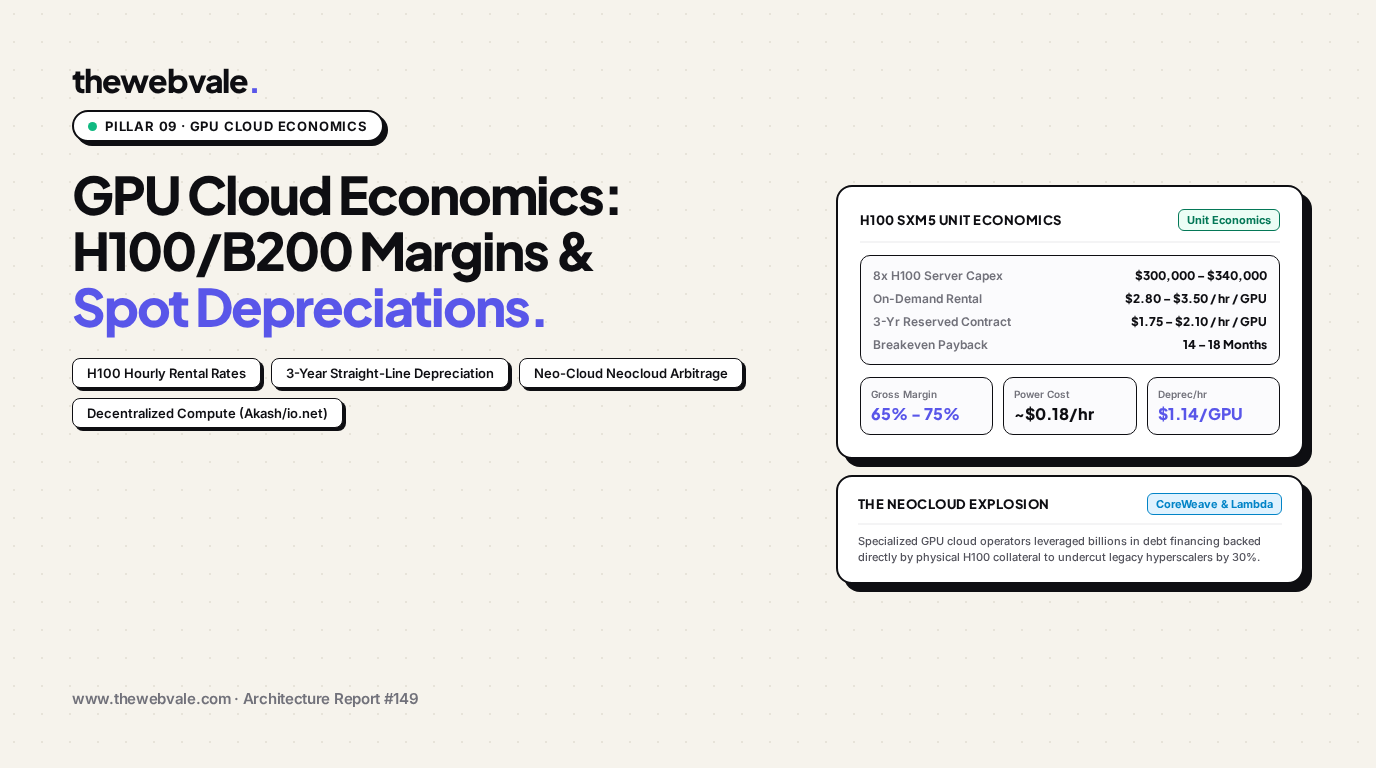
GPU Cloud Economics: Spot Pricing, H100/B200 Hourly Rental Margins, Depreciation & Decentralized Compute
In the modern technology ecosystem, compute has evolved from an IT operational expense into an asset class traded with the volatility and financial complexity of commodities. The global race to train and serve generative AI models has created a multi-billion-dollar GPU cloud economy characterized by asset-backed debt financing, rapid hardware depreciation, and intense price competition between legacy hyperscalers and agile "Neoclouds."
For engineering executives and enterprise founders, understanding the unit economics of GPU compute is as critical as understanding neural network architecture. Whether renting a single 8x H100 node on a spot instance or committing to an eight-figure multi-year reserved contract, compute costs dictate corporate burn rates and product margins. In this architectural and financial deep dive, we deconstruct the total cost of ownership (TCO) of enterprise GPU servers, model cash flow depreciation, analyze neocloud financing models, and evaluate decentralized compute protocols.
Financial Waterfall: 8x NVIDIA H100 SXM5 Server Unit Economics (3-Year Amortization)
Cost breakdown of hardware capex, power, networking, and colocation against hourly revenue at $2.20/GPU/hour.
1. Capital Expenditure (Capex) & The Fully-Loaded Cost Basis
To understand GPU pricing, we must analyze the real-world manufacturing bill of materials (BOM) for an enterprise server. An NVIDIA HGX H100 8-GPU baseboard incorporates:
- 8x NVIDIA H100 SXM5 GPUs (80GB HBM3 each).
- 4x Third-Generation NVSwitches providing 900 GB/s inter-GPU bandwidth.
- Host Server Node: Dual Intel Xeon Platinum 8480+ or AMD EPYC 9654 processors, 2TB DDR5 ECC RAM, 30TB NVMe storage.
- Networking: 8x NVIDIA ConnectX-7 400Gb/s InfiniBand OSFP adapters and 2x BlueField-3 DPUs for storage management.
In 2024–2026, the all-in procurement price of a fully integrated 8-GPU HGX server ranges between $300,000 and $340,000.
Assuming standard financial practice of 3-year straight-line depreciation with zero residual salvage value:
Hourly Depreciation per Individual GPU = rac{\$11.415}{8} = \$1.427 / ext{GPU} / ext{hour}
Adding electricity ($0.08/kWh × 10.2 kW server load × 1.25 PUE = $1.02/server/hr or $0.128/GPU/hr) and colocation rack leasing ($0.08/GPU/hr), the absolute break-even floor cost to operate an H100 is ~$1.64 per GPU per hour. Any cloud provider selling below this threshold is actively losing capital on unamortized hardware.
2. The Neocloud Revolution: Asset-Backed Debt Financing
The astronomical demand for AI compute sparked the emergence of "Neoclouds"—specialized infrastructure providers such as CoreWeave, Lambda Labs, Crusoe, and Voltage Park.
Unlike hyperscalers (AWS, Azure, GCP) that treat GPUs as just another service alongside thousands of enterprise database and networking products, Neoclouds engineered a novel financial model: asset-backed debt facilities collateralized by GPUs.
- CoreWeave and Lambda secured billions of dollars in credit lines from investment firms like Blackstone, Magnetar Capital, and Coatue by pledging their physical fleets of H100 GPUs as collateral.
- They pre-sold 1-year and 3-year capacity commitments to AI startups (like Mistral, Inflection, and Cohere) and hyperscalers facing capacity shortages (Microsoft Azure contracted with CoreWeave to satisfy OpenAI demand).
- By focusing 100% of their software stack on Kubernetes-orchestrated Slurm clusters with bare-metal InfiniBand, Neoclouds deliver higher network throughput at hourly rates 25% to 35% lower than AWS.
3. Decentralized Compute Networks: Akash, Render & io.net
A parallel movement seeks to decentralize compute using blockchain protocols:
- Akash Network & io.net: Aggregate idle consumer GPUs (RTX 4090, RTX 3090) and enterprise data center excess capacity worldwide, creating a reverse-auction spot marketplace.
- The Economic Advantage: Consumer GPUs rent for as little as $0.30 to $0.60 per hour, offering incredible cost efficiency for batch processing, image generation (Stable Diffusion), and audio transcription (Whisper).
- The Architectural Reality Wall: Decentralized compute is structurally incapable of training large frontier foundation models. Consumer GPUs communicate over consumer internet connections with millisecond latency (10,000x slower than NVLink) and lack peer-to-peer RDMA. A 70B parameter model training run across distributed residential nodes would spend 95% of its time stalled on gradient transfer. Consequently, decentralized compute remains strictly confined to independent batch inference and embarrassingly parallel fine-tuning.
4. Comprehensive GPU Rental Market Pricing Matrix
| Provider Tier | Representative Providers | H100 On-Demand Rate | H100 1-Yr Reserved Rate | Interconnect Fabric | Target Customer |
|---|---|---|---|---|---|
| Tier 1 Hyperscalers | AWS (p5.48xlarge), Azure (NDv5), GCP (a3-highgpu) | $3.80 – $4.50 / hr | $2.80 – $3.20 / hr | InfiniBand / Custom EFA | Fortune 500 Enterprises with Cloud Commitments |
| Specialized Neoclouds | CoreWeave, Lambda Labs, Nebius AI, Crusoe | $2.85 – $3.25 / hr | $1.90 – $2.25 / hr | InfiniBand Quantum-2 (Pure bare-metal) | AI Startups, Foundation Model Labs |
| Budget / Spot Clouds | RunPod, Vast.ai, Together AI | $2.20 – $2.60 / hr | $1.75 – $1.95 / hr | Mixed (Ethernet & InfiniBand) | Developers, Fine-Tuning Researchers |
| Decentralized Compute | Akash Network, io.net, Render | $1.40 – $1.80 / hr (SXM) / $0.45 (RTX 4090) | Dynamic Bidding | Standard Internet / P2P | Batch Inference, Rendering, Web Scraping |
5. Production Simulation: GPU Cloud Financial Payback & ROI Model
The Python script below models the 3-year cash flow waterfall for an operator purchasing a 64-GPU cluster, calculating gross margins, debt service payments, and exact payback periods:
# -*- coding: utf-8 -*-
"""
TheWebVale Silicon Lab — GPU Cloud Financial Waterfall & Payback Model
Simulates debt amortization, operating expenses, and net profit for a 64-GPU H100 cluster.
"""

import dataclasses
from typing import Dict

@dataclasses.dataclass(frozen=True)
class ClusterInvestment:
    num_gpus: int
    capex_per_gpu: float
    hourly_rental_rate: float
    utilization_rate: float     # e.g., 0.90 = 90% billable uptime
    annual_power_opex_per_gpu: float
    annual_datacenter_rent_per_gpu: float
    debt_financing_percent: float  # e.g., 0.70 = 70% debt funded
    debt_interest_rate: float      # e.g., 0.09 = 9% annual interest
    loan_term_years: int

def model_gpu_payback(inv: ClusterInvestment) -> Dict[str, float]:
    total_capex = inv.num_gpus * inv.capex_per_gpu
    debt_principal = total_capex * inv.debt_financing_percent
    equity_down_payment = total_capex - debt_principal

    # Annual gross revenue
    billable_hours_per_year = 8760.0 * inv.utilization_rate
    annual_revenue = inv.num_gpus * inv.hourly_rental_rate * billable_hours_per_year

    # Annual Opex
    annual_opex = inv.num_gpus * (inv.annual_power_opex_per_gpu + inv.annual_datacenter_rent_per_gpu)

    # Annual Debt Service (standard amortizing loan payment formula)
    r = inv.debt_interest_rate
    n = inv.loan_term_years
    if r > 0:
        annual_debt_payment = debt_principal * (r * ((1 + r) ** n)) / (((1 + r) ** n) - 1)
    else:
        annual_debt_payment = debt_principal / n

    net_annual_cash_flow = annual_revenue - annual_opex - annual_debt_payment
    payback_years = equity_down_payment / (annual_revenue - annual_opex)

    return {
        "total_capex_usd": round(total_capex, 2),
        "equity_invested_usd": round(equity_down_payment, 2),
        "annual_gross_revenue_usd": round(annual_revenue, 2),
        "annual_operating_expenses_usd": round(annual_opex, 2),
        "annual_debt_service_usd": round(annual_debt_payment, 2),
        "net_annual_free_cash_flow_usd": round(net_annual_cash_flow, 2),
        "equity_payback_months": round(payback_years * 12.0, 1),
        "gross_operating_margin_percent": round(((annual_revenue - annual_opex) / annual_revenue) * 100.0, 1)
    }

if __name__ == "__main__":
    investment = ClusterInvestment(
        num_gpus=64,                      # 8x HGX servers
        capex_per_gpu=37500.0,            # Fully integrated server + networking allocation
        hourly_rental_rate=2.15,          # Realistic 3-year enterprise reserved price
        utilization_rate=0.92,            # 92% SLA uptime
        annual_power_opex_per_gpu=1120.0, # 1,400W server share @ $0.08/kWh
        annual_datacenter_rent_per_gpu=700.0,
        debt_financing_percent=0.70,      # 70% debt-financed
        debt_interest_rate=0.085,         # 8.5% Wall Street credit line
        loan_term_years=3
    )

    results = model_gpu_payback(investment)
    print("=== 64-GPU H100 CLUSTER FINANCIAL WATERFALL ===")
    print(f"Total Capex:           ${results['total_capex_usd']:,.2f}")
    print(f"Equity Down Payment:   ${results['equity_invested_usd']:,.2f}")
    print(f"Annual Gross Revenue:  ${results['annual_gross_revenue_usd']:,.2f}")
    print(f"Annual Opex:           ${results['annual_operating_expenses_usd']:,.2f}")
    print(f"Annual Debt Service:   ${results['annual_debt_service_usd']:,.2f}")
    print(f"Net Free Cash Flow:    ${results['net_annual_free_cash_flow_usd']:,.2f} / year")
    print(f"Operating Margin:      {results['gross_operating_margin_percent']}%")
    print(f"Equity Payback Period: {results['equity_payback_months']} Months")
6. Summary: The Inevitable Margin Compression
As next-generation architectures like Blackwell B200 ramp and custom hyperscaler ASICs (Trainium 2, TPU v6p) capture larger shares of internal cloud workloads, the historic H100 gross margin bubble is returning to earth. Cloud providers that built business models assuming permanent $3.50/hour spot rates will face severe financial distress when market rental rates settle closer to the unamortized floor of $1.50/hour. In this commoditizing market, long-term survival belongs to operators with the lowest cost of electrical power, automated infrastructure orchestration, and vertical integration.