
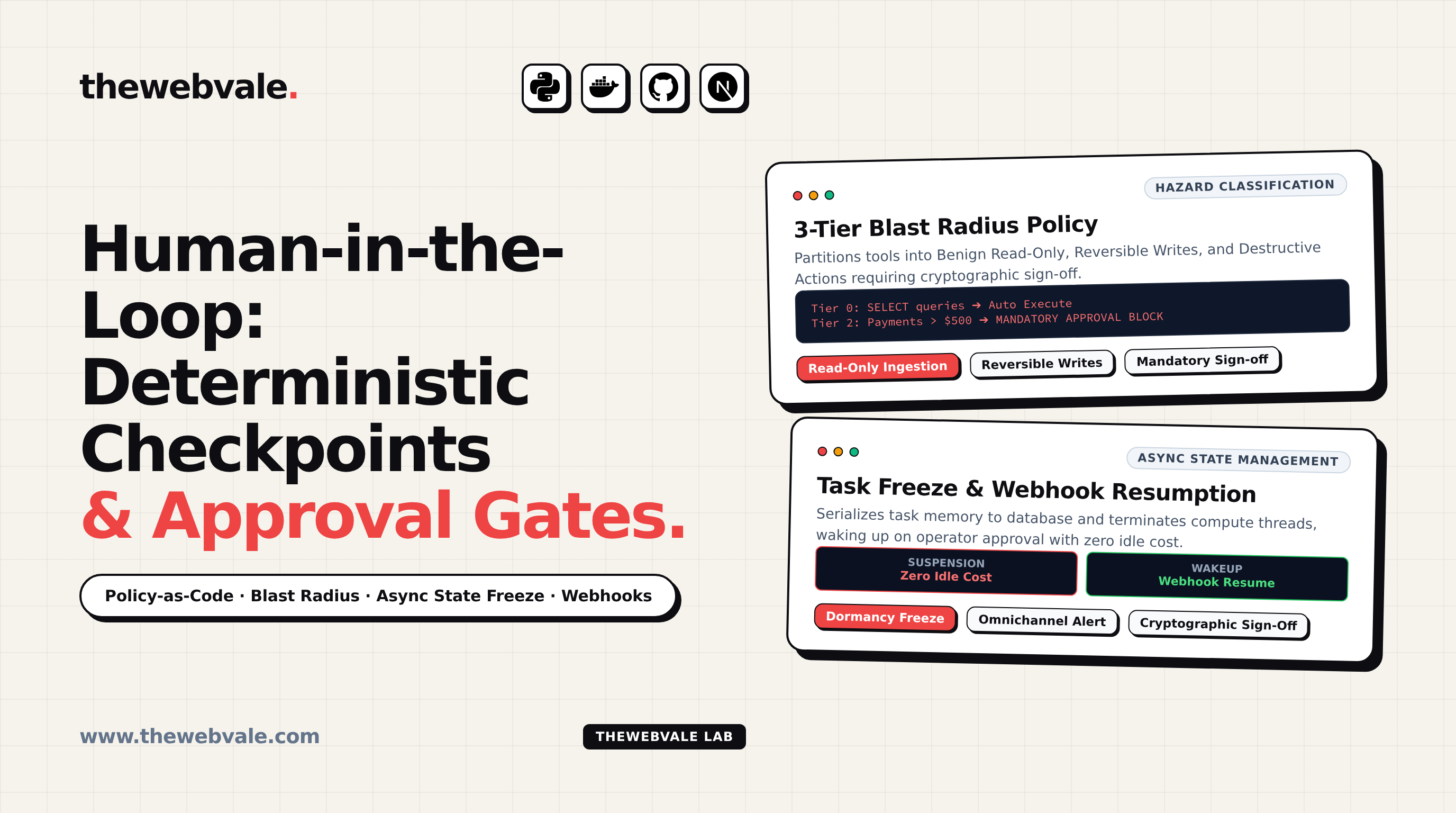
Human-in-the-Loop (HITL): Deterministic Checkpoints and Approval Gates for High-Risk Actions
The dream of "100% full autonomy" in enterprise AI is an operational catastrophe waiting to happen. An agent granted unconstrained write privileges to a production PostgreSQL database, an authorized corporate credit card, or a public company Twitter account will eventually encounter an ambiguous edge case and make a catastrophic decision. In real-world enterprise engineering, true intelligence is not defined by the absence of human oversight; it is defined by the precision with which an agent recognizes its own boundary of certainty and yields control. Building robust Human-in-the-Loop (HITL) Checkpoints transforms untrusted stochastic models into dependable enterprise infrastructure.
1. The Blast Radius Taxonomy: Partitioning Read vs. Write Mutations
An enterprise agent should never treat all tool executions equally. Production architectures partition capabilities into three risk tiers governed by Policy-as-Code:
2. The Architecture of State Suspension: Interrupt & Resume
Implementing Human-in-the-Loop in distributed async systems requires solving the Process Dormancy Problem. An agent cannot keep an active Python thread or HTTP connection open for eight hours while waiting for an executive to wake up and click "Approve":
- Snapshot Serialization: The full agent state—including current conversation tokens, tool name, parsed arguments, and execution step count—is serialized into a JSON document and persisted to an operational store (MongoDB Atlas / PostgreSQL).
- Process Termination: The compute worker terminates or returns to the shared connection pool. Zero compute or token costs accrue while idle.
- Webhook Wakeup: When the operator approves the action (via Telegram inline button, Slack interactive message, or web UI), an incoming webhook wakes up an orchestrator worker, hydrates the exact state snapshot, and resumes execution seamlessly.
3. Production Python Harness: Resumable HITL Gate Engine
Below is a complete, production-ready implementation of an asynchronous Human-in-the-Loop checkpoint manager with state serialization and cryptographic webhook verification:
from typing import Dict, Any
from pydantic import BaseModel
class PendingApproval(BaseModel):
approval_id: str
agent_id: str
tool_name: str
args: Dict[str, Any]
risk_level: str
created_at: float
status: str = "pending"
class HITLGateway:
def __init__(self, db_client):
self.col = db_client["agent_approvals"]
def request_human_approval(self, agent_id: str, tool_name: str, args: dict) -> str:
approval_id = str(uuid.uuid4())
record = PendingApproval(
approval_id=approval_id,
agent_id=agent_id,
tool_name=tool_name,
args=args,
risk_level="destructive",
created_at=time.time()
)
self.col.insert_one(record.dict())
self.dispatch_telegram_alert(record)
return approval_id
def handle_webhook_approval(self, approval_id: str, approved: bool, user_id: str):
new_status = "approved" if approved else "rejected"
self.col.update_one(
{"approval_id": approval_id},
{"$set": {"status": new_status, "approved_by": user_id, "resolved_at": time.time()}}
)
if approved:
self.resume_agent_execution(approval_id)
4. Core Engineering Directives
- Enforce deterministic policy checks before LLM execution: Never trust the LLM to decide whether an action requires human review. Use hardcoded Policy-as-Code filter rules.
- Implement hard expiration timeouts: If an approval request is not acted upon within 24 hours, automatically abort the task and notify the operator of expiration.
- Log full cryptographic audit trails: Record the operator's identity, timestamp, and exact approved arguments in an immutable compliance ledger.