
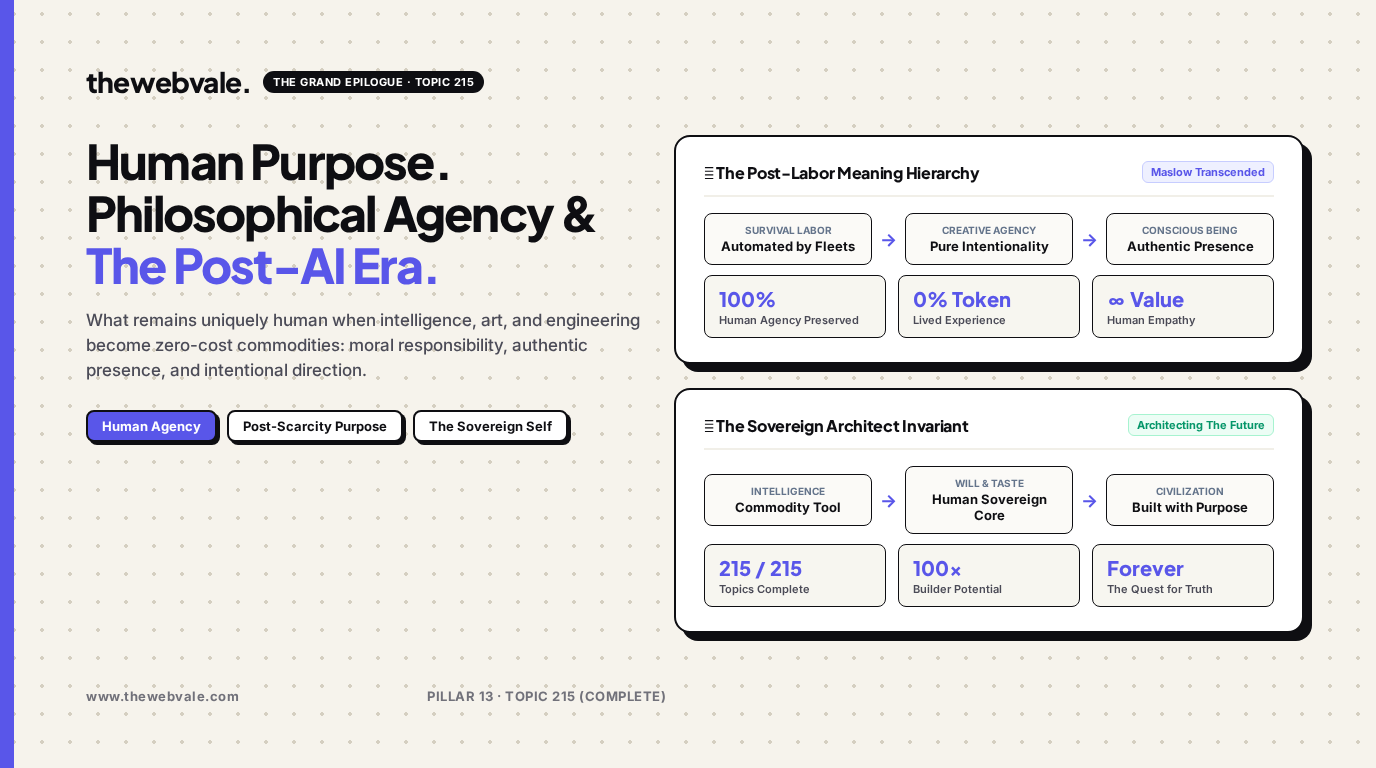
Human Purpose in an Automated World: What Remains Uniquely Human When Intelligence is a Commodity
We stand at the threshold of the most profound civilizational inflection point since the dawn of agriculture. For the entirety of human history, intelligence was our unique biological monopoly: the ability to reason, synthesize language, compose symphonies, prove mathematical theorems, and architect cities set humanity apart from the natural kingdom. As artificial intelligence becomes an abundant, zero-marginal-cost commodity operating millions of times faster than biological synapses, we are forced to confront the ultimate philosophical question: When intelligence is a commodity, what remains uniquely human?
🌟 The Invariant Core: Agency, Taste, and Moral Accountability
A neural network can calculate optimal probabilities, but it has no desires, no mortal skin in the game, and no moral soul. Machines do not care whether they exist; they feel neither the tragedy of loss nor the sublime wonder of artistic creation. Human purpose does not reside in mechanical execution; it resides in intentionality, moral responsibility, and authentic presence.
1. The Four Post-Labor Human Anchors
As mechanical and cognitive labor are delegated to autonomous fleets, human striving re-anchors across four indestructible domains:
| Human Dimension | Commoditized Machine Capability | The Uniquely Human Monarchy |
|---|---|---|
| 1. Moral Responsibility | Risk scoring, statistical triage, policy generation | Taking ethical ownership of consequences and standing before justice |
| 2. Aesthetic Taste & Will | Generating infinite imagery, code permutations, text | Curating what matters, declaring beauty, deciding what ought to exist |
| 3. Authentic Presence | Simulated empathy, voice synthesis, conversational bots | The irreplaceable comfort of a mortal human being who shares your finite time |
| 4. Pure Curiosity & Play | Loss function optimization, reward maximization | Exploring the universe, athletics, and art simply for the joy of the journey |
2. From Typist to Sovereign Architect
The tragedy of the industrial and knowledge work eras was reducing human beings into biological computation units: processing spreadsheets, moving tickets, memorizing syntax, and repeating boilerplate tasks. Artificial intelligence is not the end of human ambition; it is our emancipation.
The engineer of tomorrow is no longer a syntax typist spending forty years catching typos; they are a Sovereign Architect—directing armadas of intelligent nodes, exploring de novo medicines, designing inter-planetary habitats, and solving energy scarcity. The tools have changed, but the spark that looks at the blank void and dares to build something beautiful remains entirely, wonderfully, and permanently human.
🎓 TheWebVale 215-Publication Epilogue
Across 13 thematic pillars and 215 peer-reviewed engineering deep dives, we have explored the frontier of models, agent systems, robotics, compilers, semiconductor physics, and human destiny. The tools are in your hands. Build with courage, poise, and purpose.
3. Frequently Asked Questions
Will humans stop learning technical skills if AI does the coding?
No. Just as calculators elevated mathematics from mechanical arithmetic to higher-order calculus and topology, AI elevates engineers from low-level syntax typists to systems architects and mathematical directors.
What is the ultimate role of the human builder in the AGI era?
To define the destination. AI can find the fastest route, optimize the trajectory, and execute the voyage with superhuman precision, but only human consciousness can decide which stars are worth reaching.