
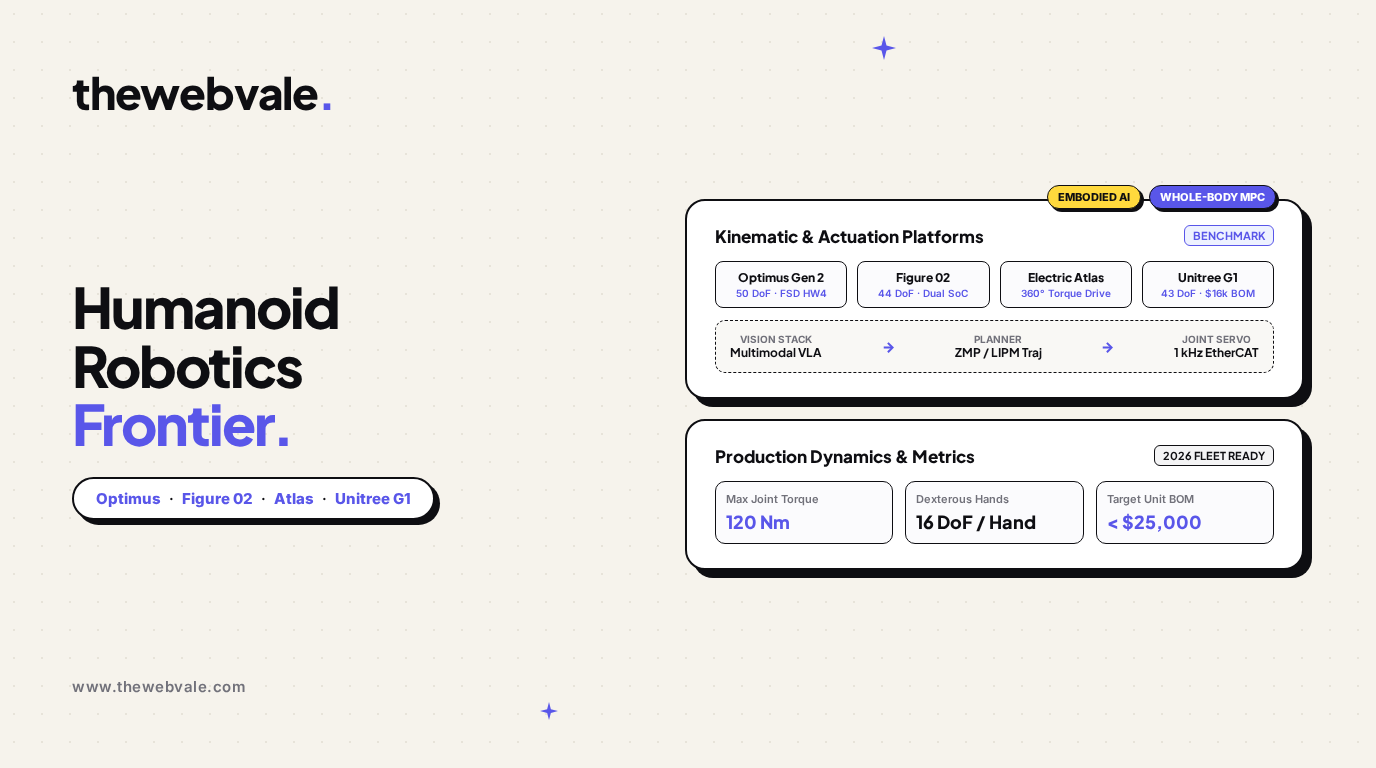
The Humanoid Robotics Race: Architectural Analysis of Tesla Optimus Gen 2, Figure 02, Boston Dynamics Electric Atlas & Unitree G1
For six decades, humanoid robotics remained a specialized domain of academic curiosity and heavily scripted stage demonstrations. Bipedal platforms were notoriously fragile, power-hungry, and dependent on brittle heuristic state machines that collapsed upon encountering unmapped obstacles. In 2026, the convergence of high-torque-density electric actuators, whole-body Model Predictive Control (MPC), and multimodal Vision-Language-Action (VLA) neural networks has ignited a rapid transition into commercial manufacturing.
Automotive assembly lines, logistics fulfillment centers, and industrial fabrication plants are now actively piloting general-purpose humanoid workforces. Four flagship platforms define the technological frontier: Tesla Optimus Gen 2, Figure 02, Boston Dynamics Electric Atlas, and the hyper-cost-effective Unitree G1. In this technical deep dive, we deconstruct their underlying mechanical actuation topologies, kinematic stability mathematics, distributed onboard compute stacks, and the commercial economics governing the race toward general-purpose embodied labor.
System Architecture: Hierarchical Control Stack in Modern Humanoid Robots
Hierarchical flow showing sensory perception, neural VLA decision-making, whole-body optimal control, and sub-millisecond motor execution.
1. The Mechanical Paradigm Shift: Electric Actuation Over Hydraulics
For decades, Boston Dynamics' hydraulic Atlas set the gold standard for dynamic athleticism, backflips, and terrain traversal. However, hydraulic systems suffer from insurmountable commercial flaws: high fluid leakage risks on pristine factory floors, extreme acoustic noise (exceeding 85 dB from hydraulic pumps), massive thermal dissipation requiring heavy radiator blocks, and low energy efficiency (~15–25% net wall-to-actuator transfer).
In 2024–2026, the entire humanoid industry decisively unified around high-power-density brushless DC (BLDC) electric motors paired with specialized reduction mechanisms:
- Strain Wave (Harmonic) Gearing: Zero-backlash, ultra-compact reduction ratios (typically 50:1 to 160:1), utilized extensively in wrists, elbows, and neck pivots where positioning precision outweighs catastrophic shock-load resilience.
- Cycloidal & Quasi-Direct Drive (QDD) Planetary Reducers: Featured predominantly in knee, hip, and ankle joints. QDD systems operate at low reduction ratios (6:1 to 20:1) with high torque-transparency and low reflected inertia, enabling rapid back-drivability when the foot strikes uneven ground without shattering gear teeth.
- Linear Roller-Screw Actuators: Pioneered by Tesla Optimus for high-load linear extension (such as the upper thighs and knee linkages), converting rotary BLDC torque into tremendous linear force exceeding 4,000 N per actuator.
General Rigid-Body Dynamic Equation:
τ = M(q)·q̈ + C(q, q̇)·q̇ + G(q) + JT(q)·Fext
Where M(q) represents the generalized configuration inertia matrix, C(q, q̇) captures Coriolis and centrifugal force tensors, G(q) models gravitational torque vectors, and JT(q)·Fext represents the Jacobian transpose mapping external contact wrenches (ground reaction forces) back into motor joint torques τ.
2. Comprehensive Hardware & Kinematic Benchmark Matrix
To evaluate the competitive landscape objectively, we compare the published and reverse-engineered specifications of the four leading platforms across physical geometry, compute hardware, degree-of-freedom allocation, and manufacturing unit economics:
| Hardware Specification | Tesla Optimus Gen 2 | Figure 02 | Boston Dynamics Electric Atlas | Unitree G1 |
|---|---|---|---|---|
| Height & Mass | 173 cm / 57 kg | 168 cm / 60 kg | 150 cm / 89 kg | 127 cm / 35 kg |
| Total Body Degrees of Freedom (DoF) | 28 body + 22 hands = 50 DoF | ~32 body + 32 hands = 64 DoF | ~36 body (360° continuous rotation) | 23 to 43 DoF (modular options) |
| Hand / Manipulator Architecture | 11 DoF per hand (tendon-driven, tactile finger pads) | 16 DoF per hand (integrated palm camera & strain gauges) | Modular heavy-duty industrial grippers | 3-finger tactile gripper or 7 DoF hand |
| Onboard Compute Architecture | Dual Tesla FSD Computer HW4 (~500 TOPS INT8) | Custom Dual AI SoC (NVIDIA RTX / Orin cluster, 3x CPU power) | Industrial Real-Time Embedded Linux + High-Compute GPU | 8-Core High-Perf CPU + 40–100 TOPS NPU |
| Actuation Topology | Custom 2.3 kW linear roller screws & rotary planetary | Integrated cycloidal & planetary motors | Custom electric rotary with infinite joint rotation | High-torque planetary (120 Nm peak torque) |
| Battery Pack Capacity & Runtime | 2.3 kWh pack (52V, ~4–5 hours continuous assembly) | 2.25 kWh pack (~5 hours active work) | High-discharge swappable industrial pack | 9,000 mAh quick-release (~2 hours) |
| Target Commercial Price / BOM | $20,000 – $30,000 (Tesla automotive scale) | Enterprise RaaS ($100k+ enterprise contracts) | High-end automotive pilot (Hyundai integration) | $16,000 base retail (Disruptive consumer/R&D) |
3. Stability Mathematics: Zero Moment Point (ZMP) & Whole-Body MPC
Humanoid walking requires maintaining dynamic balance while supporting a high center of mass (CoM) over a variable, non-stationary polygon of support. The foundational theorem governing bipedal stability is the Zero Moment Point (ZMP), formulated by Miomir Vukobratović:
Zero Moment Point (ZMP) Position:
xZMP = ∑ mi(z̈i + g)·xi - ∑ mi·ẍi·zi / ∑ mi(z̈i + g)
yZMP = ∑ mi(z̈i + g)·yi - ∑ mi·ÿi·zi / ∑ mi(z̈i + g)
For a humanoid robot to remain upright without falling, the computed ZMP coordinate (xZMP, yZMP) must remain strictly within the convex hull of the contact polygon defined by the robot's foot sole (or both soles during double-support stance). If the ZMP reaches the boundary of the foot polygon, the contact edge acts as a pivot axis, causing the robot to tip over.
In modern architectures, robots do not merely execute precomputed ZMP trajectory tables. Instead, they execute Whole-Body Model Predictive Control (WB-MPC) running in real time at 500 Hz to 1,000 Hz. The MPC optimizes a receding time horizon (typically 0.8–1.5 seconds into the future) by solving a constrained Quadratic Program (QP) that balances momentum regulation, joint limits, motor torque bounds, and friction cone constraints.
4. Production Implementation: Linear Inverted Pendulum Balance MPC
Below is a runnable Python production module implementing a Linear Inverted Pendulum Model (LIPM) balance and footstep preview controller. It solves for optimal CoM acceleration to stabilize the humanoid's center of mass while rejecting simulated lateral impact disturbances:
# Linear Inverted Pendulum Model (LIPM) Balance Controller
# Whole-Body Optimal ZMP Trajectory Tracking

import numpy as np
from dataclasses import dataclass
from typing import Tuple, List

@dataclass
class RobotParameters:
    mass: float = 57.0         # Robot mass in kg (Optimus Gen 2 spec)
    z_c: float = 0.85          # Constant center of mass height in meters
    g: float = 9.81            # Gravitational acceleration (m/s^2)
    dt: float = 0.02           # Control sample interval (50 Hz planning cycle)
    horizon_steps: int = 40    # Preview horizon (0.8 seconds preview)

class LIPMBalanceController:
    def __init__(self, params: RobotParameters):
        self.params = params
        self.omega = np.sqrt(params.g / params.z_c)

        # State: [CoM position, CoM velocity, CoM acceleration]
        # Input u: CoM jerk (d3x/dt3)
        dt = params.dt
        self.A = np.array([
            [1.0, dt, (dt**2) / 2.0],
            [0.0, 1.0, dt],
            [0.0, 0.0, 1.0]
        ])
        self.B = np.array([
            [(dt**3) / 6.0],
            [(dt**2) / 2.0],
            [dt]
        ])
        # Output C maps state to ZMP: p = x - (z_c / g) * x_ddot
        self.C = np.array([[1.0, 0.0, -params.z_c / params.g]])

    def compute_optimal_control(
        self,
        current_state: np.ndarray,
        zmp_reference: np.ndarray,
        q_weight: float = 1.0e5,
        r_weight: float = 1.0e-3
    ) -> float:
        # Construct dense batch QP matrices over preview horizon N
        N = self.params.horizon_steps
        P_ps = np.zeros((N, 3))
        P_pu = np.zeros((N, N))

        A_power = np.eye(3)
        for i in range(N):
            A_power = A_power @ self.A
            P_ps[i, :] = self.C @ A_power

            for j in range(i + 1):
                mat = np.eye(3)
                for k in range(i - j):
                    mat = mat @ self.A
                P_pu[i, j] = (self.C @ mat @ self.B)[0, 0]

        # Cost function: min 1/2 u^T H u + g^T u
        # where error = P_ps * x_0 + P_pu * u - zmp_ref
        H = P_pu.T @ (q_weight * np.eye(N)) @ P_pu + r_weight * np.eye(N)
        error_unactuated = P_ps @ current_state - zmp_reference[:N]
        g_vec = P_pu.T @ (q_weight * np.eye(N)) @ error_unactuated

        # Closed-form unconstrained optimal control input vector
        u_opt = -np.linalg.solve(H, g_vec)
        return float(u_opt[0])

    def step_simulation(
        self,
        state: np.ndarray,
        jerk_input: float,
        external_force: float = 0.0
    ) -> Tuple[np.ndarray, float]:
        # Propagate dynamics with external impulse acceleration
        external_accel = external_force / self.params.mass
        next_state = self.A @ state + (self.B * jerk_input).flatten()
        next_state[2] += external_accel * self.params.dt

        # Calculate instantaneous ZMP
        actual_zmp = (self.C @ next_state)[0]
        return next_state, actual_zmp

# Demonstration of disturbance rejection under 150 N lateral strike
if __name__ == "__main__":
    params = RobotParameters()
    controller = LIPMBalanceController(params)

    # Initialize robot at rest at origin
    state = np.array([0.0, 0.0, 0.0]) # [pos, vel, accel]
    zmp_ref = np.zeros(100)           # Foot sole center at x=0

    print("--- LIPM Balance & Impact Recovery Simulation ---")
    print(f"Robot Mass: {params.mass} kg | CoM Height: {params.z_c} m")

    # Apply 150 Newton external strike at t = 0.2s (step 10)
    for step in range(30):
        force = 150.0 if step == 10 else 0.0
        jerk = controller.compute_optimal_control(state, zmp_ref[step:])
        state, zmp = controller.step_simulation(state, jerk, external_force=force)

        if step % 5 == 0 or step == 10:
            print(f"Step {step:02d} | CoM: {state[0]:+0.4f}m | Vel: {state[1]:+0.4f}m/s | ZMP: {zmp:+0.4f}m")
5. The Embodied AI Frontier: VLA Models & Factory Economics
While classical control systems handle balance, gait, and reflex stabilization at high frequencies (500–1000 Hz), high-level task cognition and dexterous manipulation require semantic understanding of the physical world.
Modern humanoids utilize Vision-Language-Action (VLA) foundation models (such as RT-2, OpenVLA, and Tesla's end-to-end multi-camera occupancy neural nets). These models directly project visual tokens from head-mounted stereo cameras and linguistic instructions into high-dimensional motor token actions. By collecting hundreds of thousands of hours of teleoperated human task demonstrations via VR headsets, neural policies learn to pick, insert, sort, and assemble components with sub-millimeter tolerances.
The ultimate decider of humanoid deployment will not be backflips, but amortized labor economics ($/hour). With human automotive assembly wages averaging $35–$45/hour in North America, a $30,000 humanoid operating over a 3-year depreciation cycle with electricity and maintenance costs of $2.50/hour yields an effective labor cost of under $6.00/hour. With Unitree pricing the G1 at an astonishing $16,000, the barrier to industrial and educational adoption has collapsed permanently.