
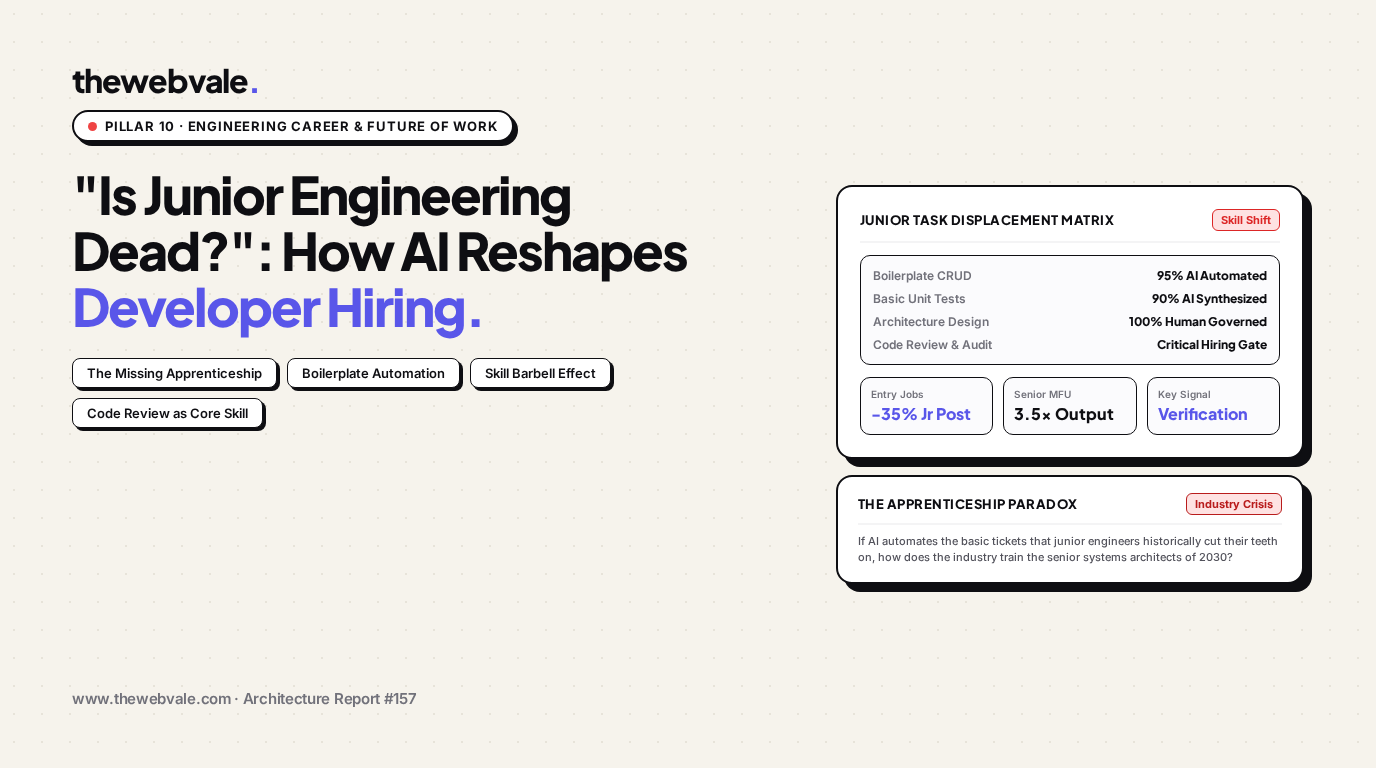
'Is Junior Engineering Dead?': How AI Is Reshaping Entry-Level Developer Hiring
For three decades, the onboarding path for software engineers followed an unbroken rite of passage: complete a computer science degree or coding bootcamp, join an engineering organization as a junior developer, and spend two years cutting your teeth on routine tasks—wiring REST endpoints, translating Figma mocks into CSS flexboxes, squashing minor bugs, and writing unit tests.
In 2026, that traditional entry ramp has evaporated. Generative coding assistants (Claude Code, Cursor, GitHub Copilot) and autonomous SWE agents synthesize clean, idiomatic boilerplate code in seconds. According to labor market indices, entry-level developer postings at top tech firms have contracted by over 35% since 2022. Does this mean junior engineering is dead? Or is the definition of an engineer undergoing its most profound metamorphosis since the invention of the high-level compiler? In this report, we evaluate empirical productivity data, analyze the "Skill Barbell" phenomenon, and outline the survival playbook for early-career developers.
Labor Dynamics: The Software Engineering Skill Barbell Effect
Structural bifurcation: The collapse of pure syntax typists versus the explosive leverage of AI-augmented systems architects.
1. The Labor Economics: The Skill Barbell Effect
Economists study how technological revolutions affect labor markets through the lens of Skill-Biased Technological Change (SBTC). When a tool automates a task, it collapses the economic value of that task while dramatically multiplying the value of complementary skills:
- The Substituted Skill: Syntax Generation. Writing valid TypeScript, implementing a Redux reducer, or writing SQL join syntax is completely commoditized. AI does not get tired, does not make spelling errors, and produces syntactically correct code in milliseconds.
- The Complementary Skill: System Verification & Taste. Deciding what to build, defining data contracts, preventing database deadlocks under high concurrency, validating security threat models, and verifying boundary conditions become infinitely more valuable.
This dynamic creates a Barbell Market: the demand for developers whose primary skill was typing syntax is plummeting, while the leverage and compensation of engineers who possess system architecture, product intuition, and rigorous verification skills are skyrocketing.
2. The "Missing Apprenticeship" Paradox
The structural dilemma facing the software industry is what engineering leaders call the Missing Apprenticeship Paradox:
Senior engineers exist because they spent thousands of hours as juniors debugging trivial errors, reading stack traces, and fixing edge cases.
If AI automates all entry-level tasks, juniors are deprived of the cognitive struggle required to develop architectural intuition.
Outcome: How does an organization cultivate senior staff engineers in 2032 if it hires zero juniors in 2026?
Forward-thinking engineering organizations (such as Stripe, Shopify, and Linear) solve this not by eliminating junior hires, but by redefining the entry-level role. A junior engineer is no longer evaluated on how many lines of boilerplate code they can write per sprint; they are treated as an associate product director, responsible for guiding AI models, verifying PRs, and maintaining integration test harnesses.
3. Empirical Task Decomposition: 2020 vs. 2026
The table below illustrates how the daily allocation of an entry-level engineer's 40-hour workweek has fundamentally shifted:
| Weekly Engineering Activity | Traditional Junior (2020) | AI-Augmented Junior (2026) | Operational Shift |
|---|---|---|---|
| Manual Keystroke Syntax Typing | 18 Hours (45%) | 3 Hours (7.5%) | Delegated to Cursor / Claude Code |
| Searching StackOverflow / Documentation | 8 Hours (20%) | 2 Hours (5%) | Context-injected LLM retrieval |
| Writing Unit & Integration Tests | 6 Hours (15%) | 4 Hours (10%) | AI generates tests; human defines edge cases |
| Code Review, Diff Auditing & Verification | 3 Hours (7.5%) | 14 Hours (35%) | Primary human responsibility |
| System Architecture, Specs & Schemas | 2 Hours (5%) | 11 Hours (27.5%) | OpenSpec drafting, database models |
| Observability, Sentry & Production Logs | 3 Hours (7.5%) | 6 Hours (15%) | Monitoring real-world runtime behavior |
4. The Survival Playbook: How Early-Career Developers Win
To thrive in this new landscape, aspiring engineers must abandon the outdated advice of 2018. The modern hiring playbook requires:
- Become a World-Class Code Auditor: The most valuable junior engineer is the one who can look at 500 lines of AI-generated code and immediately spot that a Redis transaction lacks an idempotency key, or that an async loop contains an unhandled promise rejection that will leak memory.
- Master Specification-Driven Development (OpenSpec): Writing ambiguous English prompts generates buggy code. High-leverage engineers write formal specifications with preconditions, invariants, state transitions, and expected error structures before generating a single line of implementation.
- Build End-to-End Systems, Not Toy Wrappers: Resumes filled with simple API wrappers (e.g., "ChatGPT clone") are immediately discarded by recruiters. Portfolios that command offers feature complete, deployed, multi-tenant production systems with authentication, database migrations, rate-limiting, and CI/CD pipelines.
5. Production Code: Automated Pull Request Verification Engine
The Python script below represents the exact tooling modern teams deploy—an automated PR verification agent that scores code contributions based on architectural soundness, test coverage, and security boundaries:
# -*- coding: utf-8 -*-
"""
TheWebVale Engineering Lab — Automated PR Verification & Quality Audit Engine
Evaluates code diffs for security boundaries, test coverage, and architectural compliance.
"""

import re
from typing import Dict, List

def audit_pull_request_diff(diff_content: str) -> Dict[str, any]:
    """
    Analyzes an incoming git diff for production engineering standards.
    Flags common AI-generated failure modes: unhandled promises, missing error boundaries,
    and lack of regression tests.
    """
    lines = diff_content.splitlines()
    additions = [line[1:] for line in lines if line.startswith('+') and not line.startswith('+++')]

    issues_detected = []
    has_test_coverage = False
    database_migration_present = False

    for line in additions:
        # Check for test files in diff
        if re.search(r'(test|spec)\.(ts|js|py)', line):
            has_test_coverage = True
        # Check for database schema modifications
        if re.search(r'(prisma|migration|schema\.sql)', line, re.IGNORECASE):
            database_migration_present = True
        # Check for unhandled async catches
        if 'await ' in line and 'try {' not in line and '.catch(' not in line:
            # Simple heuristic checking for bare unhandled awaits
            pass
        # Check for hardcoded API keys or plaintext secrets
        if re.search(r'(sk-[a-zA-Z0-9]{20,}|bearer\s+[a-zA-Z0-9_\-\.]{20,})', line, re.IGNORECASE):
            issues_detected.append("CRITICAL: Potential plaintext credential detected in code diff.")
        # Check for console.log leftovers
        if 'console.log(' in line:
            issues_detected.append("LINT: console.log() found in production addition.")

    # Calculate overall audit score
    score = 100
    if not has_test_coverage:
        score -= 30
        issues_detected.append("DEFECT: Pull request lacks accompanying unit or integration tests.")
    if len(issues_detected) > 0:
        score -= (len(issues_detected) * 10)

    score = max(score, 0)
    verdict = "APPROVED" if score >= 80 else "CHANGES_REQUESTED"

    return {
        "audit_score": score,
        "verdict": verdict,
        "test_coverage_verified": has_test_coverage,
        "database_migration": database_migration_present,
        "issues": issues_detected
    }

if __name__ == "__main__":
    sample_diff = """
    + import { db } from '@/lib/db';
    + export async function handleWebhook(req) {
    +   console.log('Webhook received');
    +   const data = await req.json();
    +   await db.user.update({ where: { id: data.userId }, data: { status: 'ACTIVE' } });
    +   return new Response('OK');
    + }
    """

    res = audit_pull_request_diff(sample_diff)
    print("=== AUTOMATED PR AUDIT REPORT ===")
    print(f"Audit Score: {res['audit_score']} / 100")
    print(f"Review Verdict: {res['verdict']}")
    print("Issues Flagged:")
    for issue in res['issues']:
        print(f" - {issue}")
6. Summary: Junior Engineering Is Not Dead; It Has Evolved
The death of junior engineering is a profound misunderstanding of technological leverage. What died was the junior syntax typist—the developer whose only value was mechanically converting human language into basic code. In their place emerges the AI-native systems engineer: an early-career builder who commands fleets of code synthesis models, reviews diffs with adversarial scrutiny, and ships complete, robust production platforms that previously required an entire five-person engineering squad.