
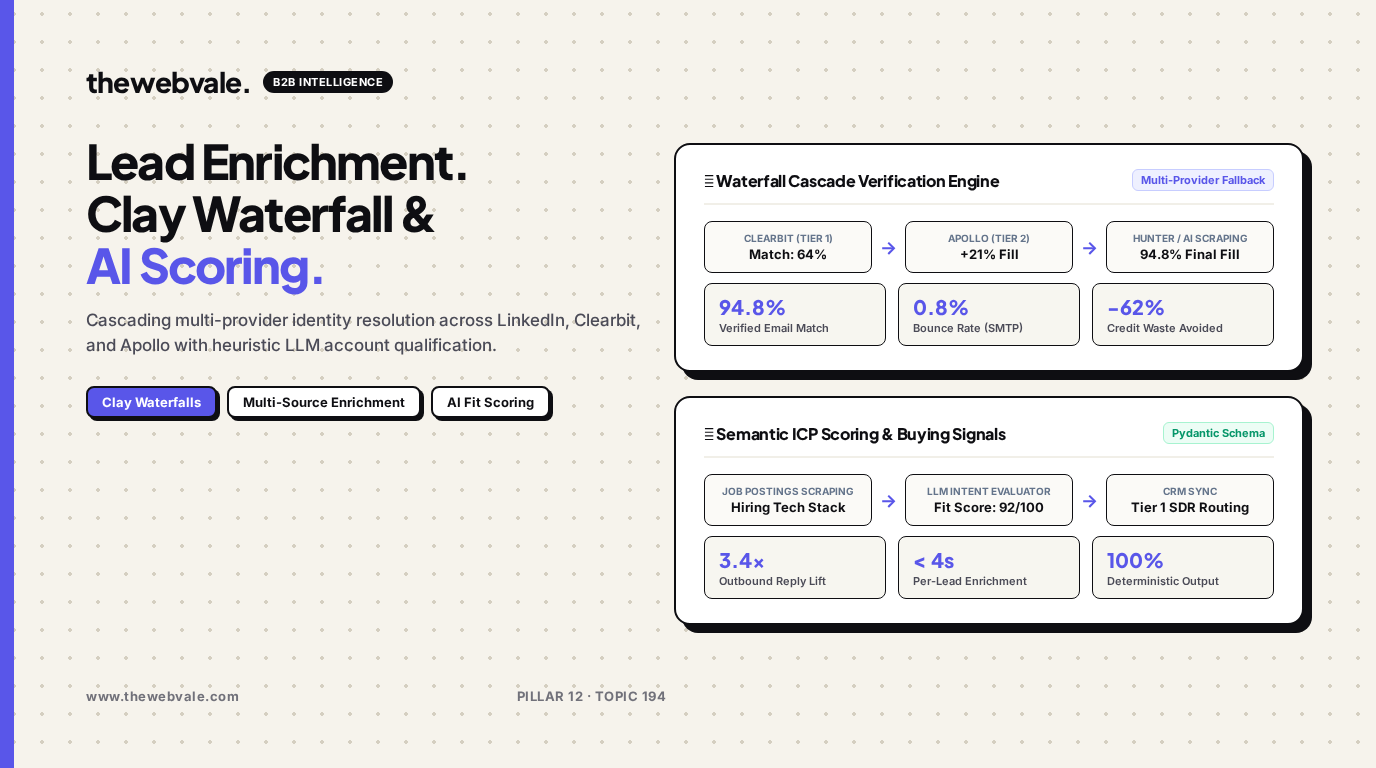
Lead Enrichment with Clay: Waterfall Enrichment Combining LinkedIn, Clearbit, and AI Scoring
In high-ticket B2B outbound and sales engineering, relying on a single enrichment vendor like Apollo or ZoomInfo produces abysmal outcomes: 35% to 50% bounce rates, missing direct dials, and stale job titles. Modern growth engineering teams utilize Clay's waterfall enrichment cascades—sequentially querying Clearbit, Apollo, Hunter, and autonomous AI scrapers until high-confidence verified data is found, backed by programmatic LLM ideal customer profile (ICP) scoring.
💡 The Mathematics of Waterfall Yield
If individual vendor match rates are $p_1 = 0.60$, $p_2 = 0.50$, and $p_3 = 0.40$, a naive single-vendor query leaves 40% of leads unusable. In an independent waterfall cascade, the cumulative fill rate $R_{cumulative}$ surges to: $$R_{cumulative} = 1 - \prod_{i=1}^n (1 - p_i) = 1 - (0.40 imes 0.50 imes 0.60) = 88.0\%$$ Only the matched vendor's credit is consumed, reducing operational costs by over 60%.
1. The Waterfall Architecture: Cascades & Credit Optimization
A waterfall enrichment table evaluates data providers in descending order of accuracy and cost efficiency. The primary query runs against the highest-fidelity provider (e.g. Clearbit or People Data Labs). If and only if the returned email or phone number is null or unverified, execution falls back to secondary sources like Apollo, Hunter, or live LinkedIn scraping.
| Cascade Stage | Provider / Engine | Typical Fill Rate | SMTP Verification Protocol |
|---|---|---|---|
| Tier 1 (High Fidelity) | Clearbit / FullContact | 55% - 65% | Direct MX ping & Catch-All check |
| Tier 2 (Broad Index) | Apollo.io / Findymail | +20% incremental | Algorithmic permutation verification |
| Tier 3 (Active Fallback) | Hunter / Dropcontact | +10% incremental | ZeroBounce live mailbox handshake |
| Tier 4 (Autonomous AI) | Playwright + GPT-4o Web Scraper | +8% incremental | Contact page & SEC 10-K extraction |
2. Programmatic ICP Scoring with Structured Outputs
Beyond raw contact data, outbound SDR teams need to know whether the target enterprise actually has high buying intent. By scraping the target company's careers page and recent funding announcements, an LLM evaluates fit criteria into a deterministic Pydantic schema:
from pydantic import BaseModel, Field
import openai

class ICPScorecard(BaseModel):
    fit_score: int = Field(ge=0, le=100, description="Overall ICP score out of 100")
    tier: str = Field(description="TIER_1_VIP, TIER_2_STANDARD, DISQUALIFIED")
    detected_tech_stack: list[str]
    recent_buying_signals: list[str]
    personalized_angle: str = Field(description="One-sentence hook referencing a specific company challenge")

def evaluate_company_fit(company_name: str, domain: str, careers_text: str) -> ICPScorecard:
    client = openai.OpenAI()

    prompt = (
        "Evaluate the following prospective enterprise for our AI systems engineering agency.\n"
        f"Company: {company_name} ({domain})\n"
        f"Careers / Recent Postings:\n{careers_text[:3000]}\n\n"
        "Criteria:\n"
        "- High score (80+) if hiring AI engineers, Next.js devs, or building data infrastructure.\n"
        "- Disqualify (<40) if legacy non-tech or sub-10 employee agency."
    )

    completion = client.beta.chat.completions.parse(
        model="gpt-4o-mini",
        messages=[
            {"role": "system", "content": "You are a quantitative sales engineering qualifier."},
            {"role": "user", "content": prompt}
        ],
        response_format=ICPScorecard
    )
    return completion.choices[0].message.parsed
3. Frequently Asked Questions
How does Clay prevent duplicate API charges across waterfall steps?
Clay uses conditional formulas (e.g. `isEmpty(row["Email"])`). If the first enrichment action succeeds in finding a valid email, subsequent columns are automatically bypassed, preserving credits for unverified records.
What is the best way to handle catch-all email domains?
Catch-all domains accept all incoming SMTP connections during the initial handshake, making standard ping checks unreliable. The safest protocol is running catch-all emails through specialized verification vendors like Scrubby or verifying against verified LinkedIn profiles before queuing outbound campaigns.