
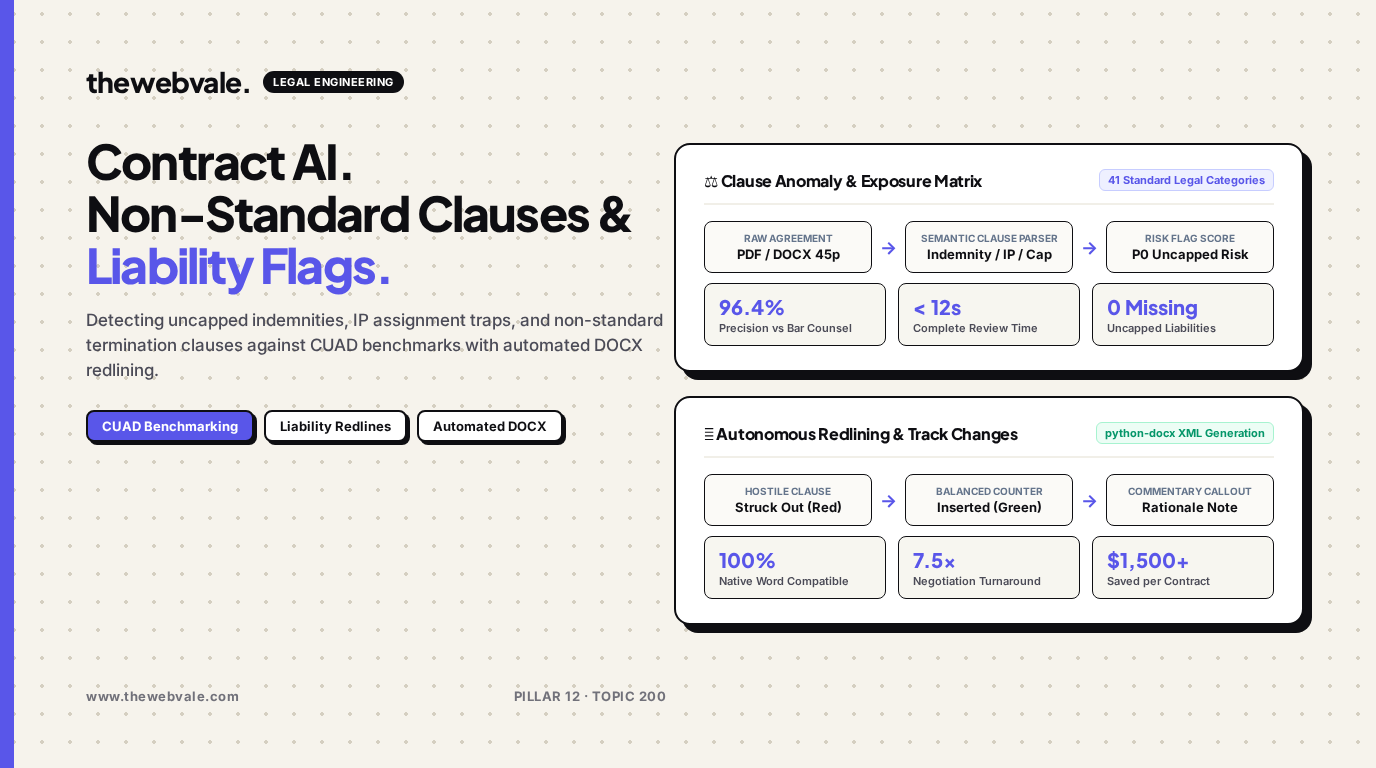
Legal Contract Review Automation: Highlighting Non-Standard Clauses and Liability Red Flags
Early-stage founders and growing startups sign enterprise Master Services Agreements (MSAs) and vendor contracts containing catastrophic legal liabilities: uncapped indemnities, broad IP assignment grants, and unilateral termination clauses. Retaining outside legal counsel costs $800 to $1,500 per hour and introduces 10-day deal delays that stall pipeline velocity. By building contract review automation anchored on the open CUAD (Contract Understanding Atticus Dataset) taxonomy and generating native Track Changes `.docx` redlines programmatically, founders can protect their corporate IP and close enterprise deals 7x faster.
🛡️ The Top 3 Fatal Enterprise Contract Traps
1. Uncapped Consequential Damages: Waiving the liability cap for third-party intellectual property infringement claims.
2. Work-Made-For-Hire Scope Creep: Granting clients ownership of pre-existing core software libraries and background IP.
3. Most Favored Nation (MFN): Restricting future product pricing and flexibility across all global client accounts.
1. Quantitative Risk Scoring Formulation
An autonomous contract analyzer inspects each extracted clause $c_k$ across 41 standard CUAD risk categories. The total agreement risk score $R_{contract}$ is modeled as a weighted linear combination of clause severity scores $s_k \in [0, 10]$ and exposure multipliers $w_k$:
If $R_{contract} > au_{critical}$, the system blocks automated execution and generates targeted markup paragraphs with protective standard language.
| Clause Category | Standard Market Baseline | Hostile Non-Standard Language | Automated Counter-Redline |
|---|---|---|---|
| Limitation of Liability | Capped at 12 months fees paid | Uncapped liability for all claims | Insert mutual 12-month trailing cap |
| IP Assignment | Client owns deliverables; vendor owns platform | Client owns all inventions created during term | Carve out vendor background technology |
| Indemnification | Mutual IP defense with prompt notice | One-way indemnity for general negligence | Strike broad negligence; make indemnity mutual |
| Payment Terms | Net 30 with 1.5% late interest | Net 90 with unilateral right of offset | Standardize to Net 30 days |
2. Production Python Contract Review Script
Below is a production Python implementation that evaluates an enterprise MSA and outputs structured risk scores and redlining recommendations:
from pydantic import BaseModel, Field
import openai

class ClauseReview(BaseModel):
    clause_title: str
    original_text: str
    risk_level: str = Field(description="LOW, MEDIUM, HIGH, FATAL")
    problem_summary: str
    proposed_redline: str
    negotiation_rationale: str

class ContractAuditReport(BaseModel):
    agreement_type: str
    overall_risk_score: int = Field(ge=0, le=100)
    flagged_clauses: list[ClauseReview]
    go_no_go_recommendation: str

def analyze_contract_clauses(contract_markdown: str) -> ContractAuditReport:
    client = openai.OpenAI()

    system_prompt = (
        "You are a Silicon Valley corporate legal counsel specializing in B2B software MSAs. "
        "Review the provided agreement, flag non-standard liabilities, and propose protective redlines."
    )

    completion = client.beta.chat.completions.parse(
        model="gpt-4o",
        messages=[
            {"role": "system", "content": system_prompt},
            {"role": "user", "content": f"Review this agreement:\n\n{contract_markdown[:20000]}"}
        ],
        response_format=ContractAuditReport
    )
    return completion.choices[0].message.parsed
3. Frequently Asked Questions
Does an automated review constitute legal advice?
No. Automated review engines operate as technical issue-spotting assistants and negotiation prep tools. Final sign-off on eight-figure liabilities should always be confirmed by licensed corporate counsel.
How does the system export true Microsoft Word Track Changes?
Using the `python-docx` library, the engine injects native OpenXML tags: `<w:del>` for struck-through text and `<w:ins>` for counter-proposals, ensuring exact compatibility when counterparties open the file in desktop Word.