
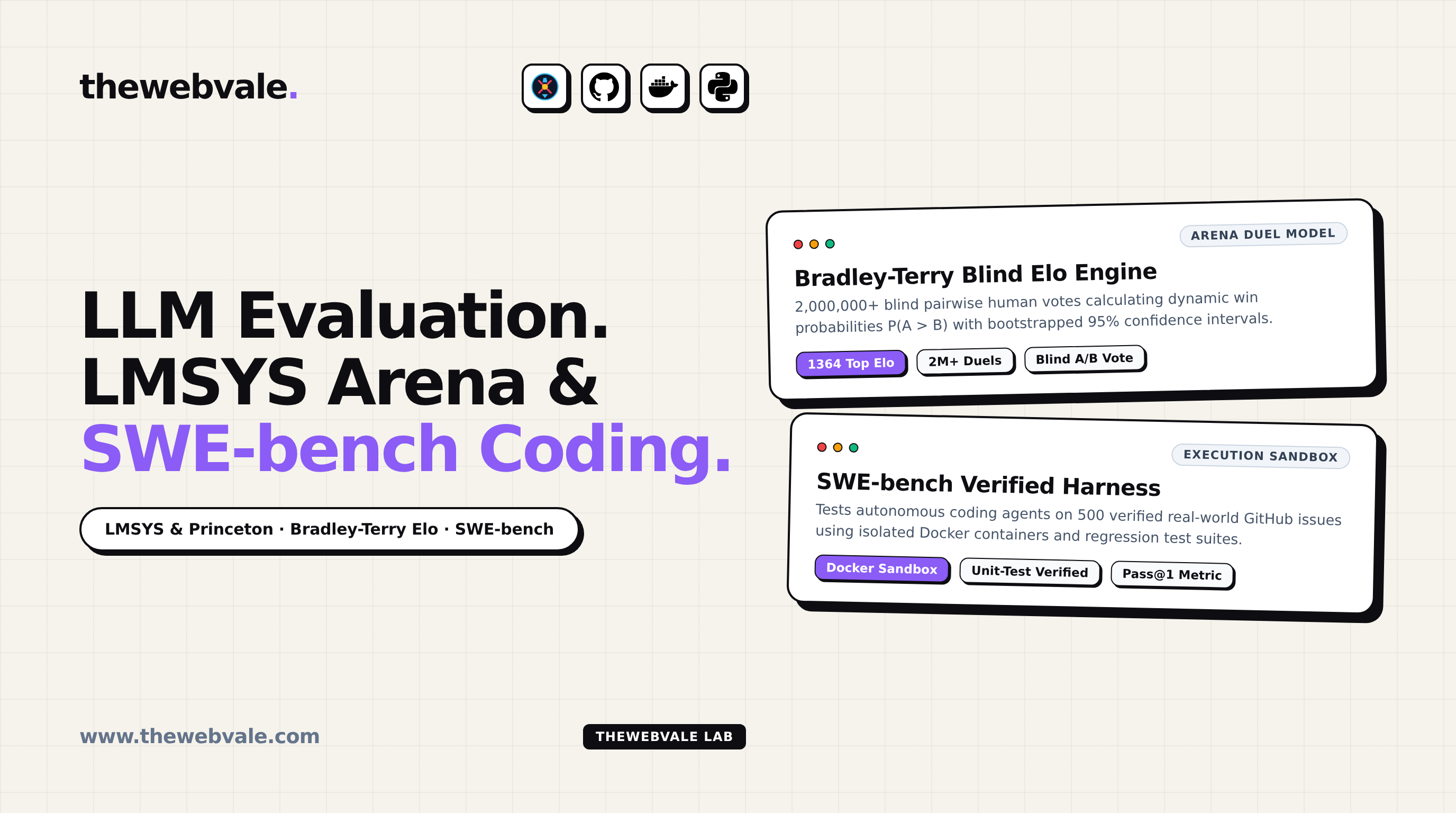
LLM Evaluation & Leaderboards: LMSYS Chatbot Arena, MMLU-Pro, SWE-bench & HumanEval
The artificial intelligence industry faces an acute measurement crisis. Standard static benchmarks like MMLU (Massive Multitask Language Understanding) and HumanEval have reached near-total saturation, with frontier models scoring above 90%. Worse, pervasive data contamination has allowed models to memorize test questions during web pre-training. Evaluating whether a new foundation model genuinely improves real-world engineering productivity requires moving beyond static multiple-choice tests to dynamic, crowdsourced blind evaluation frameworks like LMSYS Chatbot Arena and execution-based environments like SWE-bench Verified.
1. Mathematical Mechanics of the LMSYS Chatbot Arena: Bradley-Terry Elo
Operated by the Large Model Systems Organization (LMSYS) in collaboration with UC Berkeley, the Chatbot Arena collects over 2 million blind, side-by-side pairwise comparisons. When an anonymous user submits a prompt, two anonymous models (e.g. Model A and Model B) generate responses simultaneously. The user judges which response is superior without knowing the model identities.
To convert qualitative human preference votes into quantitative rankings, LMSYS utilizes the Bradley-Terry probability model. The probability that Model $i$ defeats Model $j$ is formalized as:
Where $R_i$ and $R_j$ represent the latent Elo ratings of each model. If Model $A$ has an Elo of 1350 and Model $B$ has an Elo of 1250 ($\Delta R = 100$), Model $A$ has an expected win probability of:
Following match outcome $S \in \{1.0, 0.5, 0.0\}$ (win, tie, loss), ratings update via:
Figure 1: LMSYS Chatbot Arena workflow: double-blind generation, user preference voting, and Bradley-Terry Elo updating.
2. The Benchmark Evolution Spectrum: From MMLU to SWE-bench
As language models transitioned from autocomplete engines to autonomous software agents, evaluation frameworks underwent three generational shifts:
Generation 1: MMLU & MMLU-Pro (Multiple-Choice Saturation)
Standard MMLU evaluates models across 57 subjects using 4-choice questions. Because random chance gives a 25% baseline and top models score >90%, MMLU exhibits severe ceiling effects. To counter this, MMLU-Pro expanded choices from 4 to 10 options, integrated multi-step reasoning problems, and removed trivial recall questions, dropping GPT-4's score from 87% down to 72.6% and creating a meaningful evaluation spread.
Generation 2: HumanEval & MBPP (Isolated Function Synthesis)
Created by OpenAI, HumanEval evaluates 164 standalone Python programming prompts (e.g. has_close_elements). While useful for assessing syntax, it fails to evaluate real software engineering: solutions are single functions under 20 lines without external dependencies, third-party libraries, or repository context.
Generation 3: SWE-bench Verified (Real Repository Execution)
Engineered by Princeton University, SWE-bench evaluates AI agents on real-world GitHub issues extracted from major open-source repositories (Django, SymPy, scikit-learn, Sphinx, matplotlib). To succeed, an agent must clone the repository, read issues, traverse directory trees, edit multiple files, and produce a unified Git diff that passes the repository's real pre-existing unit test suite inside an isolated Docker sandbox. SWE-bench Verified filtered out ambiguous unit tests, establishing the premier gold standard for AI coding capabilities.
Figure 2: The evolution of evaluation rigor from static multiple-choice tokens to sandboxed repository testing.
3. Comparative Frontier Leaderboard: Arena, SWE-bench & MMLU-Pro
| Model Architecture | Chatbot Arena Elo | SWE-bench Verified (%) | MMLU-Pro (%) | AIME 2024 Math (%) |
|---|---|---|---|---|
| OpenAI o1 (High Reasoning) | 1364 (#1 Overall) | 60.7% | 83.3% | 83.3% |
| Claude 3.5 Sonnet (Coding Frontier) | 1328 (#2 Overall) | 49.0% (Raw) / 64.0% (Agent) | 78.2% | 16.0% |
| DeepSeek-R1 (Open Weight Frontier) | 1358 (#2 Overall) | 49.2% | 84.0% | 79.8% |
| Google Gemini 2.0 Flash | 1308 | 44.2% | 75.4% | 23.4% |
| Meta Llama 3.1 405B | 1286 | 38.8% | 73.3% | 23.3% |
4. Production Python Script: SWE-bench Sandboxed Docker Evaluator
Below is a simplified architecture harness executing a generated patch against an isolated Docker container with automated test evaluation:
import subprocess
import tempfile
import os

def evaluate_swebench_patch(container_id: str, patch_diff: str, test_command: str) -> dict:
    # 1. Write git diff patch to temporary file
    with tempfile.NamedTemporaryFile(mode="w", suffix=".patch", delete=False) as f:
        f.write(patch_diff)
        patch_path = f.name

    try:
        # 2. Copy patch into isolated docker container
        subprocess.run(["docker", "cp", patch_path, f"{container_id}:/tmp/eval.patch"], check=True)

        # 3. Apply git patch inside container
        apply_res = subprocess.run(
            ["docker", "exec", container_id, "git", "apply", "-v", "/tmp/eval.patch"],
            capture_output=True, text=True
        )
        if apply_res.returncode != 0:
            return {"passed": False, "stage": "git_apply_failed", "error": apply_res.stderr}

        # 4. Execute repository unit test suite
        test_res = subprocess.run(
            ["docker", "exec", container_id, "bash", "-c", test_command],
            capture_output=True, text=True, timeout=180
        )

        return {
            "passed": test_res.returncode == 0,
            "stage": "tests_executed",
            "stdout": test_res.stdout[-500:],
            "exit_code": test_res.returncode
        }
    finally:
        os.remove(patch_path)
5. Primary Research & Official References Registry
LMSYS Chatbot Arena Leaderboard
Live crowdsourced Elo ratings and Bradley-Terry statistical models across 150+ LLMs.
Princeton NLP · Oct 2023SWE-bench: Can Language Models Resolve Real GitHub Issues?
Jimenez et al. introducing repository-level execution testing on real open source PRs.
ArXiv:2406.01574 · Jun 2024MMLU-Pro: A More Robust and Challenging Multi-Task Benchmark
Wang et al. expanding multiple-choice choices to 10 options to prevent guessing and saturation.