
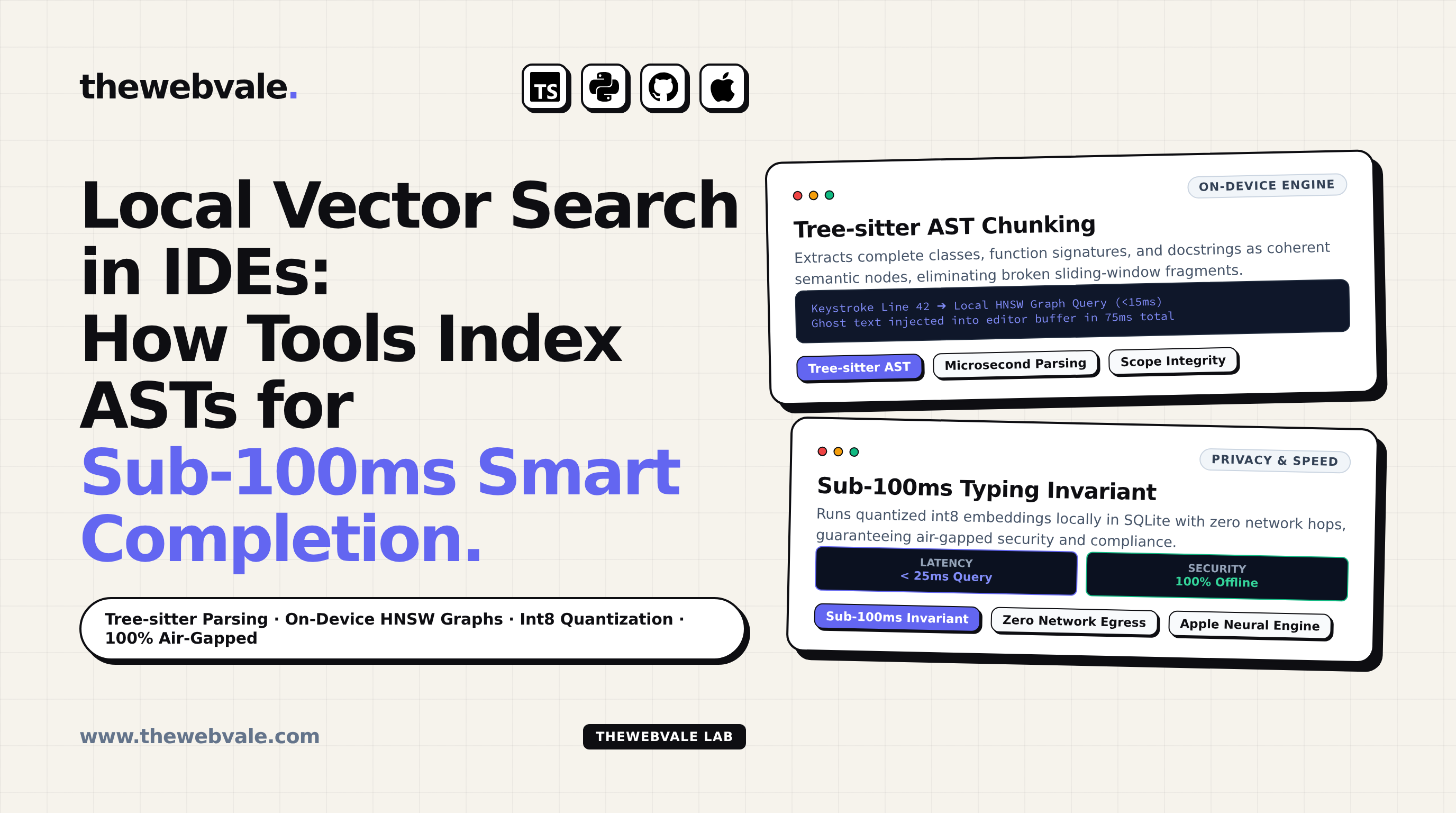
Local Vector Search in IDEs: How Tools Index Abstract Syntax Trees (AST) for Smart Completion
In modern code editors like Cursor, Windsurf, and GitHub Copilot, inline code completion is an exercise in extreme low-latency engineering. A typist expects code suggestions to appear within sub-100 millisecond windows. Routing every keystroke to a remote frontier cloud API across the public internet introduces 400ms to 1,200ms of latency, instantly shattering typing flow. To achieve instant, context-aware suggestions across multi-gigabyte enterprise repositories, next-generation IDEs run local, on-device vector retrieval engines powered by Tree-sitter Abstract Syntax Tree (AST) chunking and quantized vector embeddings.
1. Why Text-Based Sliding Windows Fail for Code Retrieval
Standard document RAG splits text into arbitrary chunks of 500 tokens with 50-token overlaps. When applied to source code, this naive approach produces catastrophic structural corruption:
- Broken Syntax Boundaries: A sliding window split often severs an interface definition from its implementation methods, leaving the embedding model with unparseable syntax fragments.
- Scope Blindness: A variable defined in a parent class is completely decoupled from the method using it in child blocks.
- The Tree-sitter Solution: Tree-sitter generates concrete syntax trees in microseconds. IDEs chunk code along functional AST boundaries—extracting complete classes, function signatures, docstrings, and exported types as discrete atomic entities.
2. Production Python Prototype: AST Semantic Chunker & Indexer
Below is a production implementation demonstrating how syntax-aware chunking isolates function signatures and interfaces for vector search:
3. The Offline & Privacy Mandate
For regulated industries—such as healthcare, defense, and fintech—streaming intellectual property to external third-party LLMs violates compliance standards (HIPAA, SOC 2, ITAR). Local AST vector search ensures:
- Zero Telemetry Egress: Proprietary source code never leaves localhost.
- Air-Gapped Engineering: Autocomplete functions with 100% fidelity on airplanes or secure offline facilities.
- Hardware Acceleration: Utilizes Apple Neural Engine (ANE) on M-series chips and TensorRT on NVIDIA workstations.
4. Summary of Code Indexing Paradigms
| Approach | Chunking Fidelity | Median Query Latency | Privacy / Network |
|---|---|---|---|
| Sliding Window + Cloud API | Poor (Truncated Syntax) | 600ms – 1,200ms | Public Cloud Network Dependent |
| Local Tree-sitter + HNSW | Flawless (AST Boundaries) | < 25ms (On-Device) | 100% Air-Gapped & Private |