
Meta LLaMA 3.x Family: Running Open-Source Models Locally with Ollama and vLLM
For enterprise engineering teams handling sensitive customer medical records, proprietary quantitative trading algorithms, or internal codebase IP, the generative AI boom presented a painful trade-off: either surrender confidential data to proprietary third-party cloud APIs (OpenAI, Anthropic) or rely on underperforming, outdated open-source models. The release of the Meta LLaMA 3 and 3.1 family—spanning 8B, 70B, and 405B parameters pre-trained on over 15 trillion high-quality tokens—shattered this dilemma forever. Today, running frontier-grade intelligence locally on air-gapped private hardware is not just possible; it is the dominant architectural standard for sovereign enterprise software.
⚡ Key Architectural Takeaway
Through 4-bit GGUF and AWQ quantization, a 70-billion-parameter frontier model that originally required $60,000 in datacenter GPUs can now be served at 32+ tokens per second on dual consumer RTX 4090s or an Apple Silicon Mac Studio. Paired with vLLM PagedAttention and an air-gapped Next.js 15 frontend, enterprises eliminate third-party API token billing and achieve 100% HIPAA/SOC2 compliance with zero data egress.
"Open source AI is the path forward. Just as Linux became the open source operating system that powers the internet, open source AI models like Llama are rapidly becoming the industry standard. Open source ensures that people around the world can access the benefits of AI without being locked into closed proprietary ecosystems."
1. The Data Sovereignty Crisis: Why Cloud APIs Fail Enterprise Audits
When enterprises send production prompts to closed cloud APIs, they inherit critical systemic risks:
- Regulatory Non-Compliance (HIPAA, GDPR, SOC2): In healthcare, banking, and government sectors, streaming un-redacted user data across public internet endpoints violates statutory residency mandates.
- Uncontrolled Vendor Outages: Relying on centralized cloud APIs exposes production applications to unexpected rate limiting, 503 gateway timeouts, and sudden model deprecations that break system prompts.
- Runaway Token Economics: High-throughput applications processing millions of document summaries or customer service interactions generate astronomical API invoices ($10,000–$50,000+ monthly), whereas self-hosted hardware amortizes to zero marginal cost per token.
Llama 3 eliminates these risks by enabling full on-premise ownership of both weights and runtime compute.
2. Quantization Deep Dive: How GGUF Compresses 70B Weights into 38GB VRAM
A dense 70-billion-parameter model stored in standard 16-bit floating point precision (FP16) requires:
Memory = 70 × 10⁹ parameters × 2 bytes/param ≈ 140 GB VRAMHosting this in FP16 demands at least two 80GB NVIDIA A100 or H100 GPUs. However, through modern Post-Training Quantization (PTQ) techniques—specifically GGUF (llama.cpp) and AWQ (Activation-aware Weight Quantization)—weights are quantized down to 4 bits per parameter with negligible perplexity degradation:
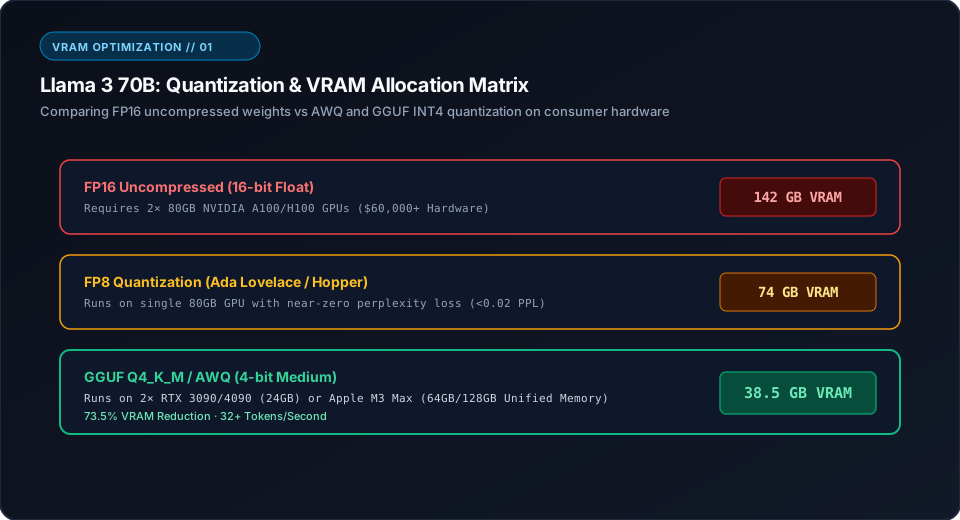
Under Q4_K_M (4-bit medium k-quant):
- Crucial attention projection layers and feed-forward gate weights are kept at 5-bit or 6-bit precision.
- Less sensitive linear weights are compressed to 4-bit integers.
- Total memory drops from 142 GB down to 38.5 GB. This allows Llama 3 70B to fit inside a pair of consumer NVIDIA RTX 3090/4090 GPUs (24GB each = 48GB total) or a single Apple M-series Mac Studio with unified memory.
"The proprietary AI model narrative that a handful of companies will control the intellectual substrate of humanity is dying. Open models like Llama 3 are proving that the collective ingenuity of the global developer community moves faster than any closed garden."
3. The Air-Gapped Serving Stack: Ollama Daemon vs. vLLM Engine
When serving Llama 3 models in production, software architects select between two battle-tested serving engines depending on concurrency requirements:
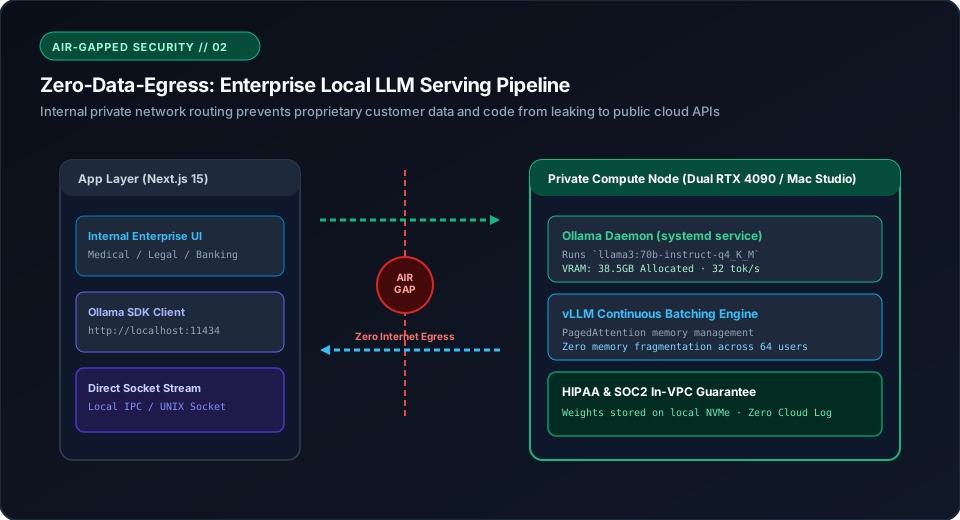
- Ollama (Developer & Workstation Inference): Runs as a background
systemdservice, wrappingllama.cppwith automated GPU layer offloading, model swapping, and an OpenAI-compatible REST API athttp://localhost:11434. Best for edge nodes, internal team copilots, and single-user low-latency tasks. - vLLM (High-Concurrency Enterprise Clusters): Utilizes PagedAttention to manage the KV-cache like virtual memory pages in an operating system. Eliminates 96% of memory fragmentation, enabling continuous batching across 64+ simultaneous user streams on an on-premise GPU server.
4. 15 Trillion Token Pre-Training Scaling Laws
Meta trained Llama 3 on 15 trillion tokens—a dataset 7 times larger than Llama 2, including 4 times more programming code and over 30 languages.
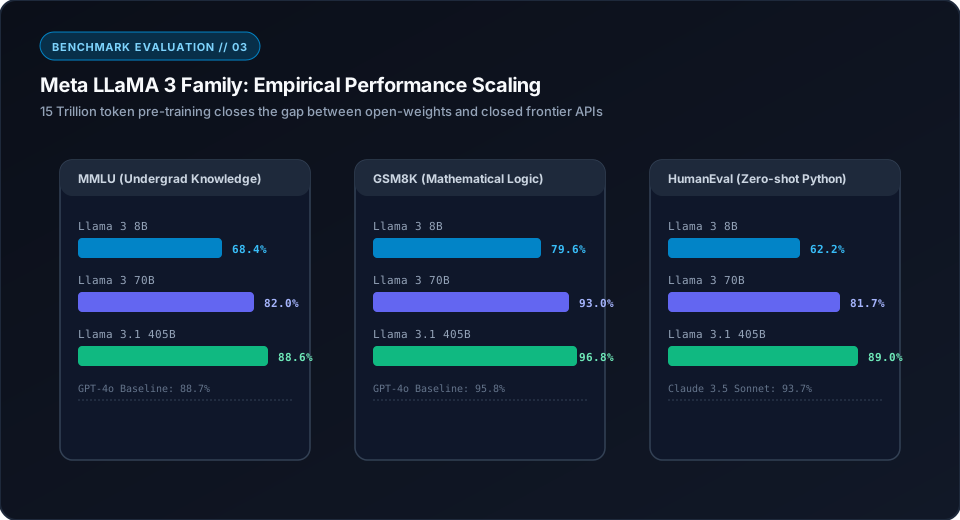
Remarkably, empirical scaling laws showed that even the smallest 8B parameter model continued to improve steadily at 15 trillion tokens without saturating. Llama 3 8B achieves 68.4% on MMLU and 79.6% on GSM8K, matching the performance of the previous generation's 70B models while running comfortably on a standard MacBook Air.
5. Production Implementation: Next.js 15 Streaming Client for Local Ollama
Below is a type-safe Next.js 15 App Router API route connecting directly to a local or internal private Ollama daemon:
// src/app/api/local-llm/route.ts
import { NextRequest } from "next/server";

export const runtime = "nodejs";
export const dynamic = "force-dynamic";

const OLLAMA_HOST = process.env.OLLAMA_HOST || "http://127.0.0.1:11434";

export async function POST(req: NextRequest) {
  try {
    const { prompt, model = "llama3:70b-instruct-q4_K_M" } = await req.json();

    const response = await fetch(`${OLLAMA_HOST}/api/generate`, {
      method: "POST",
      headers: { "Content-Type": "application/json" },
      body: JSON.stringify({
        model,
        prompt,
        stream: true,
        options: {
          temperature: 0.2,
          num_ctx: 32768,
        },
      }),
    });

    if (!response.ok || !response.body) {
      throw new Error(`Local Ollama error: ${response.statusText}`);
    }

    // Direct proxy to client with zero data egress
    return new Response(response.body, {
      headers: {
        "Content-Type": "application/x-ndjson; charset=utf-8",
        "Cache-Control": "no-cache",
        "Connection": "keep-alive",
      },
    });
  } catch (err: any) {
    return new Response(JSON.stringify({ error: err.message }), {
      status: 500,
      headers: { "Content-Type": "application/json" },
    });
  }
}
6. Empirical Comparison: Llama 3 70B vs. GPT-4o vs. Claude 3.5 Sonnet
| Dimension | Meta LLaMA 3.1 70B | GPT-4o | Claude 3.5 Sonnet |
|---|---|---|---|
| MMLU (General Intelligence) | 86.0% | 88.7% | 88.3% |
| GSM8K (Math Reasoning) | 93.0% | 95.8% | 96.4% |
| HumanEval (Coding) | 81.7% | 90.2% | 93.7% |
| Data Privacy / Residency | 100% On-Premise Air-Gapped | US Cloud Server | US Cloud Server |
| Marginal Cost per 1M Tokens | $0.00 (Hardware Amortized) | $2.50 / $10.00 | $3.00 / $15.00 |
7. Primary Research & Official References Registry
For engineering teams provisioning local inference clusters or fine-tuning Llama 3 checkpoints, consult the following official documentation and research papers:
The Llama 3 Herd of Models Technical Report
Comprehensive paper covering 15T token pre-training, 405B dense architecture, post-training alignment, and hardware scaling.
Ollama Official PlatformOllama: Get Up and Running with Large Language Models
Open-source runtime for managing and executing quantized GGUF models across macOS, Linux, and Windows.
UC Berkeley LMSYSvLLM: Easy, Fast, and Cheap LLM Serving with PagedAttention
High-throughput serving engine delivering 24x higher throughput than HuggingFace TGI via virtual memory paging.
Hugging Face Model HubMeta LLaMA Model Registry & Checkpoints
Official repository for downloading original PyTorch weights, Instruct fine-tunes, and tokenizer vocabularies.
Need to Build Air-Gapped Private AI Systems for Your Enterprise?
TheWebVale architects, deploys, and optimizes on-premise open-source LLM infrastructure, private vector databases, and zero-egress software platforms for ambitious companies worldwide.
Schedule a Private Architecture Consultation →